by
by The global stem cell umbilical cord blood market is witnessing significant momentum as regenerative medicine, personalized treatment approaches, and stem cell-based therapies continue to gain widespread acceptance. The market size stood at USD 18.57 billion in 2025 and is projected to rise from USD 19.49 billion in 2026 to approximately USD 30.16 billion by 2035, expanding at a CAGR of 4.97% between 2026 and 2035.
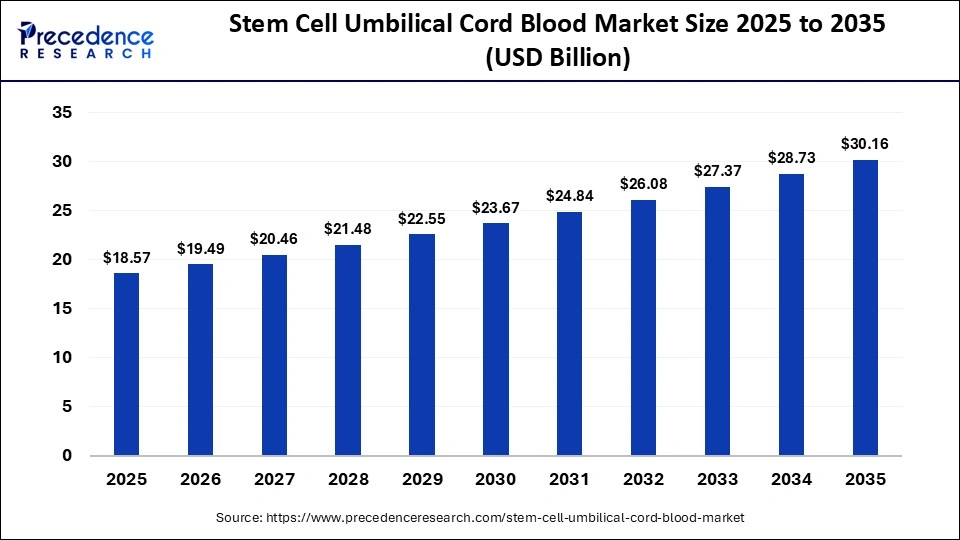
The increasing prevalence of chronic diseases, blood disorders, cancer, and immune-related conditions is creating sustained demand for stem cell therapies. At the same time, rising parental awareness regarding cord blood banking, growing healthcare investments, and rapid innovation in cryopreservation and gene editing technologies are creating new growth avenues across both developed and emerging markets.
Read Also: Transradial Access Market
Quick Insights: What You Need to Know About the Market
- The stem cell umbilical cord blood market is expected to reach USD 30.16 billion by 2035 from USD 19.49 billion in 2026.
- North America accounted for the largest market share of 38% in 2025 due to its advanced healthcare infrastructure and high awareness of cord blood banking.
- Asia Pacific is anticipated to witness the fastest growth during the forecast period with a CAGR of approximately 19%.
- Private cord blood banks dominated the market in 2025 with an 80% share because of rising demand for family-focused stem cell storage.
- Cancer treatment remained the leading application segment with a 44.3% market share in 2025.
- Storage and preservation services led the market with a 62% share because of the long-term need to maintain stem cell viability.
- Major industry participants include Cord Blood Registry, Cryo-Cell International, ViaCord, Global Cord Blood Corporation, Cordlife Group, LifeCell International, and StemCyte.
Why is the Stem Cell Umbilical Cord Blood Market Expanding So Rapidly?
The growing adoption of regenerative medicine is one of the strongest growth catalysts for the market. Cord blood stem cells are increasingly being used in the treatment of cancers, blood disorders, autoimmune diseases, and genetic conditions. Their ability to regenerate damaged tissues and improve long-term treatment outcomes is encouraging healthcare providers and researchers to expand their use.
Cord blood banking is also becoming more mainstream among parents. Families are increasingly viewing stem cell storage as a form of long-term healthcare security, especially as awareness grows around its potential use in future therapies for both children and close relatives.
In addition, healthcare providers are increasingly investing in advanced cryopreservation techniques, automated cell processing systems, and secure storage facilities. These developments are helping improve the viability and accessibility of stem cells, thereby strengthening trust in the overall cord blood ecosystem.
How is AI Influencing the Stem Cell Umbilical Cord Blood Market?
Artificial intelligence is emerging as a major force in stem cell research and cord blood banking. AI-powered platforms are helping researchers analyze genetic data, identify optimal donor-recipient matches, and predict the success rates of stem cell transplantation procedures.
Machine learning is also improving the efficiency of cord blood storage, retrieval, and classification systems. AI-enabled predictive analytics can forecast treatment responses, improve sample quality control, and streamline inventory management in cord blood banks. As AI capabilities continue to advance, they are expected to improve the scalability, reliability, and precision of stem cell therapies worldwide.
What Are the Major Growth Factors Driving the Market?
Rising Demand for Regenerative Medicine
Stem cell therapies are increasingly being explored for their potential to treat chronic diseases, neurological conditions, autoimmune disorders, diabetes, and cardiovascular diseases. This growing interest in regenerative medicine is significantly boosting demand for cord blood banking and storage.
Increasing Awareness Among Parents
Educational campaigns by hospitals, maternity clinics, and cord blood banks are helping expectant parents understand the long-term value of preserving cord blood stem cells. Greater awareness is leading to stronger adoption of private and hybrid cord blood banking services.
Technological Advancements in Cryopreservation
Advances in cryogenic storage, automated processing, and cell expansion technologies are improving the long-term viability of stored stem cells. These developments are helping enhance the reliability and effectiveness of stem cell therapies.
Expanding Use in Cancer and Blood Disorder Treatments
Cord blood stem cells are increasingly used in hematopoietic stem cell transplantation for leukemia, lymphoma, sickle cell anemia, and thalassemia. Their lower risk of graft-versus-host disease and improved donor matching are making them an attractive alternative to bone marrow.
What Opportunities Are Emerging in the Market?
Can Gene Editing Transform Future Stem Cell Applications?
Gene editing technologies such as CRISPR are creating major opportunities in the stem cell umbilical cord blood market. Researchers are exploring how edited stem cells can be used to treat genetic disorders, rare diseases, and inherited conditions with greater precision.
Will Public Cord Blood Banking Gain More Momentum?
Public cord blood banking programs are expected to grow as governments and healthcare institutions invest in donation-based systems that improve accessibility for a larger patient population. Public banks are becoming increasingly important for allogeneic transplants and donor registry expansion.
Are Hybrid Cord Blood Banking Models Becoming More Popular?
Hybrid banking models are attracting attention because they allow families to store a portion of cord blood for personal use while donating the remainder for public access. This flexible approach is becoming more appealing due to its balance of affordability and societal benefit.
Segment Analysis
Why Did Private Cord Blood Banks Dominate the Market?
Private cord blood banks accounted for 80% of the market in 2025 because they allow families to preserve stem cells for future personal or family use. Growing parental awareness, higher disposable incomes, and stronger demand for long-term healthcare protection are all supporting the growth of this segment.
Public cord blood banks held a 15% share in 2025 due to expanding government-backed initiatives and increasing interest in stem cell donation programs. Hybrid models, although smaller in size, are gradually gaining popularity because they combine the advantages of both private and public storage.
Why is Cancer Treatment the Largest Application Segment?
Cancer treatment represented 44.3% of the market in 2025 because cord blood stem cells are widely used in treating leukemia, lymphoma, and myeloma. Cord blood offers several advantages over traditional bone marrow transplantation, including easier donor matching and a lower risk of complications.
Meanwhile, regenerative medicine is expected to become one of the most promising growth segments in the years ahead. Cord blood stem cells are increasingly being explored for treating neurological disorders, diabetes, and cardiovascular diseases.
Why Does Storage and Preservation Hold the Largest Share?
Storage and preservation services accounted for 62% of the market in 2025 because stem cells need to remain viable for years or even decades before use. Cord blood banks continue to invest heavily in advanced cryopreservation facilities and long-term monitoring systems to ensure sample quality.
Processing and characterization also remain important, accounting for 33.3% of the market in 2025. Efficient processing ensures that stem cells retain their therapeutic potential and meet quality standards for future transplantation.
Regional Analysis
Why Does North America Lead the Stem Cell Umbilical Cord Blood Market?
North America held the largest market share of 38% in 2025 due to strong awareness of cord blood banking, a highly developed healthcare infrastructure, and significant investments in stem cell research.
The United States continues to dominate the regional market because of the presence of major cord blood banks, advanced biotechnology companies, and a strong clinical research ecosystem. Canada is also contributing to growth through government-supported public banking programs and increased awareness about stem cell donation.
Why is Asia Pacific Growing So Quickly?
Asia Pacific is projected to grow at the fastest CAGR of approximately 19% during the forecast period. Rising healthcare spending, improving healthcare access, and increasing awareness about regenerative medicine are major factors driving growth in the region.
China remains a leading country in the region due to government support, strong biotechnology investments, and the rapid expansion of public and private cord blood banks. India is also emerging as a key growth market because of rising middle-class incomes, increasing birth rates, and growing awareness about stem cell therapies.
Japan and South Korea are contributing to regional expansion through advanced regenerative medicine research and favorable government policies supporting biotechnology innovation.
Competitive Landscape: Leading Companies in the Market
The stem cell umbilical cord blood market is highly competitive, with companies focusing on expanding storage infrastructure, improving cryopreservation technologies, and strengthening partnerships with hospitals and research institutions.
Key companies operating in the market include:
- Cord Blood Registry (CBR)
- Cryo-Cell International, Inc.
- ViaCord (PerkinElmer)
- Global Cord Blood Corporation
- Cordlife Group Limited
- LifeCell International Pvt. Ltd.
- FamiCord Group (PBKM)
- StemCyte, Inc.
- Vita 34 AG
- Cryo-Save AG
- VcanBio Cell & Gene Engineering
- Medipost (CellTree)
- Americord Registry
- Smart Cells International
- Cryoviva Biotech Pvt. Ltd.
Recent Industry Developments
- In January 2026, the Cord Blood Council launched as a nonprofit organization to support public cord blood banks by providing shared resources to FDA-licensed and NCBI-funded institutions. The initiative is expected to improve operational efficiency and increase access to high-quality stem cell units.
- In December 2025, the approval of omidubicel-onlv marked a major milestone in advanced engineered cord blood stem cell therapy for severe aplastic anemia. The development is encouraging further investments in scalable manufacturing and advanced processing techniques for cell-based therapies.
What Challenges Could Limit Market Growth?
Despite the positive outlook, the market continues to face several challenges. The high cost of private cord blood banking services remains a major barrier, especially in developing countries where affordability is limited.
Ethical concerns related to stem cell use and storage also continue to create hesitation among certain patient groups. In addition, inconsistent regulatory frameworks across countries can slow down the approval and commercialization of stem cell-based treatments.
Case Study: How Cord Blood Banking Helped Improve Treatment Access
Several hospitals and cancer treatment centers are increasingly relying on cord blood stem cell transplantation for patients who lack a compatible bone marrow donor. In pediatric leukemia cases, cord blood transplantation has shown promising results due to its lower risk of immune rejection and broader donor compatibility.
This trend highlights the growing importance of public cord blood banks in improving access to life-saving therapies for patients worldwide.
Get Sample Copy: https://www.precedenceresearch.com/sample/8304
For inquiries regarding discounts, bulk purchases, or customization requests, please contact us at [email protected]