by
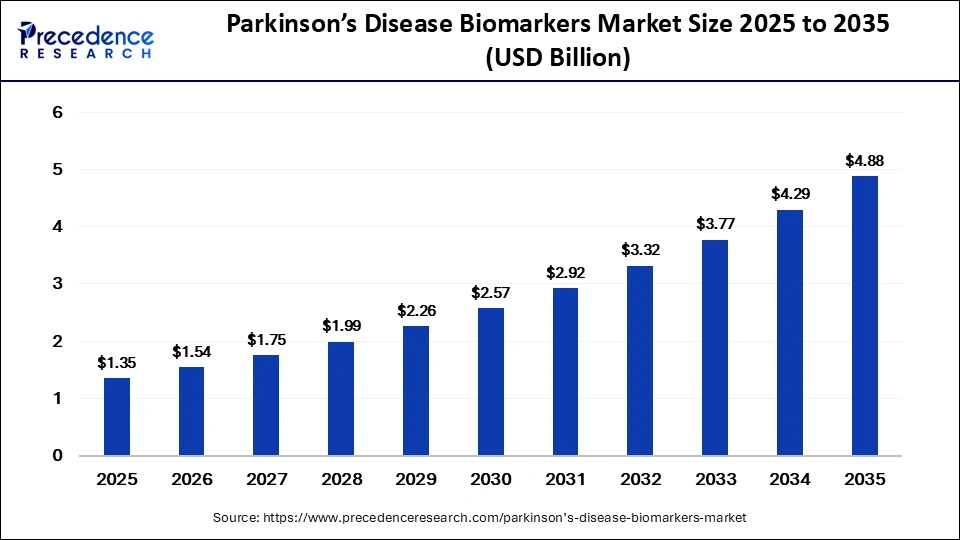
by The global Parkinson’s disease biomarkers market is projected to grow from USD 1.54 billion in 2026 to USD 4.88 billion by 2035 at a CAGR of 13.80%. Explore market trends, growth drivers, segment insights, regional analysis, and key companies shaping the industry.
Read Also: Hematopoietic Stem Cell Transplantation Market
Parkinson’s Disease Biomarkers Market Size, Share, Trends, and Forecast 2026 to 2035
The global Parkinson’s disease biomarkers market is experiencing remarkable growth due to the increasing prevalence of Parkinson’s disease (PD), rising demand for early diagnosis, and advancements in biomarker technologies. Biomarkers have become critical tools in neurological research and clinical practice, enabling healthcare professionals to detect Parkinson’s disease earlier, monitor disease progression, and develop personalized treatment strategies.
The global Parkinson’s disease biomarkers market size accounted for USD 1.35 billion in 2025 and is projected to grow from USD 1.54 billion in 2026 to approximately USD 4.88 billion by 2035, expanding at a CAGR of 13.80% during the forecast period from 2026 to 2035.
The growing focus on disease-modifying therapies, increasing adoption of AI-driven diagnostics, and rising investments in neurological research are significantly contributing to market expansion worldwide.
Market Overview
Parkinson’s disease biomarkers are measurable biological indicators that provide critical information regarding the onset, progression, and therapeutic response of Parkinson’s disease. These biomarkers include molecular markers, imaging biomarkers, genetic indicators, and biochemical compounds found in blood, cerebrospinal fluid (CSF), skin biopsies, and other biological samples.
Biomarkers such as misfolded alpha-synuclein, neurofilament light chain (NfL), DJ-1 protein, and tau protein are increasingly being used to support early diagnosis and monitor disease progression.
Traditional Parkinson’s disease diagnosis primarily relies on neurological evaluations, symptom assessment, and patient response to dopamine therapies. However, modern biomarker technologies are transforming the diagnostic landscape by enabling objective, precise, and minimally invasive disease detection.
How AI-Driven Innovations are Transforming the Market
Artificial intelligence (AI) is playing a transformative role in the Parkinson’s disease biomarkers market. AI-powered technologies enhance diagnostic precision by analyzing complex datasets generated from wearable devices, smartphones, neuroimaging platforms, and molecular diagnostics.
Machine learning algorithms can identify subtle motor and non-motor symptoms years before traditional clinical diagnosis. AI systems are increasingly capable of analyzing:
- Voice patterns
- Sleep-related breathing abnormalities
- Gait analysis
- Tremors and movement irregularities
- Facial expressions
- Digital biomarkers from wearable sensors
The integration of AI with biomarker analysis is improving early detection rates, accelerating drug discovery, and enabling continuous patient monitoring. AI-driven biomarker analysis is expected to witness the fastest growth, with a projected CAGR of 22% between 2026 and 2035.
Key Market Drivers
Rising Need for Early Diagnosis
One of the primary growth drivers of the Parkinson’s disease biomarkers market is the increasing demand for early diagnosis. Biomarkers can detect Parkinson’s disease during the prodromal or pre-symptomatic stages, allowing healthcare providers to initiate therapies before significant neuronal damage occurs.
Early diagnosis is essential for:
- Slowing disease progression
- Enhancing treatment effectiveness
- Improving patient quality of life
- Supporting clinical trials for disease-modifying therapies
The early diagnosis application segment accounted for 36% market share in 2025 and is expected to grow at the fastest CAGR of 16.5% during the forecast period.
Growing Investments in Neurological Research
Governments, pharmaceutical companies, biotechnology firms, and research organizations are increasing investments in neurological biomarker discovery and precision medicine.
Research institutions are actively developing advanced blood-based biomarkers, genetic screening tools, and imaging technologies to improve diagnostic accuracy and therapeutic outcomes.
Increasing Demand for Blood-Based Biomarkers
Blood-based biomarkers are gaining significant attention because they provide minimally invasive diagnostic solutions compared to cerebrospinal fluid analysis and imaging procedures.
The development of highly sensitive blood tests for alpha-synuclein and neurofilament light chain detection is revolutionizing Parkinson’s disease diagnostics and accelerating market growth.
Market Restraints
High Development and Validation Costs
The development of biomarker assays involves substantial investment in clinical trials, laboratory infrastructure, and regulatory approvals. These high costs may limit adoption, particularly in low- and middle-income economies.
Regulatory Challenges
Strict regulatory requirements for biomarker validation and commercialization can delay product launches and increase operational complexity for market players.
Limited Standardization
The absence of standardized biomarker testing protocols remains a major challenge. Variability in sample collection, interpretation, and assay methodologies can impact diagnostic consistency.
Emerging Opportunities in the Market
Rising Demand for Personalized Medicine
Personalized medicine is emerging as a major opportunity in the Parkinson’s disease biomarkers market. Biomarkers help identify patient-specific disease characteristics and enable tailored treatment strategies.
Genetic biomarkers such as:
- LRRK2 mutations
- GBA mutations
- SNCA gene alterations
are increasingly being used to develop targeted therapies and personalized treatment plans.
Expansion of AI-Based Biomarker Analysis
AI-driven biomarker analysis is expected to create significant market opportunities over the coming decade. AI technologies can efficiently process multimodal datasets and identify disease signatures that are difficult for clinicians to detect manually.
Increasing Clinical Trial Activity
Pharmaceutical companies are increasingly utilizing biomarkers for patient stratification and monitoring therapeutic response during clinical trials. Biomarkers help accelerate drug development and reduce trial failure rates.
Biomarker Type Insights
Molecular Biomarkers Dominated the Market
The molecular biomarkers segment accounted for the largest market share of 38% in 2025. The segment is expected to continue dominating due to the increasing adoption of blood-based and non-invasive testing approaches.
Molecular biomarkers such as alpha-synuclein, DJ-1 protein, and NfL are widely used for disease identification and therapeutic monitoring.
Key Molecular Biomarkers Include:
- Alpha-synuclein
- DJ-1 protein
- Tau protein
- Neurofilament light chain (NfL)
The segment is projected to expand at a CAGR of 14.5% during the forecast period.
Imaging Biomarkers
Imaging biomarkers held the second-largest market share of 30% in 2025. Technologies such as MRI, PET scans, and SPECT imaging provide highly accurate visualization of structural and functional brain changes associated with Parkinson’s disease.
Genetic Biomarkers to Witness Fastest Growth
The genetic biomarkers segment is expected to grow at the fastest CAGR of 15% due to increasing focus on personalized medicine and early risk identification.
Technology Insights
Immunoassays Led the Market
The immunoassays segment accounted for 28% of the market share in 2025. These technologies are widely adopted because of their scalability, affordability, and effectiveness in detecting key proteins associated with Parkinson’s disease.
Immunoassays are commonly used for measuring:
- Alpha-synuclein
- DJ-1 protein
- Neurofilament biomarkers
Molecular Diagnostics
Molecular diagnostics accounted for 24% of the market in 2025. The segment is witnessing strong growth due to advancements in highly sensitive seeding amplification assays and blood-based diagnostic technologies.
AI-Based Biomarker Analysis
AI-based biomarker analysis is anticipated to register the fastest CAGR of 22% during the forecast period due to rising adoption of machine learning technologies in neurological diagnostics.
Application Insights
Early Diagnosis Segment Held Largest Share
The early diagnosis segment dominated the market with a share of 36% in 2025. The segment’s growth is driven by the urgent need to identify Parkinson’s disease before severe neurological damage occurs.
Other Major Applications Include:
- Disease progression monitoring
- Drug discovery and development
- Personalized medicine
- Clinical research
Disease progression monitoring accounted for 28% market share in 2025 due to increasing demand for objective tools that track disease severity over time.
End-Use Insights
Hospitals Dominated the Market
Hospitals accounted for the largest market share of 38% in 2025. Hospitals are major adopters of advanced biomarker technologies, including skin biopsy diagnostics, cerebrospinal fluid analysis, and neuroimaging systems.
The presence of skilled neurologists and advanced clinical infrastructure contributes significantly to segment growth.
Diagnostic Laboratories to Grow Rapidly
Diagnostic laboratories held 26% market share in 2025 and are expected to witness the fastest CAGR of 15.5% during the forecast period.
Growing adoption of ELISA technologies, blood-based biomarker testing, and molecular diagnostics is supporting segment expansion.
Regional Analysis
North America Dominated the Global Market
North America accounted for the largest market share of 43% in 2025. The region benefits from:
- Advanced healthcare infrastructure
- Strong research funding
- High adoption of innovative diagnostic technologies
- Growing prevalence of Parkinson’s disease
The North American market was valued at approximately USD 580 million in 2025 and is projected to reach nearly USD 1.97 billion by 2035.
United States Market Trends
The United States remains the leading contributor to regional growth. According to the Parkinson’s Foundation, around 1.1 million Americans currently live with Parkinson’s disease, and the number is expected to rise significantly by 2030.
Major companies operating in the U.S. include:
- Roche
- Thermo Fisher Scientific
- Abbott Laboratories
- Bio-Rad Laboratories
Asia Pacific to Witness Fastest Growth
Asia Pacific held 18% market share in 2025 and is expected to grow at the fastest CAGR of 17.2% during the forecast period.
Key growth factors include:
- Rising aging population
- Expanding healthcare infrastructure
- Increasing neurological research investments
- Growing demand for affordable diagnostics
Countries such as China, India, and Japan are rapidly adopting AI-based diagnostic technologies and blood-based biomarkers.
Competitive Landscape
The Parkinson’s disease biomarkers market is highly competitive with the presence of major biotechnology, diagnostics, and pharmaceutical companies.
Key Companies in the Market
- F. Hoffmann-La Roche Ltd.
- Bio-Rad Laboratories
- Thermo Fisher Scientific
- Abbott Laboratories
- Quanterix
- Siemens Healthineers
- GE HealthCare
- PerkinElmer
- Sysmex Corporation
- Biogen Inc.
- Pfizer Inc.
- Novartis AG
- Quest Diagnostics
- Labcorp
- Proteome Sciences
These companies are investing heavily in research collaborations, AI integration, advanced biomarker assays, and strategic partnerships.
Recent Developments
Biognosys and Michael J. Fox Foundation Collaboration
In April 2026, Biognosys Group partnered with The Michael J. Fox Foundation to develop highly sensitive biomarker assays targeting LRRK2-related Parkinson’s disease therapies.
CND Life Sciences Clinical Trial Advancement
In November 2025, CND Life Sciences announced that its Syn-One Biomarker Services were utilized in a Phase 2 clinical trial for ABLi Therapeutics’ investigational Parkinson’s disease treatment, risvodetinib.
Future Outlook
The future of the Parkinson’s disease biomarkers market looks highly promising as healthcare systems increasingly prioritize precision medicine, AI-driven diagnostics, and early intervention strategies.
Emerging innovations in molecular diagnostics, genomics, proteomics, and digital biomarkers are expected to significantly improve diagnostic accuracy and therapeutic effectiveness.
The growing shift toward minimally invasive blood-based diagnostics and personalized medicine will likely create substantial opportunities for healthcare providers, biotechnology companies, and pharmaceutical organizations over the next decade.
Conclusion
The global Parkinson’s disease biomarkers market is poised for significant expansion between 2026 and 2035, driven by rising prevalence of neurological disorders, increasing investments in research, and rapid technological innovation.
AI-powered diagnostics, blood-based biomarkers, and personalized treatment approaches are transforming Parkinson’s disease management and accelerating the development of disease-modifying therapies.
With North America maintaining market leadership and Asia Pacific emerging as the fastest-growing region, the industry is expected to witness sustained innovation and strong commercial growth in the coming years.
Get a Sample Copy: https://www.precedenceresearch.com/sample/8424
For inquiries regarding discounts, bulk purchases, or customization requests, please contact us at [email protected]