
 by
by The global medical device testing market size is calculated at USD 10.76 billion in 2025 and is predicted to increase from USD 11.77 billion in 2026 to approximately USD 25.82 billion by 2035, expanding at a CAGR of 9.15% from 2026 to 2035. Stringent regulations and rising demand for safe, high-quality medical devices also drive the market.
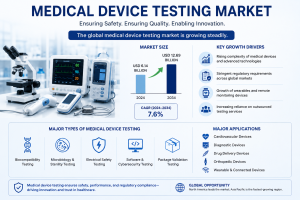
Medical Device Testing Market Overview
The medical device testing market has become an essential part of the global healthcare industry as manufacturers focus on ensuring the safety, quality, and effectiveness of medical products. Medical device testing involves a wide range of evaluations, including biocompatibility testing, microbiological analysis, sterility testing, chemical characterization, package validation, and performance assessments. These tests help manufacturers comply with regulatory requirements while reducing the risk of product failures and recalls.
The increasing use of advanced medical technologies, rising healthcare expenditures, and growing concerns regarding patient safety are driving demand for comprehensive testing services. Governments and regulatory bodies across the world continue to implement stricter quality standards, making testing a mandatory step throughout the product development lifecycle. As healthcare providers adopt more sophisticated diagnostic and therapeutic devices, the importance of reliable testing solutions continues to grow.
Get Sample Link: https://www.precedenceresearch.com/sample/4429
Medical Device Testing Market Growth
The medical device testing market is experiencing strong growth due to the rising number of medical device approvals and increasing investments in healthcare innovation. The growing prevalence of chronic diseases such as cardiovascular disorders, diabetes, and cancer has created significant demand for advanced diagnostic and treatment devices. As manufacturers develop increasingly complex products, testing requirements have expanded to include software validation, cybersecurity assessments, and connectivity verification.
Another major factor supporting market growth is the increasing adoption of outsourcing services. Many medical device companies partner with specialized testing laboratories and contract research organizations to access technical expertise, reduce operational costs, and accelerate product development timelines. The expansion of wearable devices, remote patient monitoring systems, and digital health technologies is expected to further increase demand for specialized testing services over the coming years.
Medical Device Testing Market Trends
- Growing Adoption of Connected Medical Devices: The increasing use of Internet of Medical Things (IoMT) devices has created new testing requirements related to wireless communication, cybersecurity, and interoperability. Manufacturers are focusing on ensuring secure and reliable device performance in connected healthcare environments.
- Rising Demand for Outsourced Testing Services: Medical device manufacturers are increasingly outsourcing testing activities to specialized laboratories. This approach helps reduce infrastructure costs, improve compliance efficiency, and shorten time-to-market for new products.
- Expansion of Artificial Intelligence in Testing: AI-powered testing platforms are improving testing accuracy and efficiency by automating repetitive tasks, detecting defects, and analyzing large datasets. These technologies are helping companies streamline validation processes.
Medical Device Testing Market Dynamics
Drive
Stringent Regulatory Requirements
One of the primary drivers of the medical device testing market is the increasing emphasis on regulatory compliance. Regulatory authorities require manufacturers to conduct extensive testing to demonstrate product safety, effectiveness, and quality before approval. These requirements have expanded significantly as healthcare technologies become more advanced and interconnected.
Opportunity
Growth of Digital Health and Smart Medical Devices
The rapid adoption of wearable technologies, remote monitoring systems, and AI-enabled diagnostic tools presents significant opportunities for testing service providers. These innovative devices require specialized evaluations involving software validation, cybersecurity testing, and interoperability assessments, creating new revenue streams within the market.
Challenge
High Testing Costs and Complex Approval Processes
Comprehensive medical device testing can be expensive and time-consuming, particularly for high-risk devices. Manufacturers often face challenges related to lengthy approval timelines, evolving regulations, and the need for specialized testing expertise. These factors can increase development costs and delay product launches.
Market Segments
By Service Type
- Biocompatibility Testing
- Chemistry Testing
- Microbiology and Sterility Testing
- Package Validation
- Material Characterization Testing
By Testing Phase
- Preclinical Testing
- Clinical Testing
- Laboratory Testing
- Performance Testing
By Device Class
- Class I Medical Devices
- Class II Medical Devices
- Class III Medical Devices
By Sourcing
- In-House Testing
- Outsourced Testing
By End User
- Medical Device Manufacturers
- Contract Research Organizations
- Testing Laboratories
- Healthcare Institutions
Applications in the Market
Medical device testing is applied across numerous healthcare sectors to ensure product safety and performance. In cardiovascular care, testing is conducted for devices such as pacemakers, stents, and heart valves. Orthopedic implants require extensive mechanical and biological testing to verify durability and compatibility with human tissues. Diagnostic imaging equipment, including MRI and CT systems, undergoes performance and safety evaluations to ensure accurate results.
The market also supports testing for wearable health monitoring devices, robotic surgical systems, dental devices, ophthalmic instruments, and in vitro diagnostic products. As healthcare technologies become increasingly digital, testing services are expanding to include cybersecurity assessments, software validation, and connectivity verification to ensure secure and reliable device operation.
Case Study Testing of Wearable Health Monitoring Device
A healthcare technology company developed a wearable device designed to continuously monitor heart rate and blood oxygen levels. Before commercialization, the device underwent extensive testing, including biocompatibility assessments, software validation, battery performance testing, wireless communication verification, and cybersecurity evaluations.
The testing process identified several software performance issues that could have affected data accuracy under specific conditions. After corrective actions and additional validation procedures, the device successfully met regulatory requirements and entered the market. This case demonstrates how comprehensive testing improves product quality, enhances patient safety, and supports regulatory approval.
Read Also: Microfluidics Market
Regional Analysis
North America
North America remains one of the most significant markets for medical device testing due to its advanced healthcare infrastructure, strong regulatory environment, and high concentration of medical device manufacturers. The United States leads the region with substantial investments in healthcare innovation and digital health technologies. Growing adoption of connected medical devices and AI-powered healthcare solutions continues to support market expansion.
Europe
Europe represents a mature market driven by strict regulatory standards and strong emphasis on patient safety. The implementation of the Medical Device Regulation (MDR) has increased testing requirements for manufacturers, creating greater demand for compliance and validation services. Countries such as Germany, France, and the United Kingdom remain key contributors to regional growth.
Asia Pacific
Asia Pacific is emerging as one of the fastest-growing regions due to expanding healthcare infrastructure, increasing medical device production, and supportive government initiatives. Countries including China, India, Japan, and South Korea are investing heavily in healthcare modernization and medical technology innovation. The growing presence of local manufacturers and contract testing organizations is further strengthening regional market growth.
Latin America
The Latin American market is witnessing steady growth as healthcare systems improve and regulatory frameworks become more aligned with international standards. Increasing demand for advanced medical technologies and rising healthcare investments are creating opportunities for testing service providers across the region.
Middle East and Africa
The Middle East and Africa region is gradually expanding due to ongoing healthcare development projects and increasing awareness of medical device quality standards. Government efforts to improve healthcare infrastructure and encourage medical technology adoption are expected to contribute to future market growth.
Future Outlook
The future of the medical device testing market appears highly promising as healthcare systems continue to embrace technological innovation. The growing adoption of connected medical devices, wearable technologies, robotic surgical systems, and AI-powered diagnostics will create new testing requirements and drive demand for specialized services.
Advancements in automation, artificial intelligence, and digital testing platforms are expected to improve testing efficiency and accelerate product development timelines. At the same time, evolving regulatory requirements will continue to emphasize patient safety and product quality, ensuring sustained demand for testing services. As the medical technology industry expands globally, medical device testing will remain a critical component of innovation, compliance, and healthcare excellence.
𝐘𝐨𝐮 𝐜𝐚𝐧 𝐩𝐥𝐚𝐜𝐞 𝐚𝐧 𝐨𝐫𝐝𝐞𝐫 𝐨𝐫 𝐚𝐬𝐤 𝐚𝐧𝐲 𝐪𝐮𝐞𝐬𝐭𝐢𝐨𝐧𝐬, 𝐩𝐥𝐞𝐚𝐬𝐞 𝐟𝐞𝐞𝐥 𝐟𝐫𝐞𝐞 𝐭𝐨 𝐜𝐨𝐧𝐭𝐚𝐜𝐭 𝐮𝐬 𝐚𝐭 𝐬𝐚𝐥𝐞𝐬@𝐩𝐫𝐞𝐜𝐞𝐝𝐞𝐧𝐜𝐞𝐫𝐞𝐬𝐞𝐚𝐫𝐜𝐡.𝐜𝐨𝐦
