
 by
by Nanomechanical Testing Market Expected to Reach USD 2.42 Billion by 2035 as Demand for Precision Material Characterization Accelerates
The global nanomechanical testing market is experiencing robust growth as industries increasingly rely on nanoscale characterization tools to measure the mechanical properties of advanced materials with greater precision. The market size reached USD 1.10 billion in 2025 and is forecast to grow from USD 1.19 billion in 2026 to approximately USD 2.42 billion by 2035, expanding at a CAGR of 8.20% between 2026 and 2035.
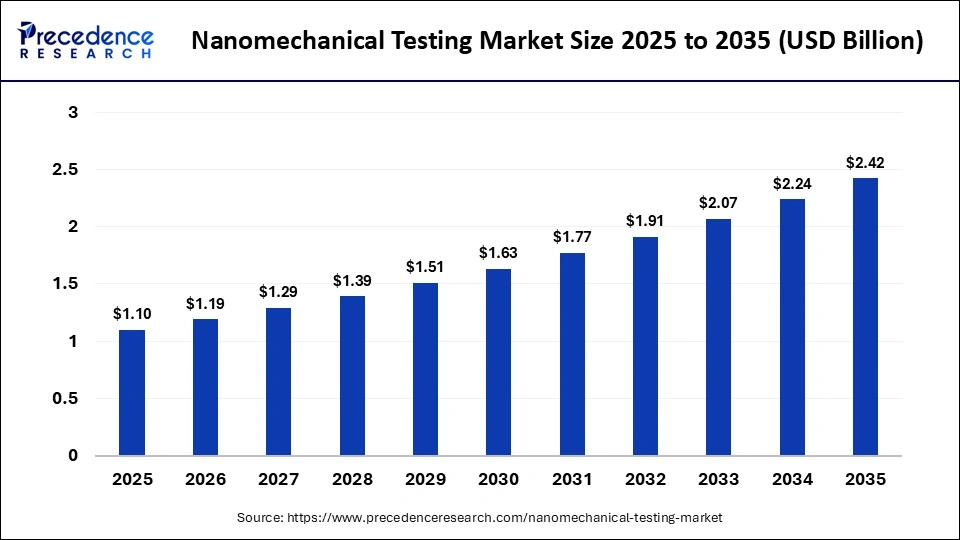
Rising miniaturization in semiconductors, electronics, and biomedical devices is significantly increasing the need for precise testing solutions that can evaluate material behavior at the nanoscale. In addition, advancements in automation, AI-based analytics, and high-throughput testing systems are improving efficiency and accuracy across industrial and research applications.
Read Also: Stem Cell Umbilical Cord Blood Market
Quick Insights: What You Need to Know About the Market
- The nanomechanical testing market is projected to grow from USD 1.19 billion in 2026 to USD 2.42 billion by 2035.
- North America dominated the market in 2025 with a 35% share because of its strong industrial and research infrastructure.
- Asia Pacific is expected to grow at the fastest CAGR of 9.2% during the forecast period.
- Nanoindentation systems led the product segment with a 40% market share in 2025.
- Indentation testing remained the dominant technology segment with a 50% market share in 2025.
- Material science accounted for the largest end-use segment, contributing 40% of market revenue in 2025.
- Major industry participants include Anton Paar, Bruker, Oxford Instruments, Keysight Technologies, KLA Corporation, and Shimadzu Corporation.
Market Snapshot: Revenue Outlook
| Metric | Value |
|---|---|
| Market Size in 2025 | USD 1.10 Billion |
| Market Size in 2026 | USD 1.19 Billion |
| Projected Market Size by 2035 | USD 2.42 Billion |
| CAGR (2026-2035) | 8.20% |
| Leading Region | North America |
| Fastest Growing Region | Asia Pacific |
Why is the Nanomechanical Testing Market Growing So Quickly?
The market is being driven by the growing importance of material characterization in advanced manufacturing industries. As devices and components become smaller, manufacturers require more precise methods to measure hardness, elasticity, adhesion, deformation, and wear at the nanoscale.
Industries such as semiconductors, aerospace, automotive, coatings, and healthcare increasingly rely on nanomechanical testing systems to ensure product durability, performance, and safety. Advanced materials such as thin films, nanocomposites, biomaterials, and coatings require highly accurate testing solutions that can evaluate performance under real-world operating conditions.
At the same time, increasing investments in research and development are accelerating the adoption of advanced testing technologies across universities, laboratories, and industrial R&D centers.
How is AI Transforming the Nanomechanical Testing Market?
Artificial intelligence is becoming a critical component of modern nanomechanical testing systems. AI-powered predictive modeling tools help researchers forecast material behavior under different environmental and mechanical conditions without conducting extensive physical tests.
AI-enabled automation is also improving testing accuracy and reducing human intervention. Smart testing systems can automatically adjust testing parameters in real time based on live feedback, making the process more efficient and consistent. As machine learning algorithms continue to improve, they are expected to make nanomechanical testing faster, more scalable, and more reliable.
What Are the Main Growth Drivers in the Market?
Rising Miniaturization Across Industries
The trend toward smaller and more sophisticated products is driving the need for advanced nanoscale testing solutions. Industries such as consumer electronics, semiconductors, and wearable medical devices require highly precise material testing to ensure reliability and long-term performance.
Increasing Demand from Semiconductor Manufacturing
The semiconductor and electronics industries are increasingly relying on nanomechanical testing to analyze thin films, microchips, integrated circuits, and nanoscale components. The growing complexity of electronic devices is creating sustained demand for high-resolution testing tools.
Growing Use in Biomedical and Healthcare Applications
Nanomechanical testing is increasingly being used to evaluate biomaterials, tissue scaffolds, implants, prosthetics, and stents. The technology helps researchers understand how medical materials behave under physiological conditions, which is important for improving patient outcomes.
Expansion of Advanced Materials Research
The development of high-performance materials such as nanocomposites, advanced coatings, lightweight alloys, and thin films is increasing the need for precise testing systems. Material scientists are relying on nanomechanical testing to measure elasticity, hardness, and deformation at very small scales.
What Opportunities Are Emerging in the Nanomechanical Testing Market?
Can Automation Create More Efficient Testing Systems?
Automation is expected to play a major role in the future of nanomechanical testing. Fully automated testing platforms can reduce errors, improve throughput, and help industries perform large-scale material analysis more efficiently.
Will Healthcare Become a Major Growth Area?
The healthcare and biotechnology sectors are expected to create significant opportunities for the market. Growing demand for implants, prosthetics, drug delivery systems, and tissue engineering materials is increasing the need for nanoscale testing technologies.
Could Smart Manufacturing Accelerate Market Expansion?
The rise of smart factories and Industry 4.0 is expected to support the growth of nanomechanical testing systems. Manufacturers are increasingly adopting intelligent quality control tools that can provide real-time insights into material performance.
Expert Perspective
“Nanomechanical testing is becoming an essential capability for industries working with advanced materials, microelectronics, and high-performance coatings. The integration of AI, automation, and predictive analytics will continue to transform how manufacturers and researchers evaluate nanoscale material behavior,” said a fictional Principal Consultant at Precedence Research.
Segment Analysis
Why Did Nanoindentation Systems Dominate the Market?
Nanoindentation systems accounted for 40% of the market in 2025 because of their ability to measure critical mechanical properties such as hardness, elastic modulus, and creep behavior with high precision.
These systems are widely used in advanced materials research, thin films, semiconductors, and coatings. Continuous technological improvements are helping nanoindentation systems become faster, more accurate, and more suitable for automated testing environments.
Microhardness testers held the second-largest share of 35% in 2025 because of their widespread use in metallurgy, semiconductors, and quality control applications. These systems are valued for their affordability and ease of use.
Atomic force microscopes and scratch testers are also gaining popularity due to their ability to deliver highly detailed surface analysis and coating performance evaluations.
Why is Indentation Testing the Leading Technology Segment?
Indentation testing dominated the market with a 50% share in 2025 because it is widely used to evaluate hardness, stiffness, and deformation behavior at the nanoscale.
Its popularity stems from its ability to deliver highly reliable results across semiconductors, advanced coatings, and high-performance materials. Continuous improvements in resolution, automation, and software integration are further strengthening the dominance of this segment.
Tensile testing also remains a key growth area because it provides valuable insights into stress-strain relationships, fracture mechanics, and material elasticity.
Why Does Material Science Hold the Largest End-Use Share?
Material science accounted for 40% of the market in 2025 because researchers increasingly require precise tools to study the properties of advanced materials.
Nanomechanical testing plays a critical role in analyzing nanocomposites, high-performance alloys, coatings, and thin films. These materials are essential in sectors such as electronics, aerospace, automotive, and healthcare.
The semiconductors and electronics segment held the second-largest share of 20% in 2025 due to increasing demand for smaller, more powerful electronic devices that require precise nanoscale testing.
Automotive and aerospace applications are also expanding steadily because manufacturers increasingly rely on lightweight materials, protective coatings, and advanced composites to improve fuel efficiency, durability, and safety.
Regional Analysis
Why Did North America Lead the Nanomechanical Testing Market?
North America held the largest market share of 35% in 2025 due to its strong industrial base, advanced research infrastructure, and high adoption of cutting-edge testing technologies.
The United States remains the key contributor to the region because of its strong semiconductor industry, well-established aerospace sector, and high investments in nanotechnology research. Universities, laboratories, and industrial R&D centers continue to play an important role in driving innovation.
Why is Asia Pacific Growing the Fastest?
Asia Pacific is expected to register the fastest CAGR of 9.2% during the forecast period due to rapid industrialization, growing investments in electronics manufacturing, and expanding semiconductor production.
China, Japan, South Korea, and India are all contributing significantly to market growth. These countries are investing heavily in advanced manufacturing, precision engineering, and quality control systems.
Japan remains one of the leading countries in the region due to its strong presence in electronics, automotive manufacturing, robotics, and materials science research.
How is Europe Supporting Market Growth?
Europe accounted for 25% of the market in 2025 and continues to benefit from strong demand for precision engineering, high-performance materials, and advanced manufacturing technologies.
Germany, France, and the UK are among the region’s leading markets because of their strong automotive, aerospace, and industrial sectors. Government support for research, innovation, and collaboration between industry and academia is also helping accelerate market development.
Competitive Landscape: Leading Companies in the Market
The nanomechanical testing market is highly competitive, with companies focusing on automation, advanced sensing technologies, software integration, and precision measurement capabilities.
Key companies operating in the market include:
- Anton Paar GmbH
- Hysitron (part of Bruker Corporation)
- Keysight Technologies Inc.
- Oxford Instruments PLC
- KLA Corporation
- Instron
- MTS Systems Corporation
- ZwickRoell GmbH & Co. KG
- Shimadzu Corporation
- CSEM SA
- Nanomechanics Inc.
- Buehler
- LUM GmbH
- Elionix Inc.
- Micro Materials Ltd.
Recent Industry Developments
In January 2026, Thailand’s National Nanotechnology Center, together with SPIKE ARCHitectonics Co., Ltd. and Furutaka Electronics Co., Ltd., introduced the Microspike Technology Pfavi at nano tech 2026 in Tokyo. The project is expected to strengthen nanotechnology collaboration and support innovation across the nanomechanical testing ecosystem.
In July 2024, Oxford Instruments acquired FemtoTools AG to strengthen its nanoindentation and micro-force testing portfolio. The acquisition is expected to expand the company’s capabilities in advanced characterization technologies for both industrial and research applications.
What Challenges Could Limit Market Growth?
Despite strong growth prospects, the market faces several challenges. The high cost of nanomechanical testing equipment remains one of the biggest barriers to adoption, especially for small and medium-sized enterprises.
In addition, advanced systems require regular calibration, software upgrades, and highly trained personnel to operate effectively. These factors can increase operating costs and slow market penetration in price-sensitive regions.
Case Study: Nanomechanical Testing in Semiconductor Manufacturing
Semiconductor manufacturers increasingly use nanomechanical testing systems to evaluate the performance of thin films, microchips, and nanoscale coatings. Nanoindentation and scratch testing are widely applied to ensure product durability, reliability, and resistance to wear.
As semiconductor devices continue to shrink in size and increase in complexity, precise material characterization is becoming essential for maintaining product quality and minimizing manufacturing defects.
Get Sample Copy: https://www.precedenceresearch.com/sample/8305
For inquiries regarding discounts, bulk purchases, or customization requests, please contact us at [email protected]

