by
by The global AI-powered embryo selection market is witnessing rapid growth due to rising infertility rates, increasing adoption of assisted reproductive technologies, and the growing use of artificial intelligence in fertility treatments. In 2025, the market size was valued at USD 320.00 million and is projected to increase to USD 379.20 million in 2026. By 2035, the market is expected to reach approximately USD 1,747.16 million, growing at a CAGR of 18.50% from 2026 to 2035.
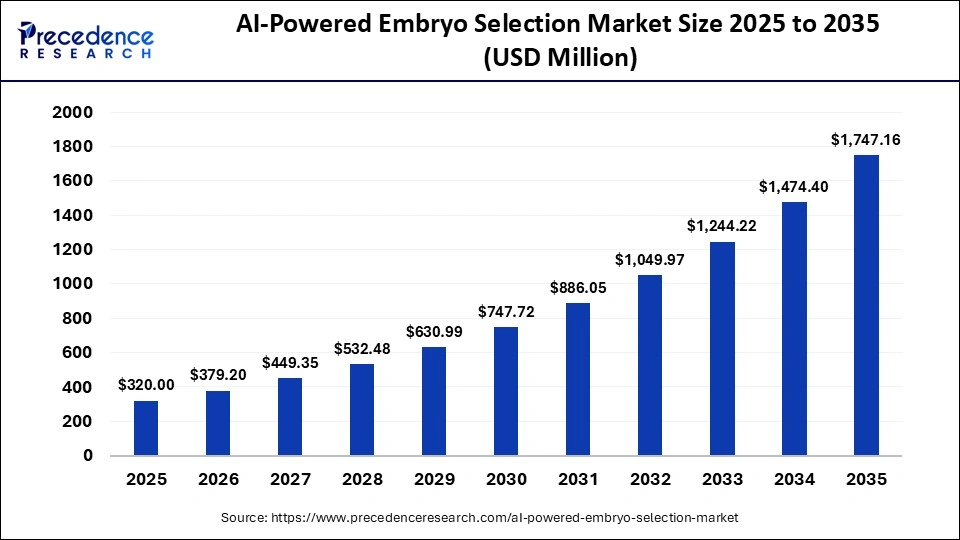
The market is being driven by advancements in machine learning, deep learning, and computer vision technologies that are improving embryo grading accuracy and increasing IVF success rates. AI is helping fertility specialists make more objective and data-driven decisions, reducing human bias and improving pregnancy outcomes.
Read Also: Montelukast Sodium Market
Market Overview
AI-powered embryo selection refers to the use of advanced artificial intelligence technologies to analyze embryo quality, viability, and implantation potential during IVF procedures. These technologies assess embryo morphology, time-lapse imaging data, morphokinetic patterns, and genetic information to identify the embryos most likely to result in successful pregnancies.
Traditional embryo selection methods often rely on manual assessment by embryologists, which can be subjective and inconsistent. AI-powered systems improve precision by analyzing large volumes of clinical and imaging data, providing more accurate predictions and supporting personalized fertility treatment. These systems are increasingly being integrated into fertility clinics and IVF laboratories worldwide.
Key Takeaways
- Market size in 2025: USD 320.00 million
- Market size in 2026: USD 379.20 million
- Projected market size by 2035: USD 1,747.16 million
- CAGR from 2026 to 2035: 18.50%
- North America dominated the market with a 40% share in 2025
- Asia Pacific is expected to grow at the fastest CAGR of 21%
- The software segment held the largest component share at 65% in 2025
- Deep learning dominated the technology segment with a 45% share
- IVF represented the largest application segment with 50% share
- Fertility clinics accounted for the largest end-use share at 60% in 2025
Market Drivers
Rising Adoption of AI-Driven IVF Tools
The growing use of AI-powered tools in IVF procedures is one of the major factors driving the market. Fertility clinics are increasingly adopting AI-based embryo grading systems to improve implantation success rates and reduce the number of IVF cycles required for successful pregnancy outcomes.
AI-powered platforms can analyze thousands of embryo images and developmental patterns in real time, allowing clinicians to make more accurate embryo transfer decisions. This is helping reduce treatment costs, improve patient outcomes, and increase confidence in assisted reproductive technologies.
Increasing Infertility Rates
The rising prevalence of infertility is significantly contributing to the demand for AI-powered embryo selection solutions. Delayed parenthood, changing lifestyles, obesity, stress, pollution, and other health conditions are increasing infertility cases globally.
As more couples turn to IVF and assisted reproductive technologies, fertility clinics are adopting AI tools to improve treatment effectiveness and increase pregnancy success rates.
Advancements in Deep Learning and Computer Vision
Technological advancements in deep learning, machine learning, and computer vision are making embryo selection more efficient and accurate. Deep learning models can process time-lapse embryo imaging data and identify subtle developmental differences that may not be visible to human embryologists.
These technologies are enabling clinics to standardize embryo assessment and reduce variability in decision-making. Research also shows that multi-modal AI can combine static images, time-lapse videos, and structured clinical data to improve pregnancy prediction accuracy.
Market Restraints
Despite strong growth prospects, the AI-powered embryo selection market faces several challenges. High implementation costs, data privacy concerns, and the lack of standardized regulations for AI in reproductive healthcare may limit broader adoption.
Ethical concerns regarding embryo selection and the use of AI in reproductive decision-making also remain significant challenges. Some critics argue that advanced embryo screening technologies could raise concerns around genetic selection and social inequality. Additionally, limited access to IVF treatments in low-income regions may restrict market expansion.
Market Opportunities
The market presents strong opportunities through the expansion of digital fertility platforms, increased use of genetic screening, and growing investments in reproductive healthcare technologies.
AI integration with genetic testing is expected to create new opportunities by improving the detection of chromosomal abnormalities and helping clinicians identify embryos with the highest likelihood of healthy development. In addition, fertility clinics are increasingly adopting patient-centered digital platforms that allow better treatment monitoring, personalized care, and improved communication with patients.
Segment Analysis
By Component
The software segment dominated the market with a 65% share in 2025 and is expected to continue growing at the fastest CAGR of 19% during the forecast period. AI-based software solutions play a critical role in embryo grading, time-lapse image analysis, predictive modeling, and embryo viability assessment.
The services segment accounted for 35% of the market in 2025 and is growing due to rising demand for AI integration, system training, technical support, and data management services in fertility clinics.
By Technology
The deep learning segment led the market with a 45% share in 2025 and is expected to remain dominant over the forecast period. Deep learning algorithms can directly analyze embryo development data and improve embryo grading accuracy.
The machine learning segment held a 30% share in 2025 due to its use in predictive analytics and clinical decision-making. The computer vision segment represented 25% of the market and is growing because of its ability to process embryo images in real time and improve assessment accuracy.
By Application
The IVF segment dominated the market with a 50% share in 2025 because AI-powered embryo selection is primarily used to improve IVF success rates. AI tools help identify the best embryos for implantation, reduce failed cycles, and improve overall pregnancy outcomes.
The embryo viability assessment segment is expected to grow at the fastest CAGR of 20% due to increasing use of AI-based viability scoring systems. The genetic screening segment is also expanding because AI is improving the detection of chromosomal abnormalities and disease-causing genetic variants.
By End Use
Fertility clinics dominated the market with a 60% share in 2025 and are expected to continue growing at the fastest rate during the forecast period. These clinics are increasingly integrating AI tools into IVF workflows to improve clinical outcomes and operational efficiency.
Hospitals held a 25% market share in 2025 due to increasing adoption of reproductive medicine services. Research institutes accounted for 15% of the market and are contributing to the development of advanced AI models for embryo assessment and reproductive technologies.
Regional Insights
North America
North America dominated the AI-powered embryo selection market with a 40% share in 2025. The region benefits from advanced IVF infrastructure, high healthcare spending, early adoption of AI-based healthcare technologies, and a strong presence of leading fertility technology companies.
The United States is the largest contributor to regional growth due to its robust digital health ecosystem, high IVF treatment volume, and increasing demand for personalized fertility care.
Europe
Europe held around 30% share of the market in 2025 and is expected to grow steadily over the forecast period. Growth is driven by rising infertility rates, favorable regulations, strong insurance coverage, and increasing awareness of fertility treatments.
Germany remains one of the leading markets in Europe because of its advanced healthcare infrastructure and growing adoption of reproductive technologies.
Asia Pacific
Asia Pacific is expected to grow at the fastest CAGR of 21% between 2026 and 2035. Rising infertility rates, increasing healthcare digitization, and rapid expansion of IVF clinics in countries such as China and India are driving market growth.
China leads the Asia Pacific market due to strong investments in AI technologies, growing awareness of fertility treatments, and the presence of major fertility technology companies.
Market Trends
Expansion of Patient-Centered Digital Platforms
Fertility clinics are increasingly using patient-centered digital platforms that allow treatment tracking, embryo monitoring, and personalized recommendations. These platforms are helping improve patient engagement and overall treatment efficiency.
Growing Use of Time-Lapse Embryo Imaging
Time-lapse embryo imaging is becoming an essential part of AI-powered embryo selection because it allows continuous monitoring of embryo development. AI algorithms can analyze these videos to identify embryos with the highest implantation potential.
Strategic Partnerships in Fertility Technology
Partnerships between AI developers, IVF clinics, fertility laboratories, and reproductive health companies are increasing. These collaborations are accelerating innovation and enabling broader adoption of AI-powered fertility solutions.
AI-Powered Embryo Selection Market Companies
- Vitrolife AB
- CooperSurgical Inc.
- Genea Biomedx
- Fairtility Ltd.
- Alife Health Inc.
- Overture Life
- AIVF (Artificial Intelligence IVF)
- iGenomix (Vitrolife Group)
- Merck KGaA
- Fujifilm Irvine Scientific
- Hamilton Thorne Ltd.
- Nikon Corporation
- ZEISS Group
- Esco Medical
- LabIVF Asia
Segments Covered in the Report
By Component
- Software
- Services
By Technology
- Machine Learning
- Deep Learning
- Computer Vision
By Application
- In Vitro Fertilization (IVF)
- Genetic Screening
- Embryo Viability Assessment
- Others
By End-Use
- Fertility Clinics
- Hospitals
- Research Institutes
By Region
- North America
- Latin America
- Europe
- Asia-pacific
- Middle and East Africa
Get Sample Link: https://www.precedenceresearch.com/sample/8295
For inquiries regarding discounts, bulk purchases, or customization requests, please contact us at [email protected]