
 by
by The global AI in omics studies market is experiencing rapid growth driven by increasing demand for precision medicine, rising adoption of AI in healthcare, and the growing need to analyze large-scale biological datasets. In 2025, the market size was valued at USD 1.25 billion and is projected to increase to USD 1.47 billion in 2026. By 2035, the market is expected to reach approximately USD 6.11 billion, growing at a CAGR of 17.20% from 2026 to 2035.
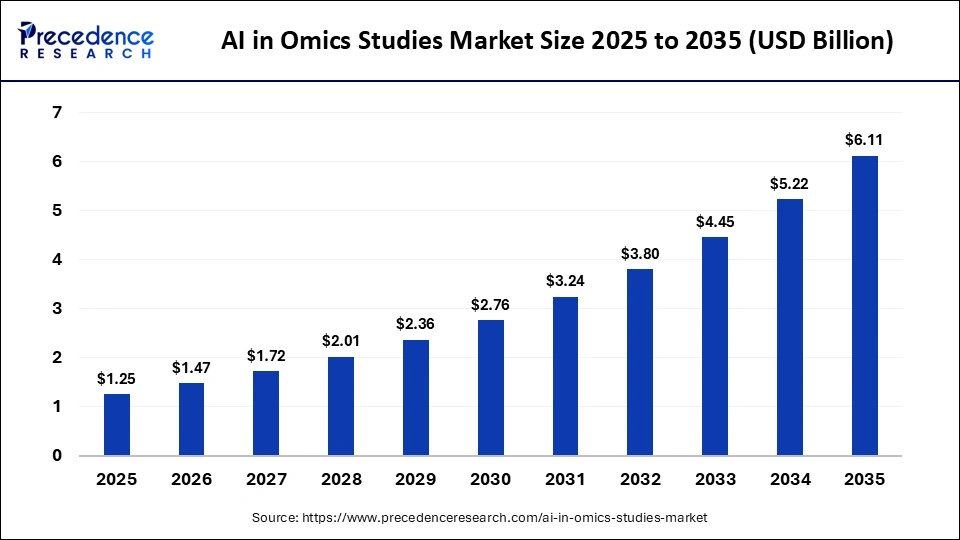
The increasing use of artificial intelligence in genomics, proteomics, transcriptomics, and metabolomics is helping researchers improve disease detection, drug discovery, and personalized treatment strategies. AI-driven tools are transforming omics studies by enabling faster and more accurate analysis of complex biological data.
Read Also: AI-Powered Embryo Selection Market
Market Overview
AI in omics studies refers to the use of artificial intelligence, machine learning, deep learning, and data analytics tools to analyze large and complex biological datasets. Omics studies include genomics, proteomics, transcriptomics, and metabolomics, all of which generate massive volumes of data that require advanced analytical techniques.
Traditional methods often struggle to process high-dimensional omics data efficiently. AI technologies can rapidly identify patterns, predict disease outcomes, discover biomarkers, and support precision medicine. These capabilities are making AI an essential component in modern healthcare research and drug development.
Key Takeaways
- Market size in 2025: USD 1.25 billion
- Market size in 2026: USD 1.47 billion
- Projected market size by 2035: USD 6.11 billion
- CAGR from 2026 to 2035: 17.20%
- North America dominated the market with a 42% share in 2025
- Asia Pacific is expected to grow at the fastest CAGR of 19.5%
- Genomics held the largest omics type share at 40% in 2025
- Software dominated the component segment with a 55% share
- Drug discovery accounted for the largest application share at 35%
- Pharmaceutical and biotechnology companies represented 50% of the market in 2025
Market Drivers
Rising Demand for Precision Medicine
One of the key factors driving the AI in omics studies market is the increasing demand for precision medicine. AI can analyze individual genetic, molecular, and clinical data to help healthcare providers develop targeted treatment plans for patients.
Precision medicine is becoming increasingly important in oncology, rare diseases, and chronic disease management, where patient-specific treatment approaches can significantly improve outcomes. AI enables faster and more accurate identification of disease-causing genes and biomarkers, supporting better diagnosis and therapy selection.
Increasing Adoption of AI in Drug Discovery
AI is increasingly being used in drug discovery to reduce research timelines, lower development costs, and improve the identification of new drug candidates. Pharmaceutical and biotechnology companies are using AI to analyze multi-omics datasets, identify therapeutic targets, and predict treatment responses.
Traditional drug discovery processes can take several years, but AI can significantly shorten timelines by rapidly screening large chemical libraries and identifying the most promising compounds for further development.
Growth of Multi-Omics Data
Advances in next-generation sequencing, proteomics platforms, and high-throughput laboratory technologies are generating large volumes of biological data. This rapid growth of multi-omics data is creating a strong need for AI-powered tools that can analyze complex datasets quickly and accurately.
AI is helping researchers integrate data from multiple omics fields, allowing them to gain a more comprehensive understanding of diseases and biological systems.
Market Restraints
Despite strong growth prospects, the AI in omics studies market faces several challenges. High implementation costs, limited AI expertise, and concerns about data privacy and security can restrict adoption.
Many healthcare organizations and research institutes lack the infrastructure and technical capabilities needed to deploy AI-based omics solutions. In addition, regulatory concerns related to patient data, algorithm transparency, and AI validation continue to create barriers for broader market adoption.
Market Opportunities
The market presents strong opportunities through the expansion of explainable AI, growing investments in genomics research, and increased use of predictive analytics in healthcare.
There is a growing shift from traditional “black box” AI systems to more transparent “glass box” models that explain how AI reaches its conclusions. Explainable AI is becoming increasingly important for clinical decision-making, regulatory approvals, and physician trust. Additionally, AI systems are increasingly being used to analyze multi-omics disease signatures and recommend approved therapies that target specific biological pathways.
Segment Analysis
By Omics Type
The genomics segment dominated the market with a 40% share in 2025 due to rapid advances in genome sequencing, genetic testing, and personalized medicine. AI is widely used in genomics to identify mutations, detect disease risks, and support drug development.
The proteomics segment held a 20% share in 2025 and is expected to grow at a CAGR of 17.5% during the forecast period. This growth is driven by increasing use of AI to analyze complex protein structures and identify new biomarkers.
The transcriptomics segment held a 15% market share in 2025 and is expected to grow at the fastest CAGR of 18%. This is because transcriptomics helps researchers better understand gene expression patterns and disease mechanisms. The metabolomics segment also accounted for 15% of the market due to its importance in real-time clinical diagnostics and precision medicine.
Segment Analysis by Component
The software segment dominated the market with a 55% share in 2025. AI-based software solutions are essential for analyzing large-scale omics datasets, automating variant detection, and generating predictive insights.
The services segment held a 30% share of the market in 2025 and is expected to grow at a CAGR of 16.5%. This growth is driven by rising demand for consulting, implementation, training, and regulatory support services.
The hardware segment represented 15% of the market in 2025 because high-performance computing systems, cloud infrastructure, and data storage platforms are essential for handling vast omics datasets.
Segment Analysis by Application
The drug discovery segment dominated the market with a 35% share in 2025 because pharmaceutical companies increasingly rely on AI to accelerate research and reduce development timelines.
The precision medicine segment accounted for 25% of the market in 2025 and is expected to grow at the fastest CAGR of 18.5% during the forecast period. This is due to rising demand for personalized therapies and better treatment outcomes, especially in oncology and rare diseases.
The biomarker discovery segment held a 20% share in 2025 because AI-driven biomarker identification is essential for early disease diagnosis and treatment planning. Clinical diagnostics represented 15% of the market and is expanding due to the increasing use of AI in disease detection and patient monitoring.
End-Use Insights
Pharmaceutical and biotechnology companies dominated the AI in omics studies market with a 50% share in 2025. These companies are increasingly using AI to accelerate drug discovery, reduce R&D costs, and personalize treatments.
Research institutes held a 25% market share in 2025 because they play a major role in generating large-scale omics data and developing new AI models. Hospitals and clinics accounted for 15% of the market and are expected to grow at the fastest CAGR of 18% due to increasing adoption of AI for clinical diagnostics and precision medicine.
Regional Insights
North America
North America dominated the AI in omics studies market with a 42% share in 2025. This dominance is driven by high R&D spending, a strong biotechnology ecosystem, advanced healthcare infrastructure, and widespread adoption of precision medicine.
The region also benefits from government-supported genomics initiatives, including programs such as “All of Us,” which aim to improve personalized healthcare through genomic research.
Asia Pacific
Asia Pacific is expected to grow at the fastest CAGR of 19.5% during the forecast period. Growth is being driven by increasing healthcare spending, expanding genomics research programs, and rapid adoption of AI technologies in countries such as China, India, Japan, and South Korea.
China is expected to lead the regional market due to strong government support for genomics and AI innovation. India is also becoming a major contributor because of rising healthcare investments and increasing research activity.
Europe
Europe remains a significant market due to growing adoption of precision medicine, strong healthcare systems, and rising investments in biotechnology and clinical research. Increasing collaboration between research institutes, pharmaceutical companies, and AI developers is also supporting regional market growth.
Market Trends
Growing Focus on Explainable AI
The biotechnology and healthcare industries are increasingly moving from “black box” AI systems toward more transparent and explainable AI models. These models help clinicians and researchers understand how AI-generated insights are produced, improving trust and regulatory acceptance.
Expansion of Multi-Omics Analysis
Researchers are increasingly combining genomics, proteomics, transcriptomics, and metabolomics data to gain deeper insights into disease mechanisms. AI is playing a critical role in integrating and analyzing these complex datasets.
Shift Toward Predictive and Mechanistic Modeling
AI in omics studies is moving beyond descriptive analysis toward predictive modeling and mechanistic understanding of diseases. This shift is helping researchers identify disease pathways, predict patient outcomes, and design targeted therapies more effectively.
Competitive Landscape
Leading companies operating in the AI in omics studies market are focusing on AI-driven drug discovery, precision medicine platforms, biomarker research, and data analytics solutions.
Companies are increasingly investing in explainable AI, multi-omics integration, and cloud-based platforms to strengthen their market position and improve healthcare outcomes.
Conclusion
The global AI in omics studies market is expected to witness strong growth over the next decade, reaching approximately USD 6.11 billion by 2035. Rising demand for precision medicine, growing adoption of AI in drug discovery, and the increasing complexity of omics data are expected to remain key drivers of market expansion.
North America is likely to maintain its dominant position, while Asia Pacific is projected to emerge as the fastest-growing region. As AI technologies continue to evolve, the market is expected to offer significant opportunities for healthcare providers, pharmaceutical companies, and research organizations.
AI in Omics Studies Market Companies
- Illumina, Inc.
- Thermo Fisher Scientific Inc.
- QIAGEN N.V.
- Agilent Technologies, Inc.
- NVIDIA Corporation
- IBM Corporation
- Microsoft Corporation
- Google (Alphabet Inc.)
- Benevolent AI
- Insilico Medicine
- Deep Genomics
- SOPHiA GENETICS
- DNAnexus, Inc.
- Tempus Labs, Inc.
- Genedata AG
Segments Covered in the Report
By Omics Type
- Genomics
- Proteomics
- Transcriptomics
- Metabolomics
Others
By Component
- Software
- Services
- Hardware
By Application
- Drug Discovery
- Precision Medicine
- Biomarker Discovery
- Clinical Diagnostics
- Others
By End-Use
- Pharmaceutical & Biotechnology Companies
- Research Institutes
- Hospitals & Clinics
- Others
By Region
- North America
- Latin America
- Europe
- Asia-pacific
- Middle and East Africa
Get Sample Link: https://www.precedenceresearch.com/sample/8296
For inquiries regarding discounts, bulk purchases, or customization requests, please contact us at [email protected]

