 by
by The global non-Hodgkin’s lymphoma market is witnessing significant momentum as advances in immunotherapy, CAR-T cell therapy, molecular diagnostics, and precision medicine continue transforming the oncology treatment landscape. The increasing global burden of hematologic cancers, coupled with growing investments in targeted biologics and AI-powered oncology research, is fueling rapid market expansion worldwide.
According to Precedence Research, the global non-Hodgkin’s lymphoma market size was valued at USD 14.10 billion in 2025 and is projected to rise from USD 15.00 billion in 2026 to approximately USD 26.22 billion by 2035, expanding at a CAGR of 6.40% from 2026 to 2035.
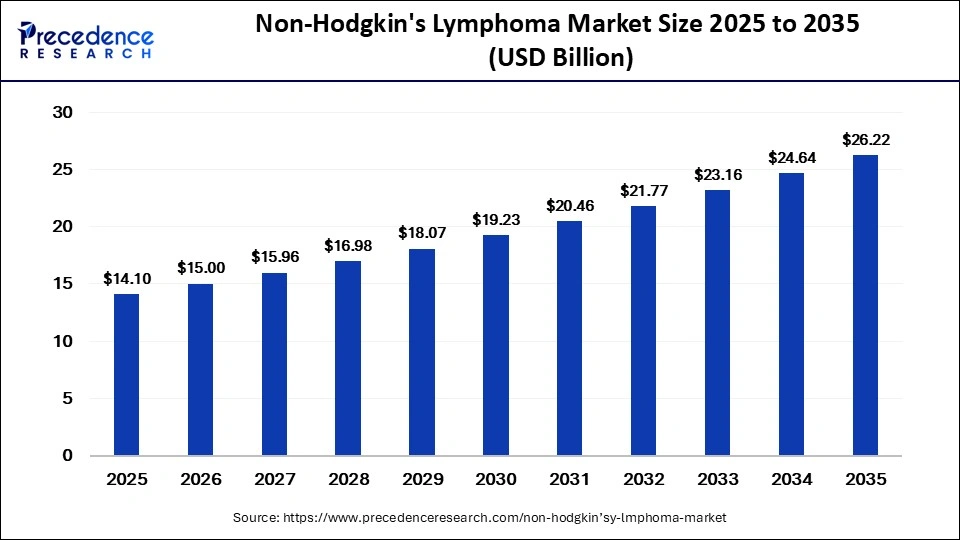
The growing prevalence of lymphoma, rising adoption of personalized cancer therapies, increasing regulatory approvals for advanced biologics, and the expanding role of CAR-T cell therapies are among the major factors accelerating market growth globally.
Read Also: Additive Manufacturing for Medical Devices Market
Quick Insights: What is Fueling the Growth of the Non-Hodgkin’s Lymphoma Market?
- The global non-Hodgkin’s lymphoma market was valued at USD 14.10 billion in 2025 and is forecasted to surpass USD 26.22 billion by 2035 at a CAGR of 6.40% during the forecast period.
- North America dominated the market with a 40% share in 2025 due to advanced oncology infrastructure, rapid biologics adoption, and strong clinical research activity.
- Asia Pacific is expected to grow at the fastest CAGR of 9.1% owing to improving healthcare infrastructure, rising cancer diagnosis rates, and increasing access to advanced oncology therapies.
- The chemotherapy segment held the highest market share of 30% in 2025 due to its continued role as a foundational first-line treatment option.
- The immunotherapy segment is projected to witness the fastest growth with a CAGR of 9.3% through 2035 as CAR-T therapies and monoclonal antibodies gain broader clinical adoption.
- CAR-T cell therapy is expected to expand at the fastest CAGR of 10.5% among drug classes due to increasing demand for precision oncology solutions targeting refractory lymphoma cases.
Revenue Snapshot of the Global Non-Hodgkin’s Lymphoma Market
| Year | Market Size |
|---|---|
| 2025 | USD 14.10 Billion |
| 2026 | USD 15.00 Billion |
| 2035 | USD 26.22 Billion |
| Growth Metric | Value |
|---|---|
| CAGR (2026–2035) | 6.40% |
| Dominating Region | North America |
| Fastest Growing Region | Asia Pacific |
How is Artificial Intelligence Revolutionizing the Non-Hodgkin’s Lymphoma Market?
Artificial intelligence is playing a transformative role in the diagnosis, treatment planning, and drug discovery processes within the non-Hodgkin’s lymphoma market. AI-driven systems are increasingly being utilized to analyze histopathological imaging, PET/CT scans, and genomic data to improve diagnostic precision and accelerate subtype classification.
Advanced AI algorithms are also helping clinicians predict patient responses to targeted therapies by evaluating tumor heterogeneity and molecular biomarkers. This is enabling more personalized treatment approaches while improving clinical decision-making and survival outcomes for lymphoma patients.
Additionally, pharmaceutical companies are leveraging AI-powered drug discovery platforms to accelerate biologic development, optimize clinical trial design, and reduce the cost and time associated with oncology research. AI integration is expected to become increasingly central to next-generation precision oncology innovation over the coming decade.
What are the Key Growth Drivers of the Non-Hodgkin’s Lymphoma Market?
Rising Prevalence of Hematologic Malignancies
The increasing global incidence of non-Hodgkin’s lymphoma remains one of the primary drivers of market growth. Aging populations, environmental risk factors, weakened immune systems, and changing lifestyles are contributing to rising diagnosis rates worldwide.
Healthcare systems globally are strengthening cancer screening programs and early detection initiatives, encouraging faster diagnosis and earlier treatment intervention.
Rapid Advancements in Immunotherapy
Immunotherapy has emerged as one of the most promising advancements in lymphoma treatment. Therapies such as:
- CAR-T cell therapy
- Monoclonal antibodies
- Immune checkpoint inhibitors
- Bispecific antibodies
are reshaping the oncology landscape by delivering more targeted and durable treatment responses compared to traditional chemotherapy.
The increasing clinical success of CD19-targeted therapies and antibody-drug conjugates is driving strong investment across the immuno-oncology ecosystem.
Increasing Shift Toward Precision Oncology
Precision medicine is transforming lymphoma treatment strategies by enabling highly personalized therapeutic approaches based on genetic and molecular profiling.
Advanced biomarker testing and genomic sequencing technologies are improving:
- Treatment selection
- Therapy effectiveness
- Patient stratification
- Survival outcomes
This shift toward mechanism-driven therapies is accelerating demand for targeted biologics and companion diagnostics.
What Opportunities are Emerging in the Non-Hodgkin’s Lymphoma Industry?
Can CAR-T Cell Therapy Redefine Cancer Care?
Yes. CAR-T cell therapy is emerging as one of the most disruptive innovations in hematologic oncology.
These therapies genetically engineer a patient’s immune cells to identify and destroy cancer cells with high precision. CAR-T treatments are increasingly being used for relapsed and refractory lymphoma patients who have limited response to conventional therapies.
Next-generation dual-targeting CAR-T platforms are expected to further improve efficacy, durability, and patient accessibility in the coming years.
Will Emerging Markets Create New Revenue Opportunities?
Absolutely. Emerging economies are rapidly investing in:
- Oncology infrastructure
- Specialized cancer hospitals
- Molecular diagnostics
- Clinical research programs
- Advanced biologics access
Countries across Asia Pacific and Latin America are witnessing increasing adoption of targeted therapies as healthcare accessibility improves.
This expansion is expected to create significant long-term revenue opportunities for pharmaceutical and biotechnology companies.
Which Regions are Leading the Non-Hodgkin’s Lymphoma Market?
Why Does North America Continue to Dominate the Market?
North America held the dominant market position with a 40% share in 2025 due to:
- Strong oncology infrastructure
- High healthcare spending
- Rapid biologics adoption
- Favorable reimbursement policies
- Presence of major pharmaceutical companies
The United States remains a global leader in CAR-T clinical research, biologic approvals, and precision oncology innovation.
Why is Asia Pacific Emerging as the Fastest-Growing Region?
Asia Pacific is projected to witness the highest CAGR of 9.1% through 2035 driven by:
- Improving healthcare infrastructure
- Increasing cancer awareness
- Expanding patient access to advanced therapies
- Rising healthcare investments
- Growth in oncology research programs
Countries such as China, India, and Japan are rapidly strengthening their oncology treatment ecosystems and diagnostic capabilities.
Segmentation Analysis of the Non-Hodgkin’s Lymphoma Market
By Treatment Type
- Chemotherapy
- Targeted Therapy
- Immunotherapy
- Radiation Therapy
- Stem Cell Transplant
The immunotherapy segment is expected to witness the fastest growth due to increasing clinical success of monoclonal antibodies and CAR-T cell therapies.
By Drug Class
- Monoclonal Antibodies
- Kinase Inhibitors
- Immune Checkpoint Inhibitors
- CAR-T Cell Therapy
- Antineoplastic Agents
Monoclonal antibodies dominated the market with a 40% share in 2025 due to their established clinical effectiveness and widespread adoption.
By Route of Administration
- Intravenous (IV)
- Subcutaneous (SC)
- Oral
The subcutaneous segment is projected to grow rapidly as healthcare providers increasingly prioritize convenience-focused and outpatient-based treatment models.
By Disease Subtype
- Diffuse Large B-cell Lymphoma (DLBCL)
- Follicular Lymphoma (FL)
- Mantle Cell Lymphoma (MCL)
- Primary Mediastinal B-cell Lymphoma (PMBCL)
DLBCL accounted for the largest market share of 40% in 2025 due to its high prevalence and aggressive disease progression.
Which Companies are Driving Innovation in the NHL Market?
Several leading biotechnology and pharmaceutical companies are aggressively investing in immunotherapy, targeted biologics, and next-generation oncology platforms.
Key Companies in the Non-Hodgkin’s Lymphoma Market
- Roche
- Bristol Myers Squibb
- Gilead Sciences
- Novartis
- Pfizer
- Johnson & Johnson
- Merck & Co.
- AstraZeneca
- AbbVie
- Amgen
These companies are actively focused on:
- CAR-T cell therapy expansion
- Monoclonal antibody development
- Precision oncology research
- AI-driven drug discovery
- Combination immunotherapy strategies
Recent Breakthroughs and Industry Developments
The market is witnessing accelerated approvals and pipeline expansion for:
- CD19-targeted CAR-T therapies
- Bispecific antibodies
- Antibody-drug conjugates
- Immune checkpoint inhibitors
Next-generation biologics are increasingly demonstrating strong clinical efficacy for refractory lymphoma patients.
Pharmaceutical companies are also investing heavily in combination therapy regimens aimed at improving progression-free survival and reducing relapse rates.
What Challenges are Affecting the Non-Hodgkin’s Lymphoma Market?
High Cost of Advanced Therapies
One of the major barriers facing the market is the extremely high cost associated with CAR-T cell therapies and advanced biologics. These treatments often require specialized infrastructure and intensive patient monitoring, limiting broader accessibility.
Stringent Regulatory and Safety Challenges
Regulatory approval pathways for cellular and gene-based therapies remain highly complex. Additionally, risks associated with immune-related adverse events and therapy toxicity continue posing challenges for widespread commercialization.
Case Study: How CAR-T Therapy Improved Outcomes for Refractory Lymphoma Patients
Clinical adoption of CAR-T cell therapies has demonstrated significant improvements in survival outcomes for patients with relapsed or refractory diffuse large B-cell lymphoma (DLBCL).
Patients previously resistant to multiple lines of chemotherapy have shown durable remission responses through CD19-targeted immunotherapies. The success of these treatments is encouraging broader investment in next-generation cellular therapies and personalized oncology platforms worldwide.
Future Outlook: What’s Next for the Non-Hodgkin’s Lymphoma Industry?
The future of the non-Hodgkin’s lymphoma market will likely be shaped by:
- AI-powered oncology diagnostics
- Precision biologics
- Gene editing technologies
- Advanced cellular therapies
- Personalized treatment algorithms
- Combination immunotherapy strategies
As biotechnology innovation accelerates, the industry is expected to transition further toward patient-specific, highly targeted cancer treatment models.
Companies investing in AI integration, biomarker-driven therapies, and scalable cellular manufacturing infrastructure are expected to gain strong competitive advantages over the next decade.
Get a Sample Copy: https://www.precedenceresearch.com/sample/8414
For inquiries regarding discounts, bulk purchases, or customization requests, please contact us at [email protected]
