
 by
by The global additive manufacturing for medical devices market is projected to reach USD 23.87 billion by 2035, driven by personalized implants, AI-powered 3D printing, biocompatible materials, and rising demand for advanced medical technologies.
The global additive manufacturing for medical devices market is witnessing remarkable expansion as healthcare providers increasingly adopt advanced 3D printing technologies for personalized medical solutions. According to Precedence Research, the market size was valued at USD 4.60 billion in 2025 and is expected to grow from USD 5.42 billion in 2026 to approximately USD 23.87 billion by 2035, registering a strong CAGR of 17.90% during the forecast period.
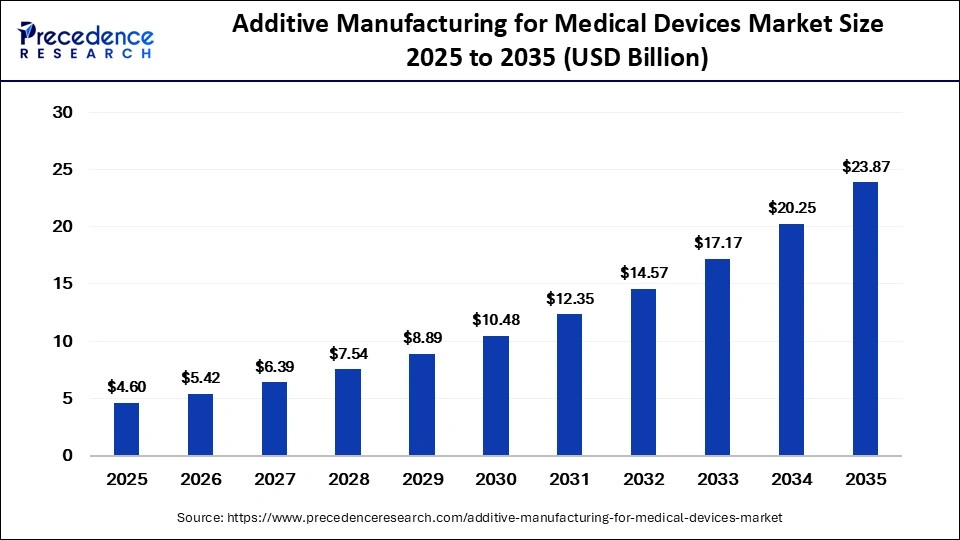
Additive manufacturing, commonly known as 3D printing, has emerged as a transformative technology in the healthcare industry. The technology enables the creation of customized implants, prosthetics, surgical guides, and anatomical models tailored to individual patient anatomy. By improving precision, reducing surgical time, and enhancing patient outcomes, additive manufacturing is reshaping the future of medical device production.
Healthcare providers and medical device manufacturers are increasingly leveraging technologies such as Selective Laser Sintering (SLS), Direct Metal Laser Sintering (DMLS), Electron Beam Melting (EBM), and Fused Deposition Modeling (FDM) to produce highly accurate and patient-specific devices. Growing investments in research and development, coupled with the integration of artificial intelligence and advanced biomaterials, are further accelerating market growth.
Read Also: Immunochemistry Instruments and Reagents Market
What is Additive Manufacturing in Medical Devices?
Additive manufacturing refers to the layer-by-layer fabrication of objects using digital 3D models. In the medical field, this technology enables the production of highly complex and customized devices that are difficult or impossible to manufacture using traditional methods.
Medical applications include:
- Orthopedic implants
- Dental implants
- Prosthetics and orthotics
- Surgical instruments
- Tissue engineering
- Wearable medical devices
- Anatomical surgical models
The technology supports rapid prototyping, reduced material waste, shorter production cycles, and personalized patient care, making it increasingly attractive to healthcare providers worldwide.
Key Market Drivers
Rising Demand for Personalized Medical Devices
One of the major factors driving market growth is the growing demand for patient-specific implants and prosthetics. Traditional manufacturing methods often fail to deliver customized solutions that match individual anatomical structures. Additive manufacturing solves this challenge by enabling the creation of tailor-made implants based on patient imaging data.
Customized orthopedic implants, dental restorations, and prosthetic limbs provide improved comfort, better fitting, enhanced functionality, and faster recovery times. The aging global population and increasing prevalence of chronic diseases are further boosting demand for personalized healthcare solutions.
Advancements in Biocompatible Materials
Continuous innovation in biomaterials and metal powders is supporting the adoption of additive manufacturing in healthcare. Materials such as titanium alloys, ceramics, polymers, and bioresorbable substances are increasingly being used to create durable and safe medical devices.
Metal-based implants dominate the market due to their strength, corrosion resistance, and compatibility with human tissues. According to the report, the metals segment accounted for approximately 40% of the market share in 2025.
Integration of Artificial Intelligence
Artificial intelligence is significantly transforming additive manufacturing processes in healthcare. AI-driven systems optimize design structures, automate quality inspections, and enhance production precision. Generative design algorithms are helping manufacturers create lightweight yet highly durable implants with complex geometries.
AI also improves surgical planning by converting patient imaging data into highly accurate anatomical models and customized implants. Real-time monitoring and predictive maintenance further improve manufacturing efficiency and reduce material waste.
Increasing Adoption of Point-of-Care Manufacturing
Hospitals and healthcare facilities are increasingly adopting in-house 3D printing labs to produce customized devices on demand. Point-of-care manufacturing reduces lead times and enables faster delivery of patient-specific surgical guides, prosthetics, and implants.
The hospitals segment held nearly 45% of the market share in 2025, highlighting the growing importance of on-site additive manufacturing capabilities in healthcare institutions.
Market Restraints
High Equipment and Material Costs
Despite significant growth opportunities, the market faces challenges related to the high initial cost of 3D printing equipment and specialized biomaterials. Advanced metal printing systems and biocompatible materials require substantial investment, limiting adoption among small healthcare providers and emerging economies.
Regulatory and Quality Compliance Challenges
Medical devices are subject to stringent regulatory approvals to ensure safety and effectiveness. Regulatory complexities associated with 3D-printed medical products can delay commercialization and increase compliance costs for manufacturers.
Quality consistency and standardization remain key concerns, particularly for highly customized implants and tissue-engineered products.
Limited Technical Expertise
The successful implementation of additive manufacturing technologies requires skilled professionals capable of operating advanced systems and designing complex medical devices. The shortage of trained personnel may hinder broader market adoption in some regions.
Emerging Market Opportunities
Growth in Tissue Engineering and Bioprinting
Bioprinting and tissue engineering represent some of the most promising growth opportunities in the market. Researchers are increasingly exploring 3D printing technologies for regenerative medicine applications, including the development of tissues, organs, and bioengineered implants.
The tissue engineering segment is expected to grow at a CAGR of 20.5% during the forecast period, reflecting rising investment in regenerative healthcare technologies.
Expansion in Emerging Economies
Rapid healthcare infrastructure development in emerging markets such as India, China, and Southeast Asia is creating new opportunities for additive manufacturing adoption. Governments and healthcare organizations are investing heavily in advanced medical technologies to improve healthcare accessibility and quality.
India, in particular, is becoming a strategic hub for medical device manufacturing and 3D printing innovation. Recent partnerships aimed at establishing orthopedic implant manufacturing facilities are further strengthening regional growth prospects.
Increasing Demand for Dental Applications
Dental implants and orthodontic devices are among the fastest-growing applications for additive manufacturing. The ability to create highly customized dental restorations with improved accuracy and faster turnaround times is driving widespread adoption in dental clinics and laboratories.
Technology Insights
Selective Laser Sintering (SLS) Dominates the Market
The Selective Laser Sintering segment accounted for approximately 25% of the market share in 2025. SLS technology is widely preferred due to its ability to produce strong, complex, and highly detailed medical devices without support structures.
The technology enables cost-effective manufacturing of customized implants and surgical tools, making it highly attractive for healthcare applications.
Direct Metal Laser Sintering (DMLS) Expected to Witness Fastest Growth
The DMLS segment is anticipated to grow at the fastest CAGR of 20.5% between 2026 and 2035. DMLS technology allows manufacturers to create precise titanium and cobalt-chromium implants with excellent biocompatibility and structural integrity.
Its growing use in orthopedic and dental implant manufacturing is contributing significantly to market expansion.
Regional Analysis
North America Leads the Global Market
North America currently dominates the additive manufacturing for medical devices market due to strong healthcare infrastructure, advanced technological capabilities, and the presence of leading market players.
The United States remains a key contributor, supported by high investments in medical innovation, favorable reimbursement policies, and increasing adoption of patient-specific implants. The U.S. market alone is expected to reach nearly USD 7.30 billion by 2035.
Asia Pacific Emerges as the Fastest-Growing Region
Asia Pacific is projected to witness the fastest growth during the forecast period. Rapid industrialization, growing healthcare expenditure, rising medical tourism, and expanding healthcare infrastructure are driving regional demand.
Countries such as China, India, Japan, and South Korea are investing heavily in 3D printing technologies for healthcare applications. Increasing government support for digital healthcare transformation is further accelerating market growth.
Europe Maintains Strong Market Presence
Europe continues to hold a significant market share due to strong research capabilities and increasing adoption of advanced manufacturing technologies. Countries including Germany, the UK, and France are actively investing in medical additive manufacturing innovation.
Competitive Landscape
The market is highly competitive, with major companies focusing on product innovation, strategic collaborations, and expansion initiatives to strengthen their market position.
Leading Companies in the Market
Key players operating in the global additive manufacturing for medical devices market include:
- 3D Systems
- Stratasys
- Materialise
- GE Additive
- Stryker
- Zimmer Biomet
- Medtronic
- Johnson & Johnson
- EOS GmbH
- Renishaw
- Desktop Metal
- Formlabs
- HP
Get a Sample Copy: https://www.precedenceresearch.com/sample/8406
For inquiries regarding discounts, bulk purchases, or customization requests, please contact us at [email protected]
