
 by
by The global immunochemistry instruments and reagents market is projected to reach USD 53.50 billion by 2035, driven by increasing chronic diseases, AI-powered diagnostics, biomarker research, and laboratory automation.
The global healthcare industry is rapidly shifting toward precision diagnostics, early disease detection, and automated laboratory workflows. In this evolving landscape, the immunochemistry instruments and reagents market has emerged as a critical component of modern clinical diagnostics. Immunochemistry technologies are widely used for detecting infectious diseases, cancer biomarkers, endocrine disorders, cardiovascular conditions, and autoimmune diseases through antigen-antibody reactions.
According to Precedence Research, the global immunochemistry instruments and reagents market size was valued at USD 26.20 billion in 2025 and is expected to grow from USD 28.14 billion in 2026 to approximately USD 53.50 billion by 2035, expanding at a CAGR of 7.40% during the forecast period.
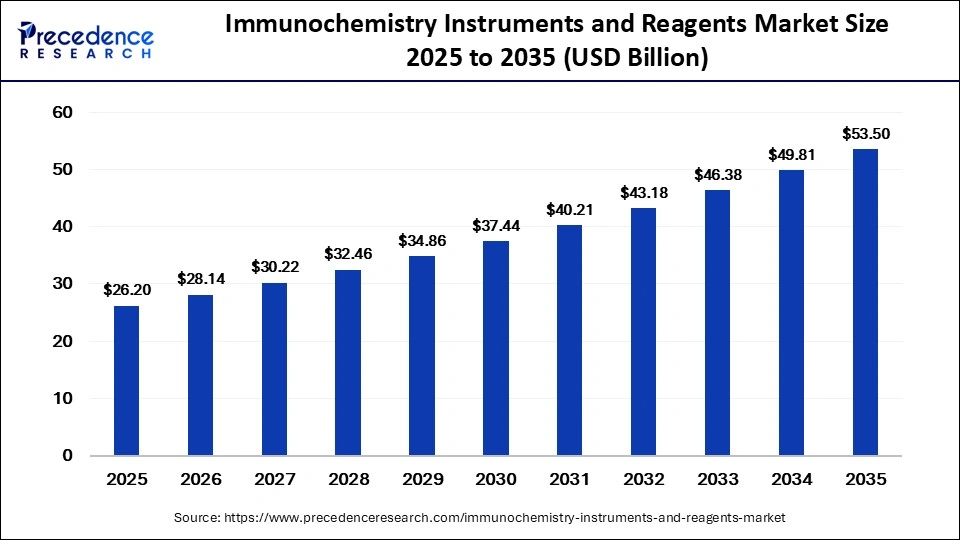
Growing demand for rapid and accurate diagnostic testing, advancements in immunoassay technologies, increasing healthcare investments, and rising adoption of automated laboratory systems are among the major factors fueling market growth worldwide.
Read Also: Hospital Acquired Infection Control Market
Market Overview
Immunochemistry involves biochemical testing methods that utilize antigen-antibody interactions for disease diagnosis and monitoring. The market includes instruments, reagents, assay kits, analyzers, and software platforms used in hospitals, diagnostic laboratories, blood banks, and research institutions.
Modern immunochemistry systems are increasingly integrated with automation, artificial intelligence (AI), and machine learning technologies to improve testing efficiency, reduce manual errors, and enhance clinical accuracy. The technology is especially valuable in oncology diagnostics, infectious disease screening, hormonal testing, and cardiac biomarker analysis.
The growing burden of chronic diseases globally continues to increase diagnostic testing volumes. Rising awareness about preventive healthcare and personalized medicine is also creating long-term opportunities for the industry.
Key Market Statistics
- Market Size 2025: USD 26.20 Billion
- Estimated Market Size 2026: USD 28.14 Billion
- Forecast Market Size 2035: USD 53.50 Billion
- CAGR (2026–2035): 7.40%
- Largest Regional Market: North America
- Fastest Growing Region: Asia Pacific
Major Growth Drivers of the Immunochemistry Instruments and Reagents Market
Rising Prevalence of Chronic and Infectious Diseases
The increasing incidence of cancer, diabetes, cardiovascular diseases, and infectious diseases is significantly driving the need for advanced diagnostic technologies. Immunochemistry tests enable early detection of disease biomarkers, helping physicians improve treatment outcomes and patient management.
The growing elderly population worldwide is also contributing to increased testing volumes, especially for endocrine and cardiac conditions. As healthcare systems focus more on preventive diagnosis, demand for immunochemistry-based assays continues to rise.
Expansion of Personalized Medicine
Personalized medicine relies heavily on biomarker-based diagnostics. Immunochemistry technologies help identify disease-specific proteins and biomarkers that support individualized treatment plans.
Healthcare providers are increasingly using targeted diagnostics in oncology, autoimmune disorders, and rare disease management. This trend is accelerating demand for high-sensitivity immunoassays and advanced reagent kits.
Growing Laboratory Automation
Automation is transforming diagnostic laboratories globally. Automated immunochemistry analyzers improve laboratory throughput, reduce turnaround time, and minimize human error.
Large hospitals and diagnostic chains are investing in fully automated systems that can handle high sample volumes efficiently. AI-powered data analysis and smart laboratory systems are further improving workflow optimization and diagnostic accuracy.
Increasing Investments in Biomarker Research
Pharmaceutical and biotechnology companies are investing heavily in biomarker discovery and companion diagnostics. Immunochemistry platforms play a crucial role in clinical research and drug development.
The rising demand for multiplex assays, precision diagnostics, and predictive disease monitoring is expected to fuel long-term market growth.
Market Restraints
High Cost of Advanced Diagnostic Systems
One of the major challenges affecting market expansion is the high cost associated with advanced immunochemistry instruments and automated analyzers.
Small laboratories and healthcare facilities in developing economies often face budget constraints that limit technology adoption. Maintenance expenses, software upgrades, and specialized training requirements also increase operational costs.
Shortage of Skilled Professionals
Advanced immunochemistry systems require trained laboratory professionals capable of handling complex workflows and interpreting results accurately.
Many emerging economies continue to face shortages of skilled healthcare personnel, which may hinder adoption rates in certain regions.
Opportunities in the Immunochemistry Market
Rising Demand for Point-of-Care Diagnostics
Portable and compact immunochemistry systems are becoming increasingly popular in emergency care, decentralized healthcare settings, and remote diagnostics.
Point-of-care testing solutions reduce diagnostic turnaround time and improve patient management, especially in rural and underserved regions.
Emerging Healthcare Markets
Developing economies in Asia Pacific, Latin America, and the Middle East are witnessing rapid improvements in healthcare infrastructure and diagnostic capabilities.
Government healthcare initiatives, rising disposable income, and expanding health insurance coverage are expected to create lucrative growth opportunities for market participants.
AI Integration in Diagnostics
Artificial intelligence is revolutionizing immunochemistry diagnostics by improving predictive analysis, result interpretation, and workflow automation.
AI-enabled platforms can identify complex disease patterns more efficiently and support precision healthcare initiatives, creating substantial opportunities for innovation.
Segment Analysis
By Product
Reagents & Kits Segment Dominated the Market
The reagents and kits segment accounted for approximately 65% of the market share in 2025. These products are used continuously in diagnostic procedures, generating recurring demand across hospitals and laboratories.
The increasing frequency of infectious disease testing and chronic disease monitoring is supporting segment expansion.
Instruments Segment
The instruments segment is witnessing steady growth due to increasing investments in automated analyzers and advanced diagnostic systems. Innovations in robotics and AI-integrated platforms are improving testing efficiency and operational productivity.
By Technology
CLIA Segment Held the Largest Share
Chemiluminescence immunoassay (CLIA) accounted for nearly 35% of the global market share in 2025. The technology offers high sensitivity, faster processing, and accurate biomarker detection, making it highly preferred in clinical diagnostics.
ELISA Technology
Enzyme-linked immunosorbent assay (ELISA) remains widely used due to its affordability, reliability, and broad application range in research and diagnostics.
By Application
Infectious Diseases
The infectious diseases segment led the market with around 28% share in 2025, supported by rising testing demand for viral and bacterial infections globally.
Oncology
The oncology segment is expected to witness strong growth due to increasing cancer prevalence and growing use of biomarker-based cancer diagnostics.
Regional Analysis
North America Dominated the Global Market
North America accounted for approximately 38% of the global market share in 2025. The region benefits from advanced healthcare infrastructure, strong research capabilities, and high healthcare spending.
The United States remains a major contributor due to the strong presence of leading diagnostic companies and widespread adoption of advanced laboratory technologies.
Key Growth Factors in North America
- Strong adoption of precision medicine
- Advanced diagnostic laboratory networks
- Increasing chronic disease burden
- High healthcare expenditure
- Continuous technological innovation
Europe Market Analysis
Europe represented nearly 30% of the global market share in 2025. Rising demand for biomarker-based diagnostics, personalized medicine, and advanced laboratory systems is supporting regional growth.
Countries such as Germany, France, and the United Kingdom continue to invest heavily in healthcare modernization and clinical research.
Asia Pacific: Fastest-Growing Region
Asia Pacific is projected to expand at the fastest CAGR of 10.5% during the forecast period. Rapid healthcare infrastructure development, increasing healthcare awareness, and growing investments in laboratory diagnostics are driving regional growth.
China, Japan, and India are emerging as key markets due to rising patient populations and increasing adoption of advanced diagnostic technologies.
Competitive Landscape
The immunochemistry instruments and reagents market is highly competitive, with major companies focusing on product innovation, automation, strategic collaborations, and AI integration.
Leading Companies in the Market
Key players operating in the market include:
- Roche Diagnostics
- Abbott Laboratories
- Siemens Healthineers
- Thermo Fisher Scientific
- Danaher Corporation
- bioMérieux
- Sysmex Corporation
- Beckman Coulter Diagnostics
Emerging Market Trends
Integration of Digital Healthcare Technologies
Cloud-based laboratory management systems and digital diagnostics are becoming increasingly common across healthcare facilities.
Growth of Portable Diagnostic Devices
Compact and portable immunochemistry analyzers are gaining popularity in remote healthcare settings and emergency diagnostics.
Focus on Precision Diagnostics
Healthcare providers are increasingly shifting toward precision medicine and targeted diagnostics, creating sustained demand for advanced immunochemistry reagents and assays.
Increasing Adoption of Multiplex Testing
Multiplex immunoassays that allow simultaneous detection of multiple biomarkers are improving laboratory productivity and reducing diagnostic turnaround time.
Conclusion
The global immunochemistry instruments and reagents market is poised for substantial growth over the next decade as healthcare systems worldwide prioritize early disease detection, precision diagnostics, and automated laboratory workflows.
The increasing prevalence of chronic diseases, rising investments in biomarker research, and rapid advancements in AI-powered diagnostics are expected to accelerate market expansion. North America currently leads the industry due to its advanced healthcare ecosystem, while Asia Pacific is emerging as the fastest-growing regional market.
As personalized medicine continues to gain momentum, demand for high-sensitivity immunochemistry assays, automated analyzers, and innovative reagent kits is expected to increase significantly. Companies investing in AI integration, multiplex testing technologies, and portable diagnostic systems are likely to gain a strong competitive advantage in the evolving diagnostic landscape.
Get a Sample Copy: https://www.precedenceresearch.com/sample/8404
For inquiries regarding discounts, bulk purchases, or customization requests, please contact us at [email protected]
