
 by
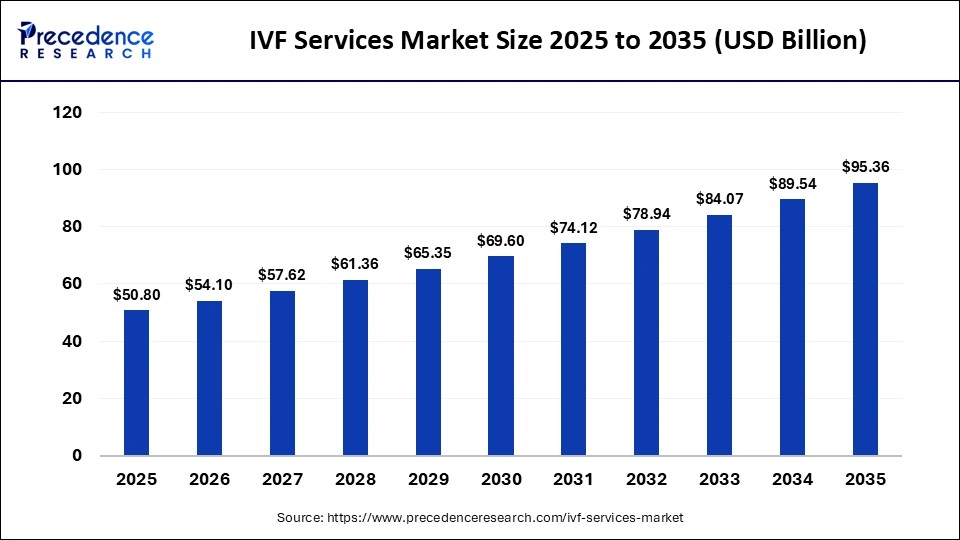
by The global IVF services market is witnessing strong momentum as changing lifestyles, delayed pregnancies, and growing infertility rates continue to increase the demand for assisted reproductive technologies worldwide. The market was valued at USD 50.80 billion in 2025 and is expected to grow from USD 54.10 billion in 2026 to nearly USD 95.36 billion by 2035, expanding at a CAGR of 6.50% during the forecast period. Rising awareness of fertility preservation, the growing use of advanced embryology technologies, and increasing access to IVF procedures are playing a major role in driving this growth.
Read Also: Veterinary Urinalysis Market
Quick Insights: What Are the Most Important IVF Services Market Numbers?
- The global IVF services market was valued at USD 50.80 billion in 2025 and is projected to reach USD 95.36 billion by 2035.
- The market is forecast to grow at a CAGR of 6.50% from 2026 to 2035.
- Europe dominated the global market in 2025 with a 39% revenue share.
- Asia Pacific is expected to witness the fastest growth rate through 2035, supported by rising infertility rates and growing IVF awareness.
- Fresh IVF cycles held the largest share of 49% in 2025.
- Fertility clinics accounted for 65% of the total market revenue in 2025.
- IVF with ICSI remained the leading procedure due to its higher success rate in treating male infertility.
How Is Artificial Intelligence Changing the IVF Services Market?
Artificial intelligence is becoming one of the most transformative technologies in reproductive healthcare. Fertility clinics are increasingly adopting AI-driven embryo grading, time-lapse imaging, and predictive analytics to improve clinical accuracy and increase IVF success rates.
AI tools can analyze embryo morphology, genetics, and patient history to identify the most viable embryos with greater precision than traditional manual methods. This allows fertility specialists to reduce subjectivity in embryo selection and improve implantation outcomes. Predictive models also help patients understand their chances of treatment success before beginning IVF cycles.
In addition, automated laboratory systems and AI-powered reproductive technologies are helping clinics reduce manual workload, improve consistency in embryo handling, and lower the emotional and financial burden on patients undergoing multiple cycles. Emerging technologies such as AI-based embryo selection, egg rejuvenation, and in vitro gametogenesis are expected to reshape the future of fertility care.
What Factors Are Driving Growth in the IVF Services Market?
Why Are Rising Infertility Rates Increasing IVF Demand?
Infertility is becoming a major global healthcare challenge. According to the World Health Organization, nearly one in six adults worldwide experiences infertility. Rising stress levels, obesity, sedentary lifestyles, smoking, and environmental factors are contributing to fertility-related disorders across both men and women.
At the same time, people are delaying parenthood due to career priorities, financial planning, and social changes. Since fertility declines with age, especially for women, more couples are turning to IVF services as a reliable reproductive solution.
How Is Fertility Preservation Creating New Market Opportunities?
The growing popularity of egg freezing and sperm preservation is creating new long-term opportunities for the IVF services market. Young professionals, cancer patients, and individuals planning delayed pregnancies are increasingly opting for fertility preservation to improve their future reproductive options.
Improved cryopreservation techniques and higher success rates are making fertility preservation more appealing, creating a future pipeline of IVF cycles linked to stored reproductive material.
Why Are Fertility Clinics Expanding So Rapidly?
The rapid growth of fertility clinics is improving access to IVF treatments across emerging economies. Specialized clinics are opening in urban and semi-urban regions, particularly across Asia Pacific, Latin America, and the Middle East. These clinics offer shorter waiting times, advanced laboratory technologies, and specialized fertility care, making them highly attractive to patients.
Which IVF Cycle Types Are Leading the Market?
Fresh IVF cycles dominated the market in 2025, accounting for 49% of total revenue. Their leadership is supported by strong clinical preference for immediate embryo transfer after ovarian stimulation, along with high patient confidence and reduced reliance on cryopreservation infrastructure.
However, thawed IVF cycles are expected to grow at the fastest pace over the forecast period. Advances in embryo freezing and cryopreservation are making frozen embryo transfer more effective, particularly in patients with diminished ovarian reserve or genetic concerns.
Why Does IVF with ICSI Dominate the Procedure Segment?
IVF with intracytoplasmic sperm injection (ICSI) has become the leading IVF procedure because it offers higher fertilization success rates, particularly in male infertility cases. By directly injecting a single sperm into an egg, ICSI increases the chances of successful fertilization and reduces the risk of failed cycles.
Meanwhile, IVF with donor eggs is expected to grow rapidly due to rising age-related infertility, poor egg quality, and growing acceptance among single parents and LGBTQ+ families.
Which End Users Generate the Highest Revenue?
Fertility clinics dominated the market with a 65% share in 2025 due to their specialized infrastructure, dedicated reproductive medicine experts, and advanced embryology labs. Clinics also offer faster treatment timelines and a more personalized patient experience compared to hospitals.
Hospitals are expected to grow at the fastest rate because they can manage complex infertility cases requiring surgery, imaging, and multidisciplinary care. Surgical centers are also gaining traction for pre-IVF procedures such as laparoscopy and hysteroscopy.
Why Is Europe Leading the IVF Services Market?
Europe accounted for 39% of the global IVF services market in 2025 due to its strong reimbursement frameworks, publicly funded fertility programs, and high treatment volumes. Countries such as France, Denmark, and Spain provide favorable policies that improve patient access to IVF treatments. The region also benefits from standardized clinical protocols and well-established fertility regulations.
Germany remains one of the leading contributors in Europe due to its strong healthcare system, advanced laboratory infrastructure, and growing adoption of genetic testing and embryo selection technologies.
North America held the second-largest share of 31% in 2025, supported by high investment in reproductive technologies, AI-based embryo assessment, and strong private fertility clinic networks. The United States recorded more than 100,000 IVF births in 2026, highlighting the scale of the market.
Asia Pacific is expected to grow at the fastest pace through 2035 due to rising infertility rates, growing awareness of IVF, increasing disposable incomes, and expanding fertility infrastructure in countries like China, India, and Japan.
What Challenges Are Limiting IVF Market Growth?
Despite strong growth prospects, high treatment costs remain one of the biggest barriers to IVF adoption. Hormonal stimulation drugs, laboratory procedures, repeated cycles, and out-of-pocket expenses can make IVF financially difficult for many patients.
Differences in reimbursement policies between countries and the higher cost of private fertility care also create unequal access to treatment. As a result, many couples delay or discontinue IVF cycles due to affordability concerns.
Case Study: How Are Fertility Clinics Expanding to Meet Demand?
The rising demand for fertility services is encouraging clinic chains to expand aggressively. For example, Gaudium IVF announced plans to use IPO funding to establish 19 new IVF centers, reflecting the growing demand for specialized fertility care across India. Market observers note that IVF-focused healthcare providers are increasingly adopting asset-light expansion strategies to scale operations more quickly and meet growing patient demand.
Leading Companies in the IVF Services Market
Key companies operating in the IVF services market include:
- Cook Medical
- Esco Medical
- Ferring Pharmaceuticals
- FUJIFILM Irvine Scientific, Inc.
- Genea Limited
- Hamilton Thorne Ltd.
- Indira IVF Hospital Pvt. Ltd.
- IVI RMA Global
- Merck KGaA
- Nidacon International AB
- Progyny, Inc.
- The Cooper Companies, Inc.
- Thermo Fisher Scientific Inc.
- Virtus Health Ltd.
- Vitrolife Group
Get Sample Copy: https://www.precedenceresearch.com/sample/8300
For inquiries regarding discounts, bulk purchases, or customization requests, please contact us at [email protected]

