
 by
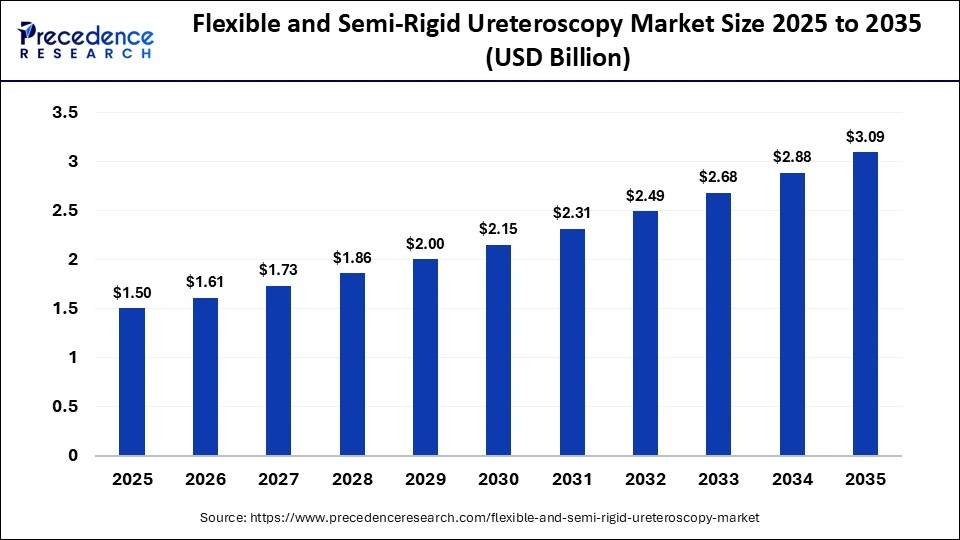
by The global flexible and semi-rigid ureteroscopy market is witnessing steady growth as healthcare systems increasingly shift toward minimally invasive treatment methods for kidney stones, urinary tract disorders, and bladder tumors. The market size stood at USD 1.50 billion in 2025 and is projected to grow from USD 1.61 billion in 2026 to approximately USD 3.09 billion by 2035, expanding at a CAGR of 7.50% during the forecast period from 2026 to 2035. Increasing prevalence of nephrological conditions, rapid adoption of advanced endoscopic systems, and growing awareness about faster recovery procedures are major factors accelerating demand.
Read Also: IVF Services Market
Quick Insights
- The global flexible and semi-rigid ureteroscopy market was valued at USD 1.50 billion in 2025 and is expected to reach USD 3.09 billion by 2035.
- North America accounted for the largest market share of 35% in 2025 due to strong healthcare infrastructure and high prevalence of kidney stones.
- Asia Pacific is expected to witness the fastest CAGR of 9% between 2026 and 2035.
- Flexible ureteroscopes dominated the market in 2025 with a 60% share because of their superior maneuverability and visualization.
- Hospitals remained the leading end-use segment with 60% share in 2025 due to the high volume of urological surgeries.
- Kidney stones treatment represented the largest application area, accounting for 50% of the market in 2025.
- Major companies operating in the market include Boston Scientific Corporation, Medtronic PLC, Olympus Corporation, Stryker Corporation, KARL STORZ SE & Co. KG, and Richard Wolf GmbH
How is Artificial Intelligence Improving Ureteroscopy Procedures?
Artificial intelligence is gradually transforming the ureteroscopy landscape by helping physicians make more accurate procedural decisions. AI-enabled systems can analyze CT scans and automatically detect urinary stones, measure their size, and determine the most effective treatment pathway. These systems help clinicians identify suitable candidates for flexible or semi-rigid ureteroscopy while improving procedural planning.
AI also supports real-time tracking of stone fragments during surgery, improving stone-free rates and minimizing complications. Machine learning models are being used to predict infection risks, recommend antibiotics for urinary tract infections, and optimize postoperative outcomes. As hospitals increasingly integrate digital imaging and AI-assisted navigation systems, the overall efficiency and accuracy of ureteroscopy procedures are expected to improve significantly.
What Are the Major Growth Factors Driving the Market?
The market is expanding rapidly due to several structural and technological trends. The rising incidence of kidney stones globally remains the primary growth driver, especially among aging populations and patients with poor dietary habits. At the same time, hospitals are increasingly preferring minimally invasive surgeries because they reduce hospital stay duration, lower complication risks, and enable faster recovery.
Technological advancements such as enhanced digital imaging, smaller scope diameters, passive bending technology, and improved mobility of flexible ureteroscopes are also fueling demand. These innovations allow surgeons to access difficult anatomical regions more effectively while improving patient comfort and treatment precision.
Why Are Flexible Ureteroscopes Dominating the Market?
Flexible ureteroscopes held the leading market share in 2025 because they provide better maneuverability, superior access to the upper urinary tract, and improved patient outcomes. Modern flexible ureteroscopes feature slim 8F tip diameters, passive bending technology, and high-definition digital visualization systems that help physicians perform procedures with greater accuracy and minimal trauma. These advantages have made flexible systems the preferred choice for kidney stone management and complex urological procedures.
Why Are Semi-Rigid Ureteroscopes Gaining Popularity?
Semi-rigid ureteroscopes are expected to grow at the fastest rate over the forecast period because they offer a strong balance between durability, procedural control, and cost-effectiveness. These scopes are especially useful in lower ureter procedures and are often preferred in healthcare facilities seeking reliable performance with lower maintenance costs. Their self-dilating insertion tubes and atraumatic tip designs make them suitable for navigating narrow ureters while maintaining stability during surgery.
Regional Analysis
Why Did North America Lead the Market in 2025?
North America dominated the market in 2025 with a 35% share due to strong healthcare infrastructure, widespread use of advanced urological procedures, and a high prevalence of kidney stone disease. The region benefits from the presence of major medical device companies, strong reimbursement systems, and early adoption of innovative endoscopic technologies.
The United States remains the largest contributor within the region because of rising import shipments of ureteroscopy equipment and the strong presence of companies such as Boston Scientific Corporation, Olympus America, and Stryker Corporation.
Why is Asia Pacific Emerging as the Fastest-Growing Region?
Asia Pacific is expected to grow at the fastest CAGR of 9% through 2035 due to expanding healthcare access, rising awareness of minimally invasive procedures, and increasing prevalence of kidney stones in countries such as China and India. Rapid healthcare infrastructure development and increasing investments in advanced urology departments are further boosting demand across the region.
How is Europe Strengthening Its Position?
Europe held 25% of the market in 2025 and continues to benefit from high healthcare standards, an aging population, and strong adoption of innovative urology technologies. Countries such as Germany are leading regional growth through favorable regulatory frameworks, advanced hospital infrastructure, and the presence of companies like KARL STORZ SE & Co. KG and Richard Wolf GmbH.
What Challenges Could Limit Market Expansion?
Despite strong growth potential, the market faces several challenges. The high cost of advanced flexible ureteroscopes, maintenance expenses, and reprocessing requirements continue to place financial pressure on healthcare providers. Infection risks associated with reusable endoscopes also remain a concern, pushing facilities toward single-use or disposable systems that can be more expensive in the short term. Limited access to trained specialists in developing regions may also slow adoption.
Case Study: The Rise of Outpatient Urology Procedures
Ambulatory surgery centers are emerging as an important end-use segment because of the growing preference for same-day minimally invasive procedures. These centers provide cost-effective care, shorter waiting times, and faster patient recovery compared to traditional hospital settings. As more healthcare systems prioritize outpatient care, ASCs are expected to witness the fastest growth rate of 8.5% during the forecast period.
Leading Companies in the Flexible and Semi-Rigid Ureteroscopy Market
- Boston Scientific Corporation
- Medtronic PLC
- Olympus Corporation
- KARL STORZ SE & Co. KG
- Richard Wolf GmbH
- Stryker Corporation
- B. Braun Melsungen AG
- Cook Medical Inc.
Get Sample Copy: https://www.precedenceresearch.com/sample/8301
For inquiries regarding discounts, bulk purchases, or customization requests, please contact us at [email protected]

