by
by The global transradial access market is witnessing steady growth as healthcare providers increasingly adopt minimally invasive procedures for diagnosing and treating cardiovascular conditions. The market size was valued at USD 2.50 billion in 2025 and is expected to grow from USD 2.71 billion in 2026 to approximately USD 5.55 billion by 2035, registering a CAGR of 8.30% during the forecast period.
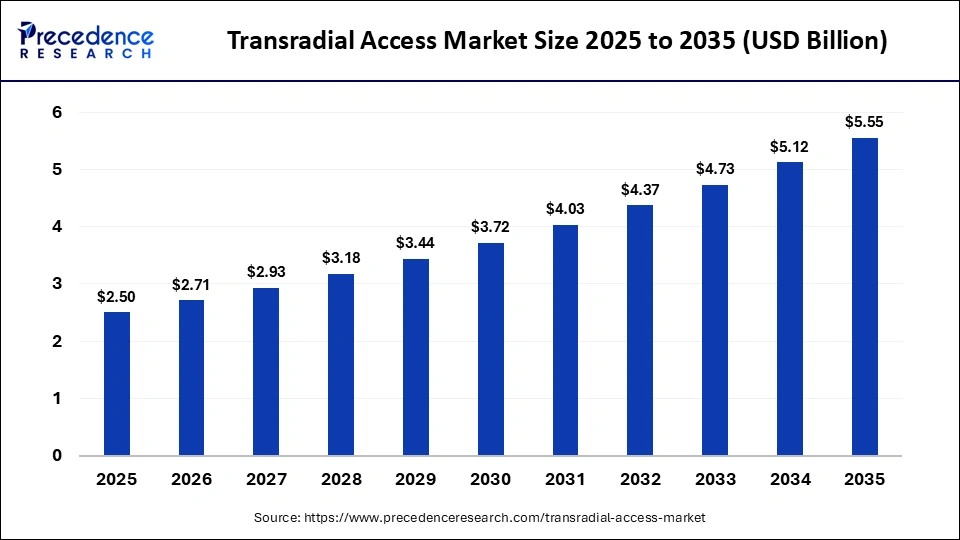
Transradial access, often referred to as transradial angiography, involves accessing the cardiovascular system through the radial artery in the wrist instead of the femoral artery in the groin. This method has become a preferred approach for coronary angiography and percutaneous coronary intervention due to its lower risk of bleeding, quicker patient recovery, and shorter hospital stays.
Read Also: Flexible and Semi-Rigid Ureteroscopy Market
Why Transradial Access is Becoming the Preferred Approach
Healthcare professionals are increasingly favoring transradial access because it provides a safer and more comfortable experience for patients. Unlike the traditional transfemoral approach, the transradial method allows patients to sit up, eat, and walk soon after the procedure. It also significantly lowers the risk of major bleeding complications and reduces the time required for post-procedure monitoring.
The growing prevalence of cardiovascular diseases worldwide is one of the major factors supporting the expansion of the market. Conditions such as coronary artery disease, hypertension, and peripheral artery disease are driving the need for diagnostic and interventional procedures that rely on transradial access.
In addition, continuous advancements in catheter technologies, guidewires, sheaths, and imaging systems are making procedures more accurate, efficient, and safer for both patients and physicians.
The Role of Artificial Intelligence in Transradial Access
Artificial intelligence is increasingly being integrated into cardiovascular care and is expected to play an important role in the future of transradial access procedures. AI technologies are improving procedural planning, enhancing image interpretation, and helping physicians make faster and more accurate clinical decisions.
AI can analyze large volumes of patient data, imaging results, and procedural information to identify risks and improve outcomes. In transradial access procedures, AI-based systems can help evaluate wrist stability, predict complications, and support better navigation during catheter placement.
The use of AI is also improving efficiency in healthcare settings by streamlining data collection, reducing procedural errors, and supporting personalized treatment plans. As hospitals continue to invest in digital healthcare technologies, AI is expected to become a valuable component of transradial interventions.
Key Market Trends Driving Growth
Rising Preference for Minimally Invasive Procedures
Patients and healthcare providers are increasingly opting for minimally invasive procedures because they reduce pain, shorten hospital stays, and lower the risk of complications. Transradial access aligns perfectly with this trend, making it a preferred choice for coronary interventions.
Growing Focus on Radiation Safety
Radiation safety has become a major concern in interventional cardiology. Medical professionals are increasingly seeking techniques that reduce radiation exposure for both patients and physicians. Transradial access is gaining attention because it can contribute to safer procedural outcomes when combined with advanced imaging technologies.
Stronger Industry Collaboration and Regulatory Support
Medical device manufacturers, hospitals, and healthcare organizations are collaborating to improve procedural standards and patient outcomes. Regulatory agencies are also supporting the adoption of advanced transradial devices through favorable approvals and quality standards.
Market Dynamics
Driver: Rising Cardiac Awareness and Procedural Advancements
Growing public awareness about cardiovascular health is encouraging more people to seek early diagnosis and treatment. As a result, the number of interventional cardiology procedures is increasing worldwide.
At the same time, improvements in catheter design, guidewire technology, and imaging systems are making transradial procedures more successful and less complicated. These innovations are helping clinicians perform procedures with greater precision and confidence.
Restraint: Clinical Complications in Transradial Cannulation
Despite its many advantages, transradial access is not entirely free from risks. Some patients may experience complications such as hemorrhage, hematoma, arterial spasm, or occlusion during or after the procedure.
These complications can make clinicians cautious when choosing transradial access, especially in patients with difficult anatomy or higher procedural risks. In certain situations, physicians may still prefer alternative access methods.
Opportunity: Expansion in Emerging Economies
Emerging economies are creating major opportunities for the transradial access market due to growing healthcare investments and increasing access to cardiovascular care.
Countries in Asia Pacific, Latin America, and the Middle East are rapidly improving healthcare infrastructure, expanding hospital networks, and increasing awareness about minimally invasive treatments. These trends are expected to drive significant demand for transradial access procedures and related devices.
Product Type Insights
Radial artery catheters dominated the market in 2025, accounting for 40% of total market share. These catheters are widely used in coronary interventions and are preferred because they offer better patient comfort and lower bleeding risks.
Guidewires represented 25% of the market in 2025 and are expected to continue growing steadily due to their essential role in navigating catheters through arteries. Advances in materials and design are making guidewires more flexible and easier to use.
Sheaths and introducers accounted for 15% of the market, supported by their importance in maintaining stable vascular access during procedures.
Balloon dilatation catheters, although holding a smaller share of 5% in 2025, are expected to witness the fastest growth rate of around 9.2% during the forecast period. These catheters are increasingly used in angioplasty procedures to open blocked blood vessels and restore blood flow.
Procedure Insights
Coronary angiography was the leading procedure segment in 2025, capturing 45% of the global market share. The procedure is commonly performed using transradial access because it offers a safer and more comfortable experience for patients.
Percutaneous coronary intervention (PCI) held 35% of the market in 2025 and is projected to grow at the fastest pace in the coming years. PCI procedures performed through the radial artery are becoming more common because they reduce recovery time and minimize complications compared to femoral access.
Angioplasty procedures are also increasingly utilizing transradial access because they provide a less invasive way to treat narrowed or blocked arteries.
End-Use Insights
Hospitals dominated the market in 2025 with a 55% share due to their ability to handle complex cardiovascular procedures and provide comprehensive patient care. Hospitals are equipped with advanced imaging systems, skilled cardiologists, and specialized cardiac units, making them the primary setting for transradial interventions.
Ambulatory surgical centers are expected to witness the fastest growth during the forecast period. These facilities are increasingly performing minimally invasive cardiovascular procedures because they offer convenience, faster patient turnover, and lower costs.
Specialized cardiac centers are also contributing to market growth as they continue to adopt transradial techniques to improve patient outcomes and reduce recovery times.
Regional Analysis
North America Remains the Largest Market
North America accounted for 35% of the global transradial access market in 2025. The region’s leadership is supported by strong healthcare infrastructure, high adoption of minimally invasive procedures, and the presence of leading medical device manufacturers.
The United States remains the largest contributor within North America due to its advanced healthcare system, rising prevalence of cardiovascular diseases, and increasing use of outpatient cardiovascular procedures.
Asia Pacific is the Fastest-Growing Region
Asia Pacific is expected to witness the fastest growth rate during the forecast period, with a CAGR of nearly 9%. Countries such as China, India, and Japan are experiencing rapid healthcare modernization, rising cardiovascular disease burden, and growing awareness about minimally invasive treatments.
China is emerging as a major market due to improvements in healthcare infrastructure, increasing access to advanced cardiovascular procedures, and stronger partnerships between medical device companies and local healthcare providers.
Europe Continues to Expand
Europe held around 25% of the global market in 2025 and is expected to grow steadily over the coming years. The region benefits from strong regulatory frameworks, growing investments in interventional cardiology, and increasing focus on patient safety.
Germany remains one of the leading countries in Europe due to its advanced healthcare system and strong emphasis on early diagnosis and treatment of cardiovascular diseases.
Competitive Landscape
The transradial access market is highly competitive, with several major companies investing in product development, innovation, and strategic partnerships.
Key companies operating in the market include:
- Terumo Corporation
- Abbott Laboratories
- Boston Scientific Corporation
- Medtronic PLC
- Cordis Corporation
- Teleflex Incorporated
- Johnson & Johnson (Ethicon)
- Asahi Intecc Co., Ltd.
- AngioDynamics, Inc.
- Stryker Corporation
- Cook Medical
- Merit Medical Systems, Inc.
These companies are focused on developing advanced catheters, guidewires, balloon systems, and other vascular access devices to improve procedural efficiency and patient outcomes.
Recent Developments
- In November 2025, Medtronic introduced the next-generation Symplicity Spyral+ catheter as part of its efforts to strengthen its renal denervation portfolio and expand the use of minimally invasive technologies.
- In October 2025, Crossroads Neurovascular announced successful early clinical use of its FDA-cleared Path balloon guide catheter across multiple hospitals, highlighting the growing importance of advanced catheter technologies in complex interventions.
Future Outlook
The future of the transradial access market looks promising as demand for minimally invasive cardiovascular procedures continues to rise. Technological advancements, increasing cardiac awareness, and the integration of AI into clinical workflows are expected to create new growth opportunities.
As hospitals, ambulatory surgical centers, and specialized cardiac facilities continue to adopt transradial techniques, the market is likely to experience sustained expansion over the next decade. Emerging economies will also play a major role in driving future growth, supported by improving healthcare infrastructure and greater access to advanced cardiovascular treatments.
Get Sample: https://www.precedenceresearch.com/sample/8303
For inquiries regarding discounts, bulk purchases, or customization requests, please contact us at sales@precedenceresearch.com