 by
by Choosing the “best” commercial allergy diagnostic platform depends on what a laboratory, hospital, or allergy clinic needs most: test menu breadth, automation, throughput, multiplex testing, clinical workflow, turnaround time, and regulatory support.
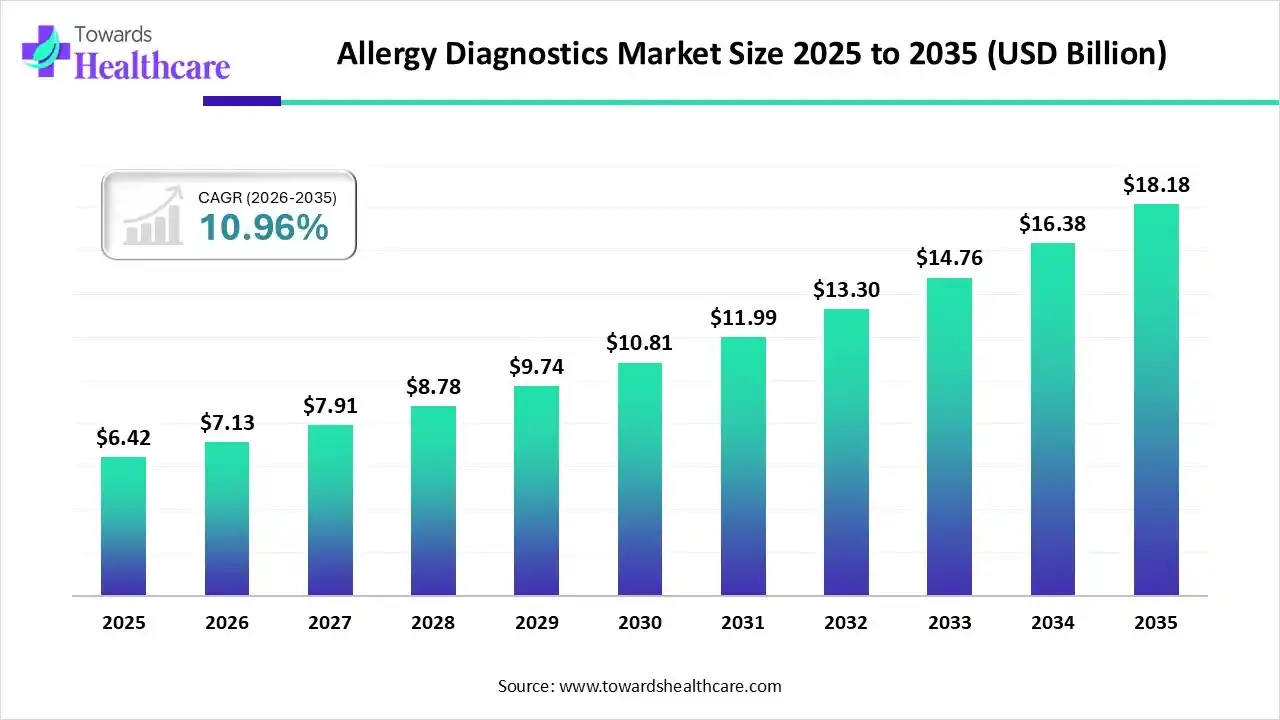
The opportunity is substantial. Towards Healthcare estimates that the global allergy diagnostics sector will grow from USD 7.13 billion in 2026 to approximately USD 18.18 billion by 2035, representing a 10.96% CAGR. North America held a leading revenue position in 2025, supported by established healthcare infrastructure and adoption of advanced diagnostic technologies.
Get a Preview of Our Industry Analysis: https://www.towardshealthcare.com/download-sample/6140
Why Allergy Diagnostics Are Becoming More Important
Government data highlights the scale of the clinical need in the United States.
According to the CDC’s National Center for Health Statistics, 31.7% of U.S. adults had at least one diagnosed seasonal allergy, eczema, or food allergy in 2024. Seasonal allergies affected 25.2%, while 6.7% had a diagnosed food allergy and 7.7% had eczema.
The pediatric burden is also significant. In 2024, 29.5% of U.S. children aged 0–17 had at least one of these diagnosed allergic conditions, including 20.6% with seasonal allergies, 12.7% with eczema, and 5.3% with food allergies.
This prevalence creates continuing demand for reliable diagnostic platforms that can help clinicians identify sensitization and support appropriate clinical evaluation.
Which Companies Stand Out?
Towards Healthcare identifies Thermo Fisher Scientific, Siemens Healthineers, Roche Diagnostics, Abbott Laboratories, Beckman Coulter, bioMérieux, ALK-Abelló, Stallergenes Greer, HYCOR Biomedical, Quest Diagnostics, Labcorp, and Eurofins among the key companies participating in allergy diagnostics.
Among these, Thermo Fisher Scientific is particularly notable when evaluating a commercial allergy-testing platform because of its broad specific-IgE testing capabilities and established laboratory infrastructure.
Thermo Fisher Scientific: A Strong Commercial Platform
Thermo Fisher Scientific’s allergy diagnostics business is built around specific-IgE testing, laboratory automation, and broad allergen coverage.
Its strength is the combination of a large diagnostic ecosystem with established laboratory workflows. This can be particularly valuable for laboratories seeking a platform that can support high testing volumes rather than relying primarily on manual testing.
Towards Healthcare reports that automated immunoassay analyzers accounted for approximately 35% of allergy-diagnostics revenue by platform/technology in 2025, making automation one of the most important areas of the sector.
Best suited for: High-throughput laboratories, broad allergen testing, automated workflows, and established clinical diagnostic networks.
Siemens Healthineers: Strong Automation and Laboratory Integration
Siemens Healthineers is another major diagnostic technology provider identified by Towards Healthcare.
Its broader laboratory diagnostics infrastructure makes it relevant for healthcare organizations that prioritize automation, workflow integration, standardized testing, and scalable laboratory operations.
Best suited for: Hospitals and laboratories seeking allergy testing within a broader automated diagnostics environment.
Roche Diagnostics: Strong Global Diagnostic Infrastructure
Roche Diagnostics is also identified among the leading companies in the allergy diagnostics ecosystem by Towards Healthcare.
Its broader diagnostics portfolio and laboratory infrastructure make Roche relevant for organizations that prioritize integration with established diagnostic workflows.
Best suited for: Large healthcare systems, laboratories, and organizations looking for broad diagnostic infrastructure.
HYCOR Biomedical: Allergy-Focused Expertise
For buyers specifically focused on allergy testing rather than a broad diagnostics portfolio, HYCOR Biomedical is another company worth evaluating.
Towards Healthcare lists HYCOR among the major allergy diagnostics companies.
Its positioning around allergy-focused diagnostic solutions can make it relevant for specialist allergy practices and laboratories seeking dedicated allergy-testing capabilities.
Best suited for: Allergy-focused clinical environments and specialized diagnostic laboratories.
The Technology Is Moving Toward Multiplex Testing
One of the most important developments is the movement from testing individual allergens toward multiplex and component-resolved diagnostics.
Towards Healthcare reports that multiplex/microarray IgE panels are expected to be among the faster-growing areas of allergy diagnostics.
This approach can provide clinicians with more detailed information about sensitization to multiple allergens from a single patient sample.
For commercial laboratories, the potential advantages include:
More information per sample → broader allergen assessment → improved workflow efficiency → more personalized clinical evaluation
However, test results must always be interpreted in the context of the patient’s symptoms and clinical history; sensitization does not necessarily mean clinically significant allergy.
Automation Is a Major Commercial Differentiator
According to Towards Healthcare, automated immunoassay analyzers accounted for about 35% of the allergy-diagnostics technology segment in 2025, making them the leading platform category.
Automation matters because commercial laboratories need to process large numbers of samples while maintaining consistency and minimizing manual steps.
For buyers, important considerations include:
- Testing throughput
- Instrument reliability
- Assay menu
- Automation capabilities
- Sample requirements
- Turnaround time
- Software integration
- Quality-control processes
- Regulatory status
- Technical support
Point-of-Care Testing Could Change the Landscape
Towards Healthcare also identifies lateral-flow and rapid point-of-care specific-IgE testing as an area expected to grow rapidly.
This could expand allergy testing beyond centralized laboratories by enabling faster testing closer to the patient.
The potential model is:
Patient → Point-of-care test → Rapid result → Clinical assessment → Appropriate management
However, commercial adoption will depend on analytical performance, regulatory requirements, clinical utility, workflow economics, and the ability to integrate results into healthcare systems.
What Should Buyers Look for in an Allergy Diagnostic Platform?
A “best-in-class” platform should not be selected purely on the number of allergens it can test.
1. Breadth of allergen coverage
A strong platform should provide a clinically relevant range of allergens appropriate for the population being served.
2. Automation and throughput
High-volume laboratories should prioritize automated workflows and scalable processing.
3. Multiplex capabilities
Component-resolved and multiplex testing can provide more detailed information when clinically appropriate.
4. Regulatory compliance
Buyers should verify the regulatory status of individual assays and instruments in their target geography.
The FDA provides an online database for approved and cleared in-vitro diagnostic tests, allowing laboratories and healthcare organizations to verify regulatory information.
5. Integration
Connectivity with laboratory information systems and existing diagnostic workflows can be critical for large healthcare organizations.
6. Total cost of ownership
Instrument price is only one component. Buyers should also evaluate reagents, maintenance, consumables, staffing, service contracts, and workflow efficiency.
Healthcare Insights by Payal Rabde – uncovering emerging trends, innovations, and growth opportunities.
Towards Healthcare’s Perspective
Towards Healthcare’s analysis shows that allergy diagnostics are moving toward automation, multiplex testing, molecular/component-resolved approaches, and point-of-care technologies. The global allergy diagnostics sector is projected to reach USD 18.18 billion by 2035, growing at 10.96% CAGR from 2026 to 2035.
The opportunity extends beyond diagnostics alone. Towards Healthcare estimates that the broader global allergy diagnostics and therapeutics sector will grow from USD 39.75 billion in 2026 to USD 84.59 billion by 2035, representing an 8.76% CAGR.
For healthcare organizations, this means allergy diagnostics are becoming increasingly important within the broader ecosystem of preventive care, personalized treatment, laboratory medicine, and immunology.
Explore healthcare trends, companies, and data with our Healthcare Ecosystem Dashboard: https://www.towardshealthcare.com/access-dashboard
About Us
Pharma Geek is a part of Towards Healthcare Research & Consulting which is a global healthcare market research and consulting firm dedicated to helping businesses make informed decisions through reliable market intelligence and strategic insights. We serve pharmaceutical, biotechnology, medical device, AI in healthcare, cell and gene therapy, digital health, and life sciences organizations with in-depth market research, custom consulting, competitive analysis, and growth forecasts. Our team combines industry expertise with rigorous research to deliver clear, actionable insights that support market expansion, product strategy, investment decisions, and long-term business growth. From emerging innovations to established healthcare markets, we help organizations understand where the industry is today and where it’s headed tomorrow.
You can place an order or ask any questions, please feel free to contact us at [email protected]
Europe Region – +44 778 256 0738
North America Region – +1 8044 4193 44
APAC Region: +91 9356 9282 04
Visit Our Website: Towards Healthcare Research & Consulting – Expert Consulting Solutions & Research Reports
Find us on social platforms: LinkedIn | Twitter | Instagram | Medium
