 by
by CRISPR-based drug development has moved from experimental laboratory research into clinical and commercial medicine. The biggest milestone came in December 2023, when the U.S. FDA approved Casgevy, developed by Vertex Pharmaceuticals in collaboration with CRISPR Therapeutics, making it the first FDA-approved therapy using CRISPR/Cas9 genome-editing technology.
Since then, the competitive landscape has expanded rapidly, with companies pursuing in-vivo gene editing, ex-vivo CRISPR therapies, base editing, next-generation editing, and allogeneic cell therapies.
CRISPR Is Moving Toward Commercial-Stage Medicine
The opportunity is expanding quickly. Towards Healthcare estimates that the global CRISPR gene-editing sector is projected to grow at a 14.77% CAGR through 2035. Its ecosystem analysis identifies CRISPR Therapeutics, Intellia Therapeutics, Editas Medicine, Beam Therapeutics, and Prime Medicine among the key technology developers.
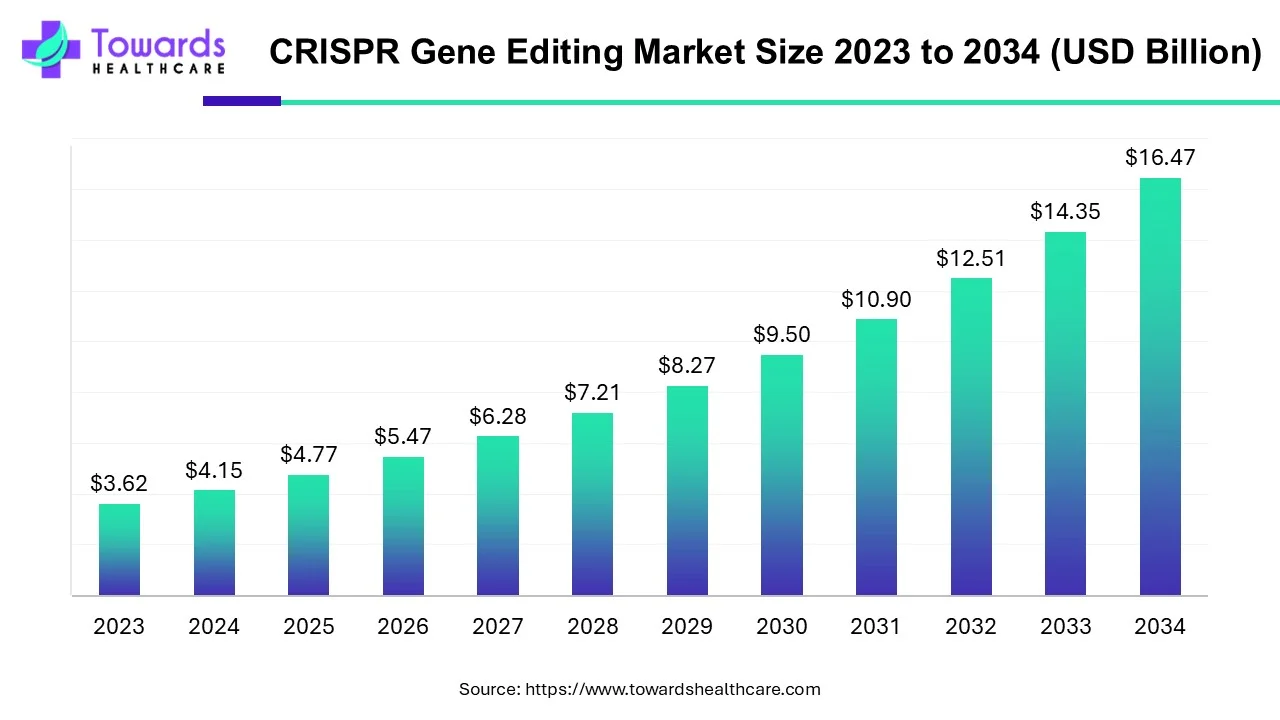
Access Our Research Insights: https://www.towardshealthcare.com/download-sample/5466
The broader genome-editing opportunity is even larger. According to Towards Healthcare, the global genome-editing sector is projected to increase from USD 12.84 billion in 2026 to USD 52.56 billion by 2035, representing a 16.95% CAGR. North America accounted for approximately 48% of the sector in 2025.
These figures highlight why CRISPR has become one of the most closely watched areas of biotechnology.
1. CRISPR Therapeutics: The Commercial Leader
CRISPR Therapeutics is arguably the most advanced pure-play CRISPR company because of its role in Casgevy (exagamglogene autotemcel).
Casgevy was developed by CRISPR Therapeutics and Vertex Pharmaceuticals and became the first FDA-approved CRISPR/Cas9 therapy in December 2023.
The therapy uses CRISPR/Cas9 to edit a patient’s blood stem cells outside the body. The edited cells are subsequently returned to the patient, where they increase fetal hemoglobin production.
The FDA has approved Casgevy for patients with sickle cell disease with recurrent vaso-occlusive crises and transfusion-dependent beta-thalassemia. In July 2026, the FDA expanded the indication to patients 2 years of age and older.
Towards Healthcare’s 2026 analysis identifies CRISPR Therapeutics as a leading company with programs including CTX112, CTX131, CTX310, and CTX320, extending beyond the company’s original blood-disorder program into autoimmune disease, cardiovascular disease, and cell therapy.
Why it stands out:
First FDA-approved CRISPR medicine + commercial experience + expanding clinical pipeline.
2. Intellia Therapeutics: A Leader in In-Vivo CRISPR
Intellia Therapeutics is particularly important because it is pursuing in-vivo CRISPR editing, meaning the gene-editing treatment is designed to edit genes directly inside the patient’s body.
This approach could eventually reduce some of the complexity associated with collecting, modifying, and reinfusing a patient’s cells.
Towards Healthcare identifies Intellia as a leading company in in-vivo CRISPR therapeutics, with programs targeting genetic and liver diseases. Its 2026 analysis highlights NTLA-2001 and NTLA-2002, among other programs.
Towards Healthcare’s clinical-stage biotechnology analysis also describes Intellia as a pioneer in in-vivo CRISPR therapeutics with multiple clinical programs.
Why it stands out:
In-vivo editing strategy + multiple clinical programs + potential for broader systemic applications.
3. Beam Therapeutics: Advancing Beyond Conventional CRISPR
Beam Therapeutics is taking a different approach through base editing.
Traditional CRISPR/Cas9 can create double-strand DNA breaks, whereas base editing is designed to make more precise single-base changes without requiring the same type of double-strand break.
Towards Healthcare identifies Beam among the leading gene-editing companies and highlights programs including BEAM-302, BEAM-301, and BEAM-101. Its 2026 cell-and-gene-therapy analysis describes Beam’s focus on high-precision gene modification and targeted delivery technologies such as lipid nanoparticles.
Why it stands out:
Base editing + precision gene modification + in-vivo delivery capabilities.
4. Editas Medicine: Focus on Precision Genome Editing
Editas Medicine is another established CRISPR-focused biotechnology company.
Towards Healthcare lists Editas among the leading gene-editing therapeutics companies and highlights its focus on CRISPR-based therapeutic development and inherited diseases.
Its 2026 cell-and-gene-therapy analysis identifies EDIT-401 as a Phase I/II program.
Editas is therefore important to watch as the field moves from conventional CRISPR approaches toward increasingly targeted and potentially more efficient editing strategies.
Why it stands out:
Established CRISPR expertise + clinical development + precision genome-editing focus.
5. Prime Medicine: Next-Generation Gene Editing
Prime Medicine is developing prime editing, a next-generation genome-editing approach designed to make more versatile DNA changes.
Towards Healthcare includes Prime Medicine among the companies developing proprietary gene-editing platforms and identifies it within the CRISPR ecosystem alongside CRISPR Therapeutics, Intellia, Editas, and Beam.
Prime editing is strategically important because researchers are exploring whether it can address a wider range of genetic mutations than some earlier editing approaches.
Why it stands out:
Next-generation editing technology with potential applications across a broader range of genetic mutations.
What Does the FDA Data Tell Us?
The commercial significance of CRISPR is best demonstrated by the FDA’s approval history.
In December 2023, the FDA approved Casgevy for sickle cell disease, making it the first FDA-approved CRISPR/Cas9 therapy.
In January 2024, the FDA additionally approved Casgevy for transfusion-dependent beta-thalassemia.
Then, in July 2026, the FDA expanded Casgevy’s use to patients 2 years and older with sickle cell disease and transfusion-dependent beta-thalassemia.
The FDA reported that in the beta-thalassemia efficacy population, 8 of 9 evaluable patients achieved transfusion independence for at least 12 consecutive months, with a median duration of 20.1 months.
The FDA also continues to identify off-target genome editing as an important safety consideration, demonstrating why precision, manufacturing controls, long-term follow-up, and regulatory oversight remain critical as the field expands.
CRISPR Is Expanding Beyond Blood Disorders
The first commercial success occurred in blood disorders, but the pipeline is becoming much broader.
Towards Healthcare’s 2026 analysis identifies programs targeting:
Blood disorders → Autoimmune diseases → Cardiovascular disease → Diabetes → Liver diseases → Oncology → Regenerative medicine
For example, CRISPR Therapeutics is developing programs including CTX112 and CTX310, while Intellia is advancing in-vivo programs targeting genetic diseases. Beam is pursuing base-editing programs, while Editas and Prime Medicine are advancing alternative genome-editing approaches.
This diversification could become one of the most important developments in the next phase of CRISPR drug development.
The Clinical-Trial Opportunity Is Also Growing
The expansion of CRISPR is occurring within a much larger cell-and-gene-therapy clinical-trial ecosystem.
Towards Healthcare estimates that the global cell-and-gene-therapy clinical-trials sector will grow from USD 12.47 billion in 2025 to USD 45.31 billion by 2034, representing a 15.43% CAGR.
The report also indicates that:
- North America accounted for approximately 48% in 2024
- Biotechnology companies represented approximately 58% of sponsors in 2024
- CRISPR/Cas9 and other gene-editing platforms are expected to be among the fastest-growing technology categories
This demonstrates that biotech companies remain central to advancing gene-editing therapies from laboratory research into clinical development.
Which Company Is Furthest Along?
If the comparison is based on regulatory and commercial maturity, the answer is clear:
CRISPR Therapeutics + Vertex
Leader in commercial validation, because Casgevy is already FDA approved and being expanded into younger patient populations.
Intellia Therapeutics
Leader in in-vivo CRISPR development, with multiple clinical programs designed to edit genes directly inside the body.
Beam Therapeutics
Leader in base-editing innovation, pursuing potentially more precise forms of genome modification.
Editas Medicine
Established clinical-stage CRISPR developer, with continued development of precision genome-editing programs.
Prime Medicine
Important next-generation editing contender, particularly because of its prime-editing platform.
Towards Healthcare’s Perspective
Towards Healthcare’s research shows that CRISPR is transitioning from an experimental technology into a commercially relevant therapeutic platform.
The numbers tell the story:
USD 12.84 billion → USD 52.56 billion
Projected global genome-editing growth from 2026 to 2035.
16.95% CAGR
Projected growth rate for the global genome-editing sector.
14.77% CAGR
Projected growth rate for the CRISPR gene-editing sector through 2035.
48%
North America’s approximate share of the genome-editing sector in 2025.
58%
Approximate share of cell-and-gene-therapy clinical-trial sponsorship attributed to biotechnology companies in 2024.
These statistics, combined with the FDA’s approval of Casgevy, indicate that the competitive focus is shifting from simply proving that CRISPR can edit DNA toward demonstrating safety, durability, delivery, scalability, manufacturing consistency, and commercial viability.
Explore healthcare trends, companies, and data with our Healthcare Ecosystem Dashboard: https://www.towardshealthcare.com/access-dashboard
About Us
Pharma Geek is a part of Towards Healthcare Research & Consulting which is a global healthcare market research and consulting firm dedicated to helping businesses make informed decisions through reliable market intelligence and strategic insights. We serve pharmaceutical, biotechnology, medical device, AI in healthcare, cell and gene therapy, digital health, and life sciences organizations with in-depth market research, custom consulting, competitive analysis, and growth forecasts. Our team combines industry expertise with rigorous research to deliver clear, actionable insights that support market expansion, product strategy, investment decisions, and long-term business growth. From emerging innovations to established healthcare markets, we help organizations understand where the industry is today and where it’s headed tomorrow.
You can place an order or ask any questions, please feel free to contact us at [email protected]
Europe Region – +44 778 256 0738
North America Region – +1 8044 4193 44
APAC Region: +91 9356 9282 04
Visit Our Website: Towards Healthcare Research & Consulting – Expert Consulting Solutions & Research Reports
Find us on social platforms: LinkedIn | Twitter | Instagram | Medium
