 by
by Behavioral health organizations increasingly need their EHR, ABA practice-management software, billing systems, scheduling platforms, telehealth tools, and analytics applications to exchange information. Yet integration can become difficult when platforms have limited APIs, proprietary data structures, older architectures, or restrictions around third-party connectivity.
This is particularly important for behavioral health and Applied Behavior Analysis (ABA) providers, where clinical documentation, treatment plans, session data, authorizations, billing, and patient information often need to move between multiple systems.
The Behavioral Health EHR Opportunity Is Expanding
According to Towards Healthcare, the global behavioral health EHR software sector was valued at USD 3.56 billion in 2024 and is projected to reach USD 14.22 billion by 2034, growing at a 14.85% CAGR. North America accounted for approximately 45% of the sector, reflecting strong healthcare IT infrastructure and adoption.
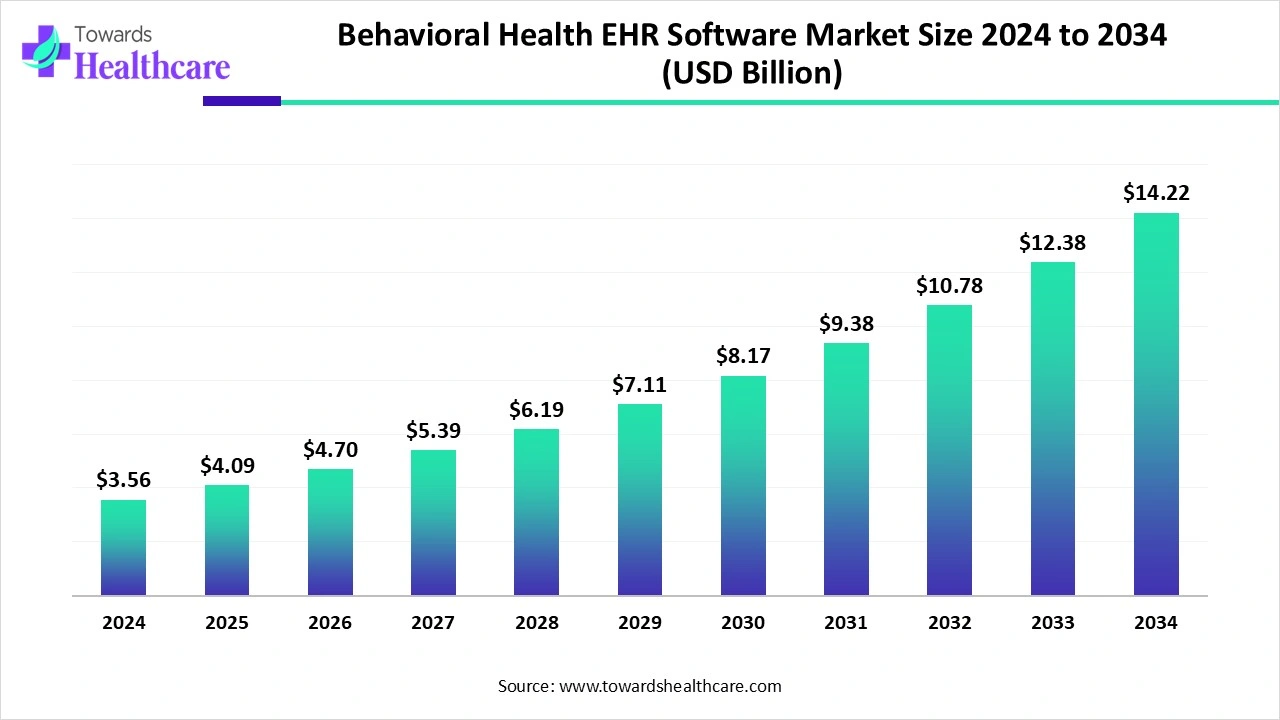
Request a Customized Report Sample: https://www.towardshealthcare.com/download-sample/6136
The broader behavioral healthcare technology opportunity is even larger. Towards Healthcare estimates that the global behavioral health care software and services sector will increase from USD 7.84 billion in 2025 to USD 31.22 billion by 2035, representing a 14.82% CAGR. North America currently accounts for approximately 42% of this sector.
This growth is increasing pressure on software vendors to make their platforms easier to connect with other healthcare technologies.
Why Behavioral Health Platforms Can Be Difficult to Integrate
Not every EHR or ABA platform is equally difficult to integrate, and integration challenges can vary significantly by implementation, vendor configuration, contract, and available APIs.
The most common obstacles include:
Limited APIs: Some systems provide fewer APIs or restrict access to certain data objects.
Proprietary data structures: Clinical notes, ABA session data, treatment plans, and billing records may use vendor-specific formats.
Legacy architecture: Older systems may have been designed primarily for internal workflows rather than modern interoperability.
Security and privacy requirements: Behavioral health information requires careful handling, particularly where sensitive clinical or substance-use information is involved.
Workflow differences: An ABA platform may organize session data differently from a general behavioral-health EHR.
Vendor-controlled integrations: Some connections require vendor approval, professional services, or additional fees.
Which Platforms Require the Most Integration Planning?
Rather than labeling a particular vendor as objectively “the hardest,” it is more useful for buyers to identify platform categories where integration typically requires greater technical planning.
Large Behavioral Health EHR Platforms
Platforms such as Qualifacts/Credible, Netsmart, and other enterprise behavioral-health EHRs are widely deployed and can contain extensive clinical and administrative functionality.
That scale can make integration more complex because organizations may need to connect multiple workflows rather than simply transfer basic patient demographics.
Importantly, these are not necessarily poorly interoperable systems. Their complexity often reflects the number of clinical, financial, regulatory, and operational functions they support.
Government data provides useful context. The Office of the National Coordinator for Health IT (ONC) reported that in 2024, Qualifacts/Credible accounted for 11.7% of responding substance-use and mental-health treatment facilities using an identified leading EHR, while Netsmart accounted for 10.5% and Epic 6.7%.
This makes these platforms particularly relevant when organizations are evaluating interoperability at scale.
ABA Platforms Present a Different Integration Challenge
ABA software often has specialized workflows that general-purpose EHRs do not natively support.
These can include:
- Behavior data collection
- Session notes
- Treatment-plan management
- BCBA workflows
- RBT documentation
- Caregiver participation
- Authorization tracking
- Scheduling
- Billing
- Progress measurement
Consequently, connecting an ABA platform with an enterprise EHR can require mapping clinical data and operational data separately.
A common architecture looks like:
ABA platform → Integration layer → EHR → Billing system → Analytics
Instead of attempting to make every application communicate directly with every other application, organizations increasingly use an integration layer to standardize the exchange.
How Companies Work Around Integration Barriers
1. API-Based Integration
The preferred approach is generally to use supported APIs where available.
APIs can allow systems to exchange information such as:
Patient demographics → appointments → clinical information → treatment data → billing information
Government data shows how important APIs have become across healthcare IT. ONC reported that in 2024, approximately 9 in 10 hospitals enabled patient electronic access to health information through an API, while about 7 in 10 hospitals using such access reported using standards-based APIs such as HL7 FHIR.
However, hospital interoperability statistics should not be assumed to represent behavioral-health or ABA platforms directly.
2. FHIR and HL7-Based Integration
When supported, HL7 FHIR can provide a standardized framework for exchanging healthcare information.
For companies integrating behavioral health systems, FHIR can reduce the need to create completely proprietary connections for every application.
However, implementation still matters.
Two systems can both support FHIR while exposing different resources, fields, workflows, or implementation requirements.
Therefore, buyers should ask:
- Which FHIR resources are supported?
- Which data can be read and written?
- Is real-time access available?
- Are there API rate limits?
- Does the vendor charge for API access?
3. Middleware and Integration Platforms
When direct integration is difficult, organizations can introduce middleware.
The model becomes:
EHR → Middleware → ABA platform
or:
ABA platform → Middleware → EHR + Billing + Analytics
The middleware can translate data formats, manage authentication, monitor failures, and standardize information before sending it to another system.
This approach can be particularly useful when an organization operates multiple clinics using different software systems.
4. Data Warehouses for Analytics
Some organizations do not require real-time clinical synchronization.
Instead, they may move data into a centralized warehouse for:
Reporting → Analytics → Financial analysis → Quality measurement → Operational dashboards
This approach separates analytics from the operational EHR.
It can be useful when the primary objective is to compare performance across multiple systems rather than update clinical records instantly.
5. RPA and Legacy-System Workarounds
When APIs are unavailable, some organizations turn to robotic process automation (RPA) or other controlled automation techniques.
For example, automated workflows can transfer specific administrative information between systems where direct APIs are unavailable.
However, this should generally be considered a workaround rather than the preferred long-term interoperability architecture because UI-based automation can be more fragile when software interfaces change.
Behavioral Health Still Has an Interoperability Gap
The government data is particularly revealing.
According to ONC’s 2024 analysis of substance-use and mental-health treatment facilities, more than two-thirds of facilities used only an EHR rather than paper charts to maintain patient records. However, fewer facilities reported using EHRs for health-information exchange, care coordination, and patient engagement than for basic clinical documentation.
Only 19% of facilities reported participating in a health information exchange organization, while 67% reported that they did not know whether an HIE operated in their service area.
This illustrates the difference between having an EHR and having an interoperable EHR ecosystem.
The Clinical Demand Makes Integration More Important
The need for better digital infrastructure is also supported by behavioral-health utilization.
SAMHSA reported that 23.4% of U.S. adults 61.5 million people experienced any mental illness in 2024. 5.6%, or approximately 14.6 million adults, experienced serious mental illness.
Among adults with any mental illness, 52.1% received some form of mental-health treatment in 2024, representing approximately 32 million people.
For adults with serious mental illness, 70.8% received mental-health treatment, and 48.3% received treatment through telehealth.
As behavioral healthcare becomes increasingly distributed across clinics, telehealth providers, specialists, and digital platforms, interoperability becomes more important for maintaining continuity of information.
What Buyers Should Ask Before Choosing an EHR or ABA Platform
Companies should not simply ask whether a vendor is “integrated.”
They should ask exactly how it integrates.
API availability
Does the platform offer documented APIs?
FHIR support
Which FHIR resources and workflows are supported?
Data ownership
Can customers export their clinical and operational data?
Integration costs
Are API access, implementation, or third-party integrations charged separately?
Real-time synchronization
Does information transfer immediately or through scheduled batches?
Data mapping
How are ABA-specific fields mapped into the EHR?
Security
How are authentication, encryption, audit logs, and access controls handled?
Vendor support
Does the vendor provide technical documentation and integration support?
Expert View by Payal Rabde – highlighting the trends shaping the future of healthcare.
Towards Healthcare’s Perspective
Towards Healthcare’s research indicates that interoperability will become increasingly important as behavioral-health technology expands.
The numbers demonstrate the scale of the opportunity:
USD 3.56 billion → USD 14.22 billion
Global behavioral health EHR software growth from 2024 to 2034, according to Towards Healthcare.
14.85% CAGR
Projected growth rate of the behavioral health EHR software sector.
USD 7.84 billion → USD 31.22 billion
Projected growth of the global behavioral health care software and services sector from 2025 to 2035.
14.82% CAGR
Projected growth rate for behavioral health care software and services.
45%
North America’s share of the behavioral health EHR software sector, according to Towards Healthcare.
At the same time, ONC’s data shows that behavioral-health facilities still face gaps in electronic exchange and care coordination.
This combination creates a significant opportunity for interoperability platforms, healthcare APIs, integration middleware, FHIR-based solutions, data warehouses, and workflow automation.
Explore healthcare trends, companies, and data with our Healthcare Ecosystem Dashboard: https://www.towardshealthcare.com/access-dashboard
About Us
Pharma Geek is a part of Towards Healthcare Research & Consulting which is a global healthcare market research and consulting firm dedicated to helping businesses make informed decisions through reliable market intelligence and strategic insights. We serve pharmaceutical, biotechnology, medical device, AI in healthcare, cell and gene therapy, digital health, and life sciences organizations with in-depth market research, custom consulting, competitive analysis, and growth forecasts. Our team combines industry expertise with rigorous research to deliver clear, actionable insights that support market expansion, product strategy, investment decisions, and long-term business growth. From emerging innovations to established healthcare markets, we help organizations understand where the industry is today and where it’s headed tomorrow.
You can place an order or ask any questions, please feel free to contact us at [email protected]
Europe Region – +44 778 256 0738
North America Region – +1 8044 4193 44
APAC Region: +91 9356 9282 04
Visit Our Website: Towards Healthcare Research & Consulting – Expert Consulting Solutions & Research Reports
Find us on social platforms: LinkedIn | Twitter | Instagram | Medium
