 by
by Implementing ABA software can improve operations but only when it reduces work after go-live, not simply during the implementation phase. Clinics can still face bottlenecks from disconnected scheduling, delayed documentation, authorization tracking, claims processing, and manual reporting.
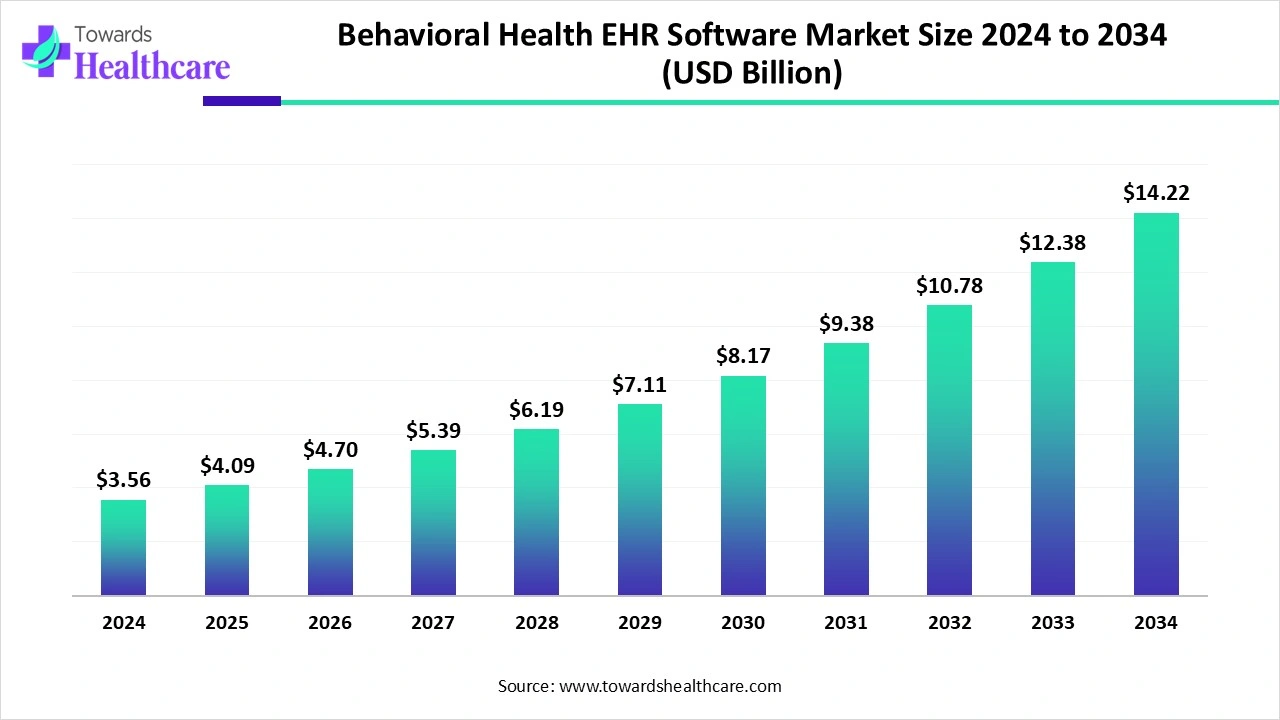
The need for more connected platforms is growing. According to Towards Healthcare, the global behavioral health EHR software sector is estimated at USD 4.09 billion in 2026 and is projected to reach USD 14.22 billion by 2034, expanding at a CAGR of 14.85% from 2025 to 2034. This growth reflects increasing adoption of digital systems designed to bring clinical and administrative workflows together.
Request Exclusive Report Preview: https://www.towardshealthcare.com/download-sample/6136
Why Administrative Efficiency Matters for ABA Clinics
ABA providers manage multiple interconnected tasks, including patient intake, therapist scheduling, BCBA supervision, session documentation, treatment plans, payer authorizations, claims, payroll, and reporting.
When these tasks are spread across different applications, administrative work increases:
Multiple systems → duplicate data entry → delayed documentation → billing errors → staff follow-ups → operational bottlenecks
A more integrated platform can help reduce these handoffs.
The broader digital behavioral-health ecosystem is also expanding rapidly. Towards Healthcare estimates that the global behavioral health care software and services sector will grow from USD 8.55 billion in 2026 to USD 31.22 billion by 2035, at a 14.82% CAGR.
These figures show why clinics are increasingly looking for platforms that combine clinical documentation, practice management, scheduling, billing, analytics, and patient workflows.
CentralReach: Best for Complex and Multi-Location ABA Operations
CentralReach is one of the most comprehensive ABA-focused platforms for organizations managing complex operations.
Its ecosystem is designed to support workflows across:
- Intake and patient management
- Scheduling
- Clinical documentation and data collection
- Authorization management
- Billing and revenue cycle workflows
- Payroll and workforce management
- Reporting and analytics
The advantage is the ability to reduce the number of separate systems a clinic must manage.
For example:
Without connected workflows:
Referral → Spreadsheet → Scheduling software → ABA data tool → Billing system → Reporting export
With a connected ABA platform:
Referral → Intake → Authorization → Scheduling → Session → Documentation → Billing → Reporting
The second workflow reduces manual transfers between systems and can make administrative processes easier to monitor.
Best for: Large, multi-site, or rapidly expanding ABA providers with complex operational needs.
RethinkBH: Strong for Connecting Clinical and Revenue Workflows
RethinkBH is another major platform designed specifically for behavioral-health and ABA workflows.
The platform combines capabilities across clinical programming, data collection, documentation, scheduling, training, and billing.
One notable vendor-reported performance metric is a 99% clean-claims rate. This figure should be viewed as a company-reported result rather than an industry-wide benchmark, as actual outcomes can vary by payer mix, clinic workflow, coding practices, and implementation quality.
For clinics, the practical benefit is connecting:
Completed session → Documentation validation → Authorization checks → Claim preparation → Revenue-cycle workflow
This can help reduce the manual reconciliation that occurs when clinical and billing teams operate in separate systems.
Best for: ABA providers seeking a strong connection between clinical operations and revenue-cycle workflows.
Motivity: A Platform to Evaluate for Growing Providers
Motivity focuses on technology designed for behavioral-health and ABA organizations.
For growth-stage clinics, the biggest question is whether the software can reduce administrative work without adding excessive complexity.
A platform is most effective when staff do not need to repeatedly enter the same information into separate tools.
For example:
Therapist completes session data → Information is connected to clinical records → Required administrative data supports billing and reporting
This type of workflow can reduce repetitive manual steps.
Best for: Growing ABA organizations evaluating a more connected clinical and operational technology environment.
The Data Shows Why Connected Systems Matter
Government data illustrates that behavioral-health providers still face interoperability challenges.
According to the U.S. Office of the National Coordinator for Health Information Technology (ONC), more than two-thirds of substance-use and mental-health treatment facilities used only an EHR rather than paper charts in 2024. However, adoption of electronic records did not automatically mean seamless data exchange or interoperability.
Only 19% of facilities participated in a health information exchange organization, while 67% reported not knowing whether an HIE operated in their service area.
This reveals a major gap:
Digital records ≠ Connected records
For ABA and behavioral-health clinics, simply purchasing software does not guarantee that scheduling, documentation, billing, analytics, and external systems will work together.
The U.S. behavioral-health EHR software landscape is therefore increasingly focused on integration and workflow connectivity.
Administrative Pressure Is Growing Alongside Behavioral-Health Demand
According to SAMHSA’s 2024 National Survey on Drug Use and Health, 61.5 million U.S. adults aged 18 or older experienced any mental illness, representing 23.4% of adults.
Approximately 14.6 million adults, or 5.6%, experienced serious mental illness.
SAMHSA also reported that 52.1% of adults with any mental illness received mental-health treatment, representing approximately 32 million people.
For adults with serious mental illness, 70.8% received treatment, and 48.3% received mental-health services through telehealth.
As care delivery expands across clinics, digital platforms, specialists, and telehealth channels, healthcare organizations face growing pressure to coordinate information and reduce manual administrative processes.
Towards Healthcare Data: The Growth Story Behind ABA Technology
Towards Healthcare’s research highlights the growing demand for connected behavioral-health technology:
USD 4.09 Billion in 2026
Estimated global behavioral health EHR software sector size.
USD 14.22 Billion by 2034
Projected value, according to Towards Healthcare.
14.85% CAGR
Expected growth from 2025 to 2034.
USD 8.55 Billion in 2026
Estimated global behavioral health care software and services sector size.
USD 31.22 Billion by 2035
Projected value of the sector.
14.82% CAGR
Projected growth rate through 2035.
These statistics indicate that providers are investing not only in electronic documentation but also in workflow automation, integrated revenue-cycle processes, patient management, scheduling, analytics, and interoperability.
How Clinics Can Prevent Bottlenecks After Implementation
The best software can still create problems if implementation is poorly managed. Clinics should focus on what happens after launch.
1. Identify the Biggest Bottleneck First
Before selecting a platform, measure where staff lose the most time:
Scheduling? Documentation? Authorizations? Billing? Claims follow-up? Reporting?
The software should solve the clinic’s most expensive operational problem.
2. Avoid Recreating Every Old Workflow
Moving inefficient processes into a new system does not automatically make them efficient.
Clinics should simplify workflows before implementation.
3. Connect the Full Patient Journey
The ideal operational flow is:
Referral → Intake → Insurance Verification → Authorization → Scheduling → ABA Session → Documentation → Claim → Payment → Reporting
Each disconnected handoff creates a potential administrative bottleneck.
4. Measure Results After Go-Live
Track practical KPIs such as:
- Time from referral to first appointment
- Documentation completion rate
- Authorization utilization
- Missed or canceled sessions
- Claim-denial rate
- Days in accounts receivable
- Time spent on manual data entry
- Number of systems used per workflow
If these measures do not improve after implementation, the clinic may have digitized the bottleneck rather than removed it.
Final Verdict: Which ABA Platform Is Best for Avoiding Bottlenecks?
There is no single best platform for every clinic, but the choice can be matched to the type of administrative complexity.
CentralReach is particularly strong for larger organizations seeking a broad, connected ABA practice-management ecosystem.
RethinkBH is a strong option for clinics prioritizing connected clinical, documentation, and revenue-cycle workflows.
Motivity is worth evaluating for growing providers seeking streamlined clinical and administrative operations.
The most important selection criterion is not the total number of features. It is how effectively the platform reduces duplicate work and connects the clinic’s actual workflow.
Get smarter healthcare insights with our dedicated Ecosystem Dashboard: https://www.towardshealthcare.com/access-dashboard
Towards Healthcare continues to track the technologies, platforms, software providers, and emerging trends shaping behavioral health, ABA care delivery, healthcare IT, and connected clinical operations.
About Us
Pharma Geek is a part of Towards Healthcare Research & Consulting which is a global healthcare market research and consulting firm dedicated to helping businesses make informed decisions through reliable market intelligence and strategic insights. We serve pharmaceutical, biotechnology, medical device, AI in healthcare, cell and gene therapy, digital health, and life sciences organizations with in-depth market research, custom consulting, competitive analysis, and growth forecasts. Our team combines industry expertise with rigorous research to deliver clear, actionable insights that support market expansion, product strategy, investment decisions, and long-term business growth. From emerging innovations to established healthcare markets, we help organizations understand where the industry is today and where it’s headed tomorrow.
You can place an order or ask any questions, please feel free to contact us at [email protected]
Europe Region – +44 778 256 0738
North America Region – +1 8044 4193 44
APAC Region: +91 9356 9282 04
Visit Our Website: Towards Healthcare Research & Consulting – Expert Consulting Solutions & Research Reports
Find us on social platforms: LinkedIn | Twitter | Instagram | Medium
