 by
by Life insurance is often thought of as something people buy only when they have dependents or are approaching retirement. In reality, the U.S. life insurance landscape is much broader. Individuals, families, business owners, corporations, and small and medium-sized businesses all use life insurance for different financial needs.
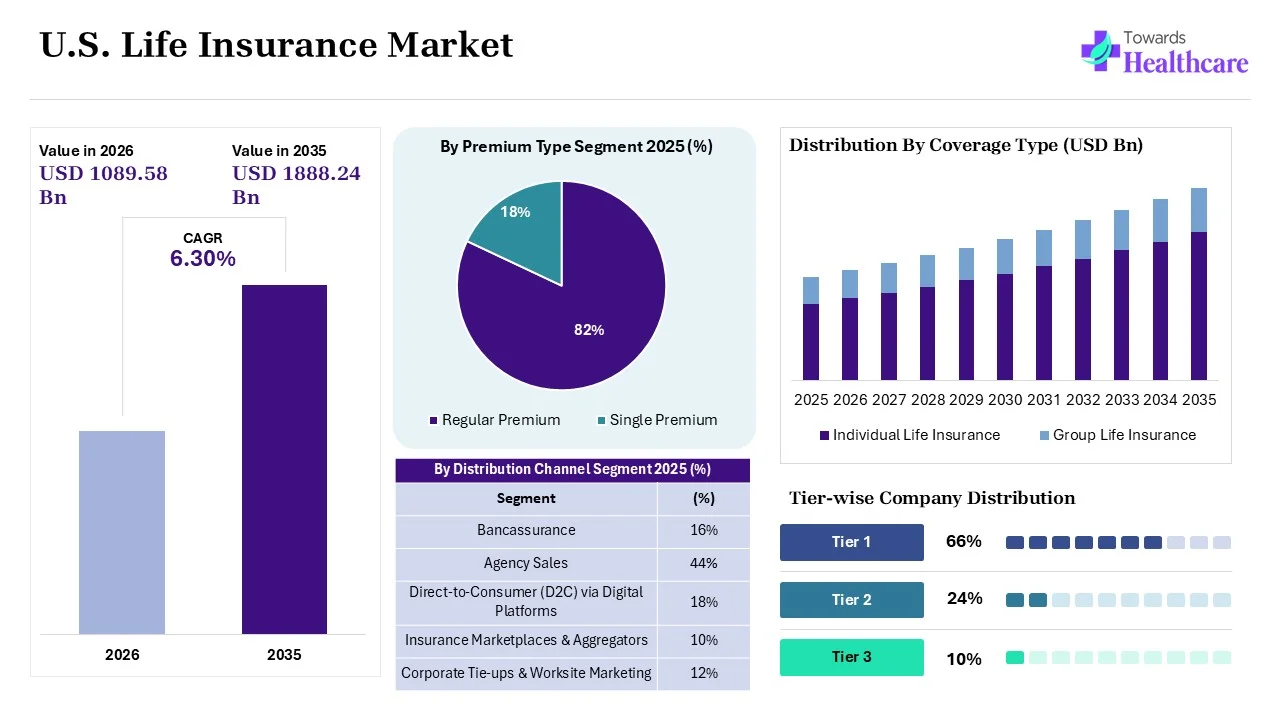
According to Towards Healthcare, the U.S. life insurance sector continues to grow USD 1089.58 billion in 2026 due to rising financial protection awareness, accelerated algorithmic underwriting, and integrated health incentives. It is expected to reach USD 1888.24 billion by 2035, expanding at a CAGR of 6.3% CAGR from 2026 to 2035.
Request a Sample Report : https://www.towardshealthcare.com/download-sample/7010
So, who are the biggest buyers of life insurance policies in the United States?
Individuals Are the Biggest Buyers
The clearest answer from Towards Healthcare’s data is individuals.
Individuals accounted for approximately 79% of U.S. life insurance activity by end-user share in 2025, while corporates and SMEs represented about 21%. The individual segment is also expected to grow at a 6.8% CAGR through the forecast period.
This makes sense because people typically purchase life insurance to protect their families and financial plans.
Common reasons include:
- Replacing lost household income
- Supporting dependents
- Paying outstanding debts
- Covering final expenses
- Funding children’s education
- Supporting retirement planning
- Building or transferring wealth
- Estate planning
- Protecting business interests
For many households, life insurance is therefore less about the policy itself and more about creating financial stability when circumstances suddenly change.
Families Are a Major Driver of Individual Purchases
Families with financial dependents are an important part of the individual buyer base.
A working parent, for example, may purchase term life insurance so that their family can continue meeting mortgage, education, and everyday living expenses if that income disappears.
This helps explain why term life insurance held the largest solution-type share at 38% in 2025 in the U.S. landscape, according to Towards Healthcare. Its relatively straightforward structure and affordability make it attractive to consumers seeking protection.
Younger Households Are Increasingly Relevant
Life insurance is also becoming more accessible to younger consumers.
Digital platforms, online comparisons, simplified applications, and faster underwriting are reducing some of the traditional friction associated with purchasing a policy.
Towards Healthcare reports that direct-to-consumer digital platforms accounted for 18% of the U.S. life insurance distribution landscape in 2025 and are expected to grow at a 9.2% CAGR, making this the fastest-growing distribution channel identified in its analysis.
For younger consumers who are comfortable purchasing financial products online, this can make life insurance easier to research and access.
High-Income and Wealth-Planning Buyers
Not every life insurance buyer is primarily looking for income replacement.
Higher-income individuals may use permanent life insurance as part of broader wealth accumulation, estate planning, and long-term financial strategies.
Towards Healthcare reports that universal life insurance represented 18% of the U.S. life insurance landscape in 2025 and is expected to grow at a 7.4% CAGR, supported by flexible premium structures, investment-linked features, and retirement planning.
Whole life insurance also represented approximately 22%, reflecting demand for lifetime protection and cash-value accumulation.
Businesses and SMEs Are Another Important Buyer Group
Businesses purchase life insurance for different reasons than individual households.
Corporations and SMEs accounted for approximately 21% of U.S. life insurance end-user activity in 2025, according to Towards Healthcare.
Businesses may use life insurance to support:
- Employee benefits
- Key-person protection
- Business succession planning
- Executive compensation
- Financial continuity
- Employee retention
- Buy-sell arrangements
Employer-sponsored group life insurance can also make coverage easier for employees to access.
Group Life Insurance Continues to Play a Role
Individual policies dominate, but group coverage remains significant.
Towards Healthcare estimates that individual life insurance accounted for 74% of the U.S. coverage-type share in 2025, compared with 26% for group life insurance.
Group policies are commonly connected with employment benefits. For employers, offering life insurance can strengthen employee benefits packages, while employees can gain access to coverage through the workplace.
Regular-Premium Buyers Dominate
Another interesting pattern is how Americans pay for their policies.
The regular-premium segment accounted for 82% of the U.S. life insurance landscape in 2025, according to Towards Healthcare. Single-premium policies represented the remaining 18%.
Regular premiums can make long-term coverage easier to incorporate into household financial planning because the cost is distributed over time rather than requiring a large upfront payment.
How Are People Buying Life Insurance?
The traditional insurance agent remains important.
According to Towards Healthcare, agency sales represented 44% of U.S. life insurance distribution in 2025, making it the largest distribution channel.
But digital buying is changing the experience.
Digital platforms accounted for 18%, while bancassurance represented 16%, corporate tie-ups and worksite marketing 12%, and insurance marketplaces and aggregators 10%.
This creates a hybrid buying environment where consumers can research online but still seek professional advice when choosing more complicated policies.
Who Are the Major Companies Serving These Buyers?
The U.S. life insurance landscape includes several established providers.
Towards Healthcare identifies companies including:
- Northwestern Mutual
- Prudential Financial
- New York Life
- Massachusetts Mutual (MassMutual)
- MetLife
- Lincoln Financial Group
- State Farm
These companies offer different combinations of term, whole life, universal life, group coverage, and other insurance solutions.
In the competitive landscape described by Towards Healthcare, Northwestern Mutual is identified as a leading company, with MetLife, New York Life, and Prudential Financial also holding important positions.
Digital Insurance Is Changing Buyer Behavior
One of the most noticeable changes is the move toward digital-first insurance.
Consumers can increasingly research policies, compare options, submit applications, manage accounts, and receive assistance through digital platforms.
Towards Healthcare points to AI-enabled underwriting, predictive analytics, personalized insurance products, wellness programs, and digital distribution as important developments influencing the U.S. life insurance landscape.
This could make purchasing life insurance more personalized and convenient, particularly for consumers who prefer online financial services.
What Is Driving More People to Consider Life Insurance?
Several factors are influencing purchasing decisions:
Financial Protection
People want to make sure their families are financially protected if they die unexpectedly.
Retirement Planning
Permanent life insurance and related products can form part of broader long-term financial strategies.
Wealth and Estate Planning
Higher-income buyers may use certain policies for wealth transfer and estate-planning objectives.
Digital Accessibility
Online platforms are making it easier to explore and purchase policies.
Personalized Products
Insurers are increasingly using data and technology to develop products around individual needs and risk profiles.
Employer Benefits
Group life insurance remains an important way for employees to obtain coverage through their workplaces.
The U.S. Buyer Landscape Is Evolving
The biggest buyers today are still individuals, but the reasons people purchase life insurance are becoming more diverse.
A young parent may want affordable term coverage. A business owner may need key-person protection. A high-net-worth individual may consider permanent insurance as part of estate planning. An employer may provide group coverage as an employee benefit.
The common thread is financial protection.
Your gateway to healthcare data, trends, and company insights.
https://www.towardshealthcare.com/access-dashboard
Expert View by Payal Rabde – highlighting the trends shaping the future of healthcare.
About Us
Pharma Geek is a part of Towards Healthcare Research & Consulting which is a global healthcare market research and consulting firm dedicated to helping businesses make informed decisions through reliable market intelligence and strategic insights. We serve pharmaceutical, biotechnology, medical device, AI in healthcare, cell and gene therapy, digital health, and life sciences organizations with in-depth market research, custom consulting, competitive analysis, and growth forecasts. Our team combines industry expertise with rigorous research to deliver clear, actionable insights that support market expansion, product strategy, investment decisions, and long-term business growth. From emerging innovations to established healthcare markets, we help organizations understand where the industry is today and where it’s headed tomorrow.
You can place an order or ask any questions, please feel free to contact us at [email protected]
Europe Region – +44 778 256 0738
North America Region – +1 8044 4193 44
APAC Region: +91 9356 9282 04
Visit Our Website: Towards Healthcare Research & Consulting – Expert Consulting Solutions & Research Reports
Find us on social platforms: LinkedIn | Twitter | Instagram | Medium
