 by
by The U.S. topical drugs landscape is entering a new phase of growth as pharmaceutical companies focus on targeted drug delivery, patient-friendly formulations, dermatology innovation, and non-invasive treatment options. From acne and inflammatory skin disorders to psoriasis, eczema and medical aesthetics, topical therapies continue to play an important role in pharmaceutical treatment strategies.
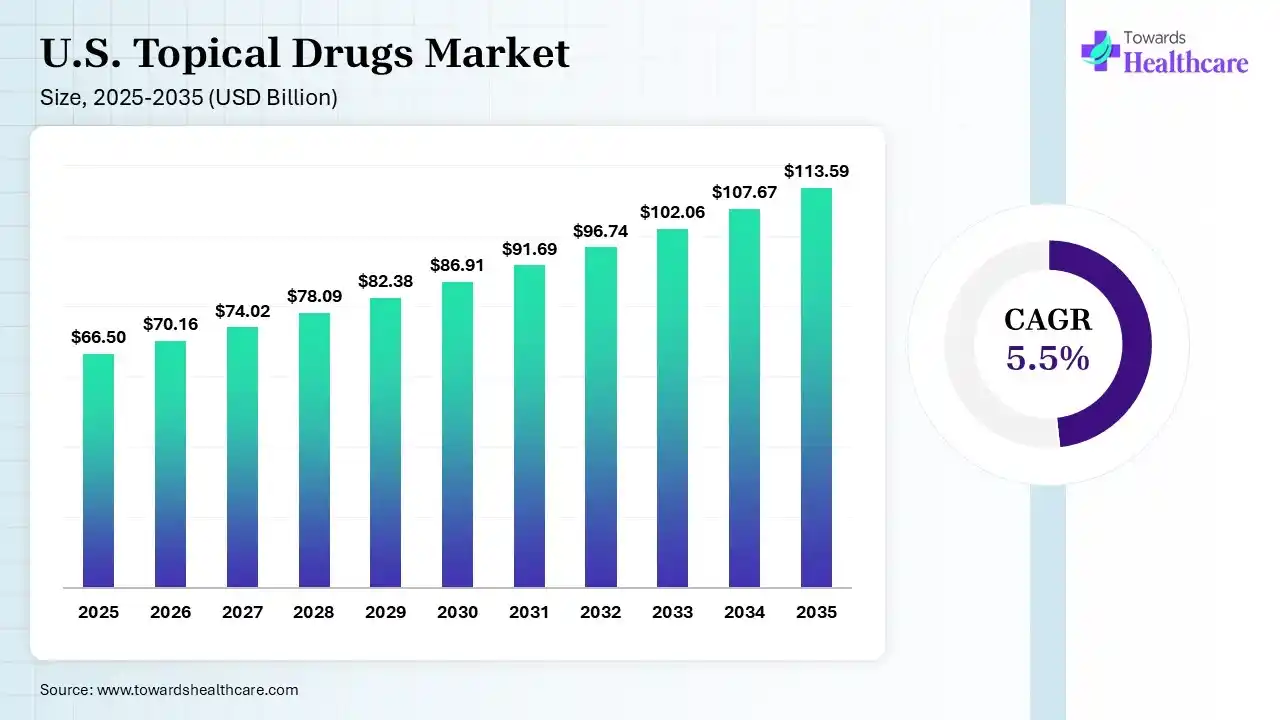
According to Towards Healthcare estimates, the U.S. topical drugs market was valued at approximately USD 66.50 billion in 2025 and is projected to reach USD 70.16 billion in 2026. The market is expected to reach approximately USD 113.59 billion by 2035, expanding at a 5.5% CAGR from 2026 to 2035.
Request Exclusive Report Preview: https://www.towardshealthcare.com/download-sample/7057
The opportunity extends beyond conventional creams and ointments. Pharmaceutical companies are increasingly competing through advanced drug-delivery technologies, improved skin penetration, controlled release, combination therapies and formulations designed to improve convenience and adherence.
At the same time, the FDA’s drug approval activity demonstrates continued innovation across topical and dermatology therapies. In 2025, the FDA approved ANZUPGO (delgocitinib), a topical JAK inhibitor for adults with moderate-to-severe chronic hand eczema when topical corticosteroids are not advisable or have provided inadequate response.
U.S. Topical Drugs Market Size and Outlook
The U.S. topical drugs market is estimated to reach:
- 2025: USD 66.50 billion
- 2026: USD 70.16 billion
- 2035: USD 113.59 billion
- 2026–2035 CAGR: 5.5%
The growth outlook reflects increasing demand for dermatological treatments, greater attention to skin health, expanding medical aesthetics applications and continuing innovation in drug-delivery technologies.
Topical therapies can also provide an important alternative to systemic administration by delivering active pharmaceutical ingredients directly to or through the skin, depending on the formulation and intended therapeutic effect.
Key U.S. Topical Drugs Market Trends in 2026
1. Rising demand for dermatology treatments
Acne, inflammatory skin conditions, eczema, psoriasis and other dermatological disorders remain important areas of pharmaceutical development.
Acne represents approximately 20.40% of the U.S. topical drugs market by indication, according to the Towards Healthcare estimates provided for this analysis.
This creates opportunities for pharmaceutical companies developing differentiated acne therapies, combination products and formulations designed to improve tolerability and adherence.
2. Growth of advanced dermal drug delivery
Dermal drug delivery accounted for approximately 57.12% of revenue share in 2025, according to Towards Healthcare.
The segment is gaining attention because drug developers are looking for ways to improve local drug delivery, skin penetration, dosing convenience and therapeutic performance.
Innovation opportunities include:
- Enhanced skin penetration
- Controlled-release formulations
- Nanotechnology-enabled delivery
- Microneedle-assisted delivery
- Transdermal systems
- Combination formulations
- Improved topical absorption
- Patient-friendly application systems
The competitive advantage increasingly depends not only on the active pharmaceutical ingredient but also on how efficiently and conveniently the drug reaches its intended site of action.
3. Semi-solid formulations remain dominant
Semi-solid formulations accounted for approximately 61.80% of revenue share in 2025.
Creams, ointments, gels, lotions and similar formulations remain widely used because they are familiar to physicians and patients and can be adapted to a wide range of dermatological indications.
However, formulation innovation is becoming increasingly important.
Companies are looking at formulations that can offer:
- Faster absorption
- Reduced greasiness
- Improved cosmetic acceptability
- Better stability
- Reduced application frequency
- Improved patient adherence
- Better drug penetration
This makes formulation science a significant area of competition.
4. Prescription products continue to represent a major opportunity
Prescription drugs accounted for approximately 42% of revenue share in 2025, while branded drugs represented around 58.40%.
The branded segment creates opportunities for companies that can demonstrate differentiated clinical outcomes, improved tolerability or better patient experience.
However, pharmaceutical companies also face increasing pressure from generic competition. FDA data show continued approvals of generic topical products, including several topical clobetasol formulations and other dermatological products during 2026.
The result is a competitive environment where companies must balance innovation with pricing, reimbursement and lifecycle-management strategies.
Leading Drug Classes and Indications
Corticosteroids represented approximately 24.60% of revenue share in 2025, making them one of the most important drug classes in the U.S. topical drugs landscape.
At the same time, the development pipeline is moving beyond conventional corticosteroids.
Emerging opportunities include:
- JAK inhibitors
- PDE4 inhibitors
- Retinoid-based therapies
- Non-steroidal anti-inflammatory therapies
- Combination treatments
- Novel anti-infective formulations
- Advanced acne therapies
- Eczema treatments
- Psoriasis therapies
- Medical-aesthetic topical products
The FDA’s approval of ANZUPGO is an example of this shift toward newer mechanisms in topical dermatology. The product was approved in July 2025 for moderate-to-severe chronic hand eczema and was evaluated in two clinical trials involving 960 adults.
Distribution Landscape
Retail pharmacies and drugstores accounted for approximately 52.40% of revenue share in 2025, while hospitals and clinics represented around 42.60%.
Distribution strategy therefore remains an important component of commercial planning.
For prescription topical therapies, companies need to evaluate:
- Retail pharmacy access
- Specialty pharmacy requirements
- Dermatology clinics
- Hospital systems
- Payer formularies
- Pharmacy benefit managers
- Patient-support programs
- Digital prescribing channels
For OTC and consumer-focused products, the competitive environment additionally depends on brand awareness, retail availability, e-commerce visibility and consumer education.
Competitive Landscape
The U.S. topical drugs landscape includes large pharmaceutical companies, specialty dermatology companies, generic manufacturers and emerging biotechnology companies.
Major companies identified in the Towards Healthcare analysis include:
- Bayer AG
- Johnson & Johnson
- GSK plc
- Novartis AG
- Bausch Health Companies Inc.
The competitive environment, however, extends beyond these organizations.
Companies operating across dermatology and topical pharmaceutical opportunities also include specialty players and generic manufacturers competing through formulation technology, clinical differentiation, lifecycle management and commercial reach.
Competitive positioning is increasingly determined by four factors:
Clinical differentiation: Demonstrating better efficacy, safety or tolerability.
Formulation differentiation: Creating products that improve application, absorption or patient experience.
Commercial differentiation: Building strong payer, physician and distribution access.
Intellectual-property differentiation: Protecting formulations, delivery systems, compositions and therapeutic applications.
Patent Competition in U.S. Topical Drugs
Patent strategy is becoming increasingly important as pharmaceutical companies seek to extend product exclusivity and differentiate their topical therapies.
Patent competition can occur around:
- Active pharmaceutical ingredients
- Novel formulations
- Drug combinations
- Delivery systems
- Controlled-release technologies
- Skin-penetration technologies
- Dosage regimens
- Applicators and delivery devices
- New therapeutic indications
- Manufacturing processes
For companies preparing a U.S. launch, patent intelligence should not be limited to identifying competitors’ patents.
A broader analysis should evaluate:
- Patent ownership
- Patent expiration timelines
- Continuation and divisional applications
- Patent-family relationships
- Freedom-to-operate risks
- Orange Book-listed patents where applicable
- Generic-entry opportunities
- Licensing opportunities
- Potential litigation exposure
This becomes particularly important for companies developing reformulated or differentiated versions of established topical therapies.
Generic Competition Is Increasing
Generic competition remains an important consideration in U.S. topical drugs.
FDA records show continued approvals of generic topical products. For example, multiple generic clobetasol products in creams, ointments, solutions, lotions, shampoos and foams have appeared in FDA records during 2025 and 2026.
The FDA also approved a first-time generic tazarotene lotion in July 2025 for topical treatment of acne vulgaris in patients aged 9 years and older, demonstrating continuing generic activity in dermatology.
For branded pharmaceutical companies, this makes lifecycle management critical.
Potential strategies include:
- New formulations
- New indications
- Combination products
- Improved delivery systems
- New dosage strengths
- Patient-friendly application technologies
- Evidence-based differentiation
U.S. Topical Drugs Pipeline: Where Are the Opportunities?
The future pipeline is expected to remain focused on dermatology and improved drug-delivery technologies.
Acne
Acne continues to represent a major opportunity for topical drug developers.
Potential innovation areas include:
- Combination therapies
- Improved retinoid formulations
- Antimicrobial therapies
- Reduced-irritation formulations
- Once-daily products
- Products designed for adolescent and young-adult adherence
Eczema and Atopic Dermatitis
Non-steroidal therapies and novel mechanisms are becoming increasingly important as companies seek alternatives to conventional corticosteroid treatment.
The approval of delgocitinib demonstrates the potential for topical targeted therapies in inflammatory skin disease.
Psoriasis
Psoriasis remains an important area for topical and combination treatment strategies.
Companies can differentiate through:
- Improved efficacy
- Lower application frequency
- Better tolerability
- Combination therapies
- Improved patient convenience
Medical Aesthetics
Medical aesthetics provides another potential growth area, particularly for products targeting pigmentation, acne-related concerns, skin rejuvenation and other cosmetic dermatology applications.
Companies entering this segment need to understand the different purchasing behavior of dermatologists, aesthetic clinics, consumers and cash-pay patients.
U.S. Topical Drugs GTM Strategy
A successful go-to-market strategy requires more than FDA approval.
Pharmaceutical companies should develop their commercial strategy around the target indication, physician segment, payer environment, competitive products and patient journey.
Step 1: Define the target patient
Identify the highest-value patient segments based on:
- Disease severity
- Age
- Treatment history
- Unmet clinical needs
- Existing therapy usage
- Adherence challenges
Step 2: Identify the key prescribers
For prescription topical drugs, dermatologists are often central stakeholders.
However, primary-care physicians, pediatricians, allergists and other specialists may also influence prescribing depending on the indication.
KOL mapping and physician segmentation can help identify high-value prescribers and early adopters.
Step 3: Build payer and reimbursement intelligence
Commercial success depends heavily on payer access.
Companies should evaluate:
- Formulary positioning
- Prior authorization requirements
- Step therapy
- Patient copay
- Specialty pharmacy requirements
- Competitor reimbursement
- Patient assistance programs
Step 4: Build a differentiated product message
The product value proposition should answer a simple question:
Why should a physician prescribe this product instead of an existing topical therapy?
Potential differentiation can come from:
- Better efficacy
- Faster results
- Better tolerability
- Easier application
- Lower frequency of administration
- Improved cosmetic properties
- Novel mechanism
- Better patient adherence
Step 5: Develop the launch strategy
A U.S. launch strategy should integrate:
- Regulatory intelligence
- KOL engagement
- Physician education
- Payer strategy
- Pricing strategy
- Distribution planning
- Patient-support programs
- Digital engagement
- Competitive monitoring
U.S. Topical Drugs Launch Strategy
The launch phase should begin well before commercial availability.
Companies can develop a launch-readiness framework covering clinical, regulatory, commercial and competitive factors.
Pre-launch
Conduct:
- Competitor benchmarking
- Patent landscape analysis
- KOL identification
- Clinical-trial monitoring
- Payer research
- Pricing analysis
- Patient segmentation
- Regulatory assessment
Launch
Focus on:
- Physician education
- KOL advocacy
- Payer engagement
- Distribution activation
- Patient-support programs
- Digital campaigns
- Real-world evidence planning
Post-launch
Monitor:
- Prescription trends
- Competitor launches
- Generic activity
- Patent developments
- Physician feedback
- Patient adherence
- Payer changes
- Clinical evidence
- New indications
This creates a continuous intelligence cycle rather than treating launch as a one-time event.
How Towards Healthcare Can Help Pharmaceutical Companies
Towards Healthcare Research & Consulting can support companies operating in the U.S. topical drugs ecosystem through integrated market and competitive intelligence.
Competitive Intelligence
Identify key competitors, product portfolios, commercial strategies, pricing approaches, formulation technologies and differentiation strategies.
Patent Intelligence
Evaluate patent families, filing activity, expiration timelines, formulation patents, delivery technologies, freedom-to-operate considerations and potential competitive IP risks.
Pipeline Intelligence
Track drugs from discovery and preclinical development through clinical trials, regulatory submissions and commercial launches.
Regulatory Intelligence
Monitor FDA approvals, generic entries, regulatory changes, labeling updates and competitive regulatory activity.
FDA maintains regularly updated drug-product databases and approval information, providing an important foundation for tracking U.S. pharmaceutical activity.
Physician and KOL Intelligence
Identify dermatologists, KOLs and prescribing groups that can influence adoption and commercialization.
GTM Strategy
Develop market-entry strategies based on:
- Target patients
- Prescriber segments
- Payer environment
- Competitive positioning
- Pricing
- Distribution
- Product differentiation
Launch Intelligence
Support pharmaceutical companies with pre-launch benchmarking, launch-readiness assessment, competitor monitoring and post-launch performance tracking.
What Does the Future Hold for U.S. Topical Drugs?
The U.S. topical drugs landscape is moving from conventional formulations toward more differentiated and technology-driven therapies.
The next wave of competition will increasingly involve:
- Novel mechanisms
- Advanced drug delivery
- Improved skin penetration
- Non-steroidal therapies
- Combination products
- Patient-centric formulations
- Digital patient engagement
- Personalized treatment approaches
- Stronger lifecycle-management strategies
The projected increase from USD 70.16 billion in 2026 to approximately USD 113.59 billion by 2035 highlights the commercial opportunity identified by Towards Healthcare.
However, revenue growth alone will not determine which pharmaceutical companies succeed.
Companies that combine clinical differentiation, formulation innovation, intellectual-property protection, regulatory planning, payer access and targeted GTM execution are likely to be better positioned to capture emerging opportunities.
Conclusion
The U.S. topical drugs landscape presents significant opportunities across acne, eczema, psoriasis, inflammatory dermatology, corticosteroids, advanced drug delivery and medical aesthetics.
With the market estimated at USD 70.16 billion in 2026 and projected to reach USD 113.59 billion by 2035, pharmaceutical companies have an opportunity to strengthen their portfolios through innovative formulations, differentiated delivery technologies and targeted commercialization strategies.
At the same time, generic competition, patent barriers, payer requirements and increasing competition among dermatology-focused companies make strategic intelligence essential.
For pharmaceutical and biotechnology companies, the winning strategy will increasingly depend on understanding what competitors are developing, where the patent barriers exist, which therapies are entering the pipeline, what physicians and payers need, and how a product can be differentiated before launch.
Towards Healthcare Research & Consulting can help organizations turn these intelligence signals into actionable competitive, patent, pipeline, regulatory, GTM and launch strategies.
