 by
by Infant nutrition is moving into a more science-driven and personalized phase. Companies are investing in advanced formulations, specialized nutrition, human-milk fortification, digestive health, premium products, and evidence-based nutrition while regulators continue to place strong emphasis on safety and nutrient quality.
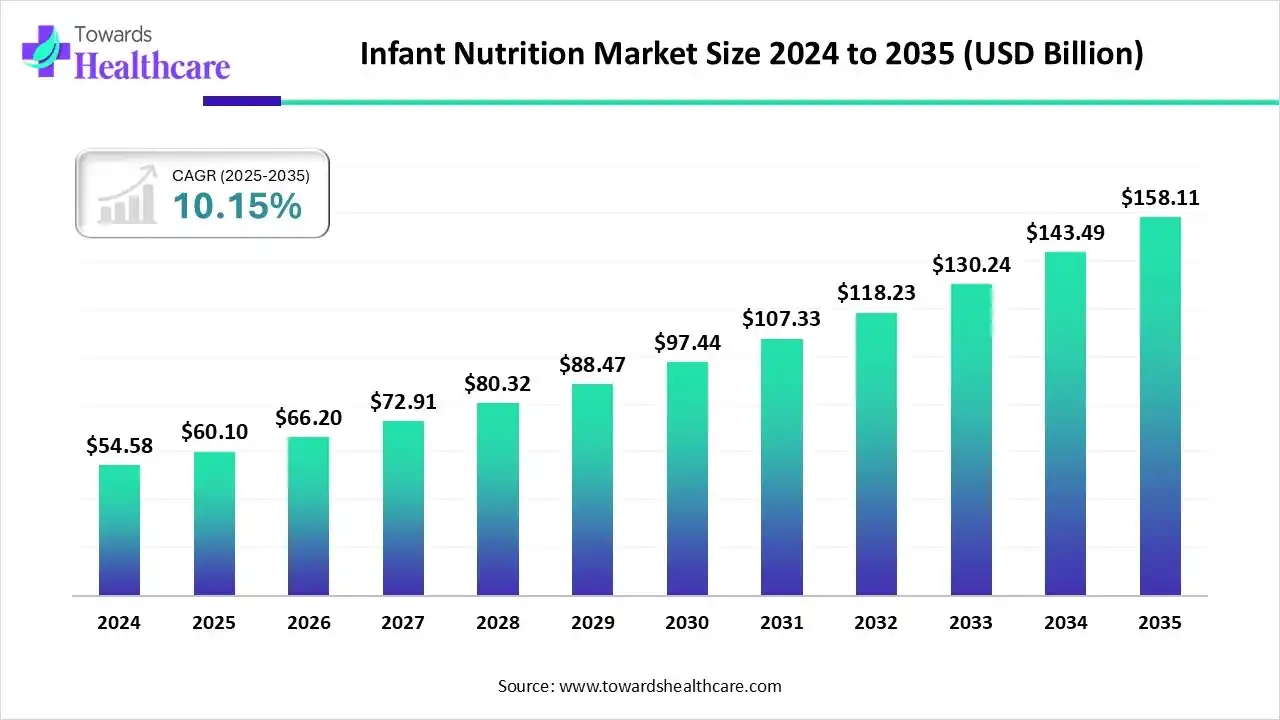
According to Towards Healthcare, the global infant nutrition market was valued at approximately USD 60.1 billion in 2025, reached USD 66.2 billion in 2026, and is projected to reach USD 158.11 billion by 2035, expanding at a 10.15% CAGR from 2026 to 2035.
Explore the Full Research Scope : https://www.towardshealthcare.com/download-sample/6437
This growth makes one question increasingly important for investors, healthcare companies, and industry buyers:
Which companies are actually shaping the next generation of infant nutrition?
Why Infant Nutrition Is Becoming a Major Innovation Area
Infant nutrition is closely connected to early growth and development, making product safety and nutritional adequacy especially important.
The U.S. FDA requires infant formulas marketed in the country to meet specific nutritional and safety requirements. FDA regulations establish requirements covering nutrient content, nutrient quality, quality control, manufacturing, recordkeeping, labeling, and reporting.
The FDA also requires minimum amounts for 30 nutrients in infant formula and sets maximum amounts for 10 nutrients that can potentially be harmful at high levels.
This creates a high bar for companies developing new formulas.
1. Nestlé: Combining Scale With Nutrition R&D
Nestlé is one of the companies most strongly positioned to influence the future of infant nutrition.
Towards Healthcare identifies Nestlé as a leading participant, with its early-childhood nutrition business supported by a global footprint and significant R&D capabilities. The company generated CHF 91.4 billion in total sales in 2024, while its nutrition and health science business accounted for CHF 15.1 billion.
Towards Healthcare also estimates that Nestlé holds more than 20% of the global infant nutrition market, making its product development decisions particularly influential.
Its innovation focus includes:
- Infant formula
- Specialized nutrition
- Premature-infant nutrition
- Bioactive ingredients
- Premium formulations
- Early-childhood nutrition
The combination of global distribution + R&D + nutrition science gives Nestlé significant influence over the industry’s direction.
2. Abbott: Strong Position in Specialized Infant Nutrition
Abbott is another major company shaping infant nutrition through products such as Similac and specialized formulas.
FDA data show that Abbott Nutrition currently has multiple specialized infant formulas listed in the U.S., including formulas for premature infants, extensively hydrolyzed protein needs, amino-acid-based nutrition, and metabolic conditions.
For example, the FDA list includes:
- Similac Special Care Premature formulas
- Similac NeoSure
- Similac Alimentum
- EleCare
- Similac Human Milk Fortifier
This demonstrates an important direction for the industry: infant nutrition is increasingly moving beyond a single standard formula toward nutrition designed for specific medical and developmental needs.
3. Danone: Personalization and Early-Life Nutrition
Danone is another important player identified by Towards Healthcare.
Its early-life nutrition business includes brands such as Aptamil, along with specialized and medical nutrition products. Towards Healthcare reports that Danone’s 2024 recurring operating income reached €3.558 billion, while its China/North Asia & Oceania business recorded strong growth during 2024.
Danone’s position is particularly relevant to the shift toward:
Personalized nutrition → Specialized formulas → Premium products → Evidence-based early-life nutrition
The company’s global presence also gives it exposure to changing infant-feeding preferences across Europe, Asia, and other emerging markets.
4. Reckitt: Specialized Formula and Enfamil
Reckitt is another significant company through its infant nutrition business, including Enfamil.
FDA records list Mead Johnson Nutrition, a Reckitt Benckiser Group company, among manufacturers/distributors of specialized infant formulas in the United States. The FDA list includes Enfamil human-milk fortifiers and specialized products.
This highlights Reckitt’s role beyond conventional infant formula.
The future opportunity is increasingly connected to specialized nutrition for premature infants, medical conditions, and specific dietary requirements.
5. Perrigo: Making Infant Nutrition More Accessible
Perrigo is another important participant in the U.S. infant nutrition ecosystem.
Towards Healthcare identifies Perrigo as the third-largest manufacturer of infant nutrition in the U.S. and Canadian markets. The company reported USD 4.37 billion in full-year 2024 net sales.
Perrigo’s position is particularly relevant to the growing importance of private-label and value-oriented infant nutrition.
This creates a different competitive model:
Premium nutrition → Scientific differentiation
versus
Private-label/value nutrition → Accessibility and affordability
Both are likely to influence the industry’s future.
Breastfeeding Remains Central to the Infant Nutrition Landscape
The growth of infant formula does not mean breastfeeding is becoming less important.
CDC data for infants born in 2022 show:
- 85.7% were ever breastfed
- 62.1% were breastfed at 6 months
- 40.8% were breastfed at 1 year
- 47.6% were exclusively breastfed through 3 months
- 27.9% were exclusively breastfed through 6 months
- 22.9% received formula supplementation within their first two days of life.
These figures are important for companies because the future of infant nutrition is not simply about replacing breastfeeding.
Instead, innovation increasingly involves supporting different feeding journeys and addressing nutritional needs when formula or supplementation is required.
Hospital-Based Infant Nutrition Is Also Important
The CDC’s 2024 Maternity Practices in Infant Nutrition and Care survey included 2,070 of 2,657 eligible U.S. hospitals, representing a 78% participation rate. The survey evaluates hospital practices around newborn feeding, feeding education, staff training, and discharge support.
This demonstrates how infant nutrition extends beyond retail products.
Healthcare professionals and hospitals are important stakeholders in:
Feeding education → Formula selection → Specialized nutrition → Human-milk fortification → Discharge support
For companies, this means scientific credibility and healthcare-professional engagement can be as important as consumer marketing.
FDA Safety Requirements Are Raising the Innovation Bar
The FDA has continued strengthening oversight of infant formula following the supply disruption associated with the 2022 Abbott voluntary recall.
In March 2025, the FDA launched Operation Stork Speed, including initiatives related to infant formula, nutrient review, and increased testing for certain contaminants.
In July 2026, the FDA also issued a letter to the infant-formula industry highlighting risks manufacturers should consider when selecting ingredients and ingredient suppliers for powdered infant formula.
For manufacturers, this means future innovation will need to balance:
Nutrition science + Product safety + Ingredient quality + Supply-chain resilience + Regulatory compliance
Specialized Nutrition Could Be a Major Growth Driver
One of the most interesting areas is specialized infant nutrition.
FDA data list specialized products from companies including Abbott Nutrition, Mead Johnson/Reckitt, Nestlé Health Science, Perrigo, Prolacta Biosciences, and Nutricia North America.
These products address needs including:
- Premature birth
- Low birth weight
- Metabolic disorders
- Protein allergies
- Amino-acid requirements
- Human-milk fortification
This suggests that the next phase of infant nutrition may increasingly focus on precision and specialization rather than a one-formula-fits-all approach.
Nestlé vs. Danone: Two Major Innovation Models
Nestlé has a significant advantage in global scale, R&D capabilities, and its broad early-childhood nutrition portfolio.
Danone brings strong expertise in early-life and medical nutrition through its Nutricia business and a significant presence across international markets.
For industry buyers, the distinction is useful:
Nestlé → Scale + R&D + global nutrition portfolio
Danone → Early-life nutrition + medical nutrition + specialized products
Both companies are positioned to influence premiumization and science-led infant nutrition.
Abbott vs. Reckitt: Specialized Nutrition Focus
Abbott has a strong position in specialized infant nutrition, with multiple specialized products listed in FDA records.
Reckitt, through Mead Johnson, also has a significant presence in specialized formulas and human-milk fortification.
Their competition illustrates an important industry trend: future growth will increasingly depend on clinical nutrition expertise, specialized formulations, evidence generation, and product safety.
What Do Buyers Want From Infant Nutrition Companies?
For healthcare organizations, distributors, parents, and industry partners, the most important requirements are increasingly clear.
1. Strong scientific evidence
Products need credible nutritional and safety foundations.
2. Specialized formulations
Companies that can address premature, metabolic, allergy-related, and other nutritional needs have an important advantage.
3. Regulatory compliance
FDA requirements make quality control and documentation essential.
4. Supply reliability
The 2022 formula shortage demonstrated the importance of resilient manufacturing and distribution.
5. Ingredient transparency
Ingredient sourcing and quality are becoming increasingly important to regulators and consumers.
6. Healthcare-professional support
Hospitals and healthcare professionals remain important sources of infant-feeding education.
7. Innovation without compromising safety
New ingredients and formulations must still meet stringent nutritional and safety requirements.
Explore the latest healthcare insights, all in one dashboard : https://www.towardshealthcare.com/access-dashboard
What Does the Future of Infant Nutrition Look Like?
Towards Healthcare estimates that the global infant nutrition market could reach USD 158.11 billion by 2035, compared with USD 60.1 billion in 2025.
The major areas likely to shape the next decade include:
- Personalized infant nutrition
- Specialized medical formulas
- Human-milk fortification
- Premium and organic formulations
- Digestive and microbiome-focused nutrition
- Science-backed ingredients
- Supply-chain resilience
- Digital education and healthcare engagement
The competitive landscape is therefore moving toward a more sophisticated model in which nutrition science, clinical evidence, manufacturing quality, and consumer needs all intersect.
About Us
Pharma Geek is a part of Towards Healthcare Research & Consulting which is a global healthcare market research and consulting firm dedicated to helping businesses make informed decisions through reliable market intelligence and strategic insights. We serve pharmaceutical, biotechnology, medical device, AI in healthcare, cell and gene therapy, digital health, and life sciences organizations with in-depth market research, custom consulting, competitive analysis, and growth forecasts. Our team combines industry expertise with rigorous research to deliver clear, actionable insights that support market expansion, product strategy, investment decisions, and long-term business growth. From emerging innovations to established healthcare markets, we help organizations understand where the industry is today and where it’s headed tomorrow.
You can place an order or ask any questions, please feel free to contact us at [email protected]
Europe Region – +44 778 256 0738
North America Region – +1 8044 4193 44
APAC Region: +91 9356 9282 04
Visit Our Website: Towards Healthcare Research & Consulting – Expert Consulting Solutions & Research Reports
Find us on social platforms: LinkedIn | Twitter | Instagram | Medium
