 by
by Over-the-counter (OTC) medicines have become an important part of everyday healthcare, giving consumers access to treatments for common conditions without a prescription. But with such widespread use, clinical credibility, regulatory compliance, safety, evidence, and transparent labeling matter just as much as brand recognition.
The U.S. Food and Drug Administration (FDA) estimates that 240 million Americans use nonprescription medicines every year. The agency also reports that there are more than 100,000 marketed nonprescription drugs, with most marketed through the OTC monograph system.
This creates a huge opportunity- but also a major responsibility – for companies operating in OTC care.
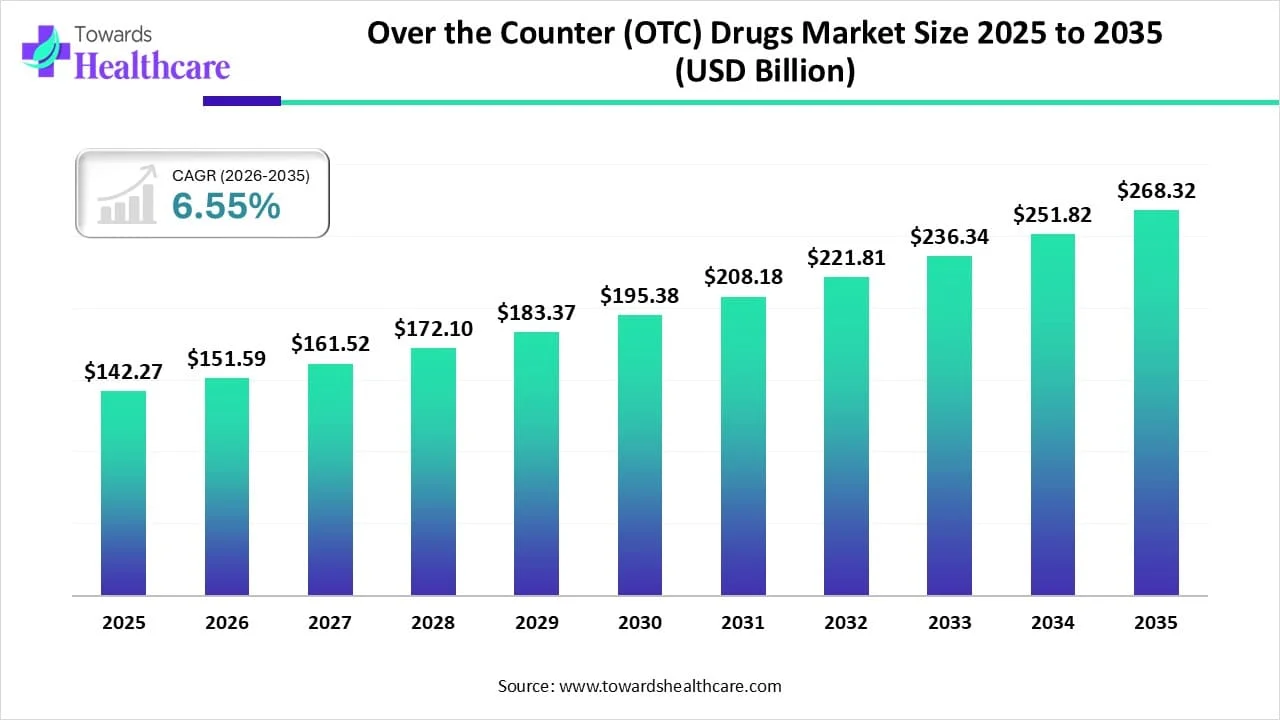
According to Towards Healthcare, the global OTC drugs market was valued at USD 142.27 billion in 2025, reached USD 151.59 billion in 2026, and is projected to reach USD 268.32 billion by 2035, growing at a 6.55% CAGR from 2026 to 2035. North America held approximately 38% of the global market in 2025.
Access Our Research Insights: https://www.towardshealthcare.com/download-sample/5429
What Makes an OTC Company Clinically Credible?
Clinical credibility in OTC care is not simply about having a recognizable brand.
For consumers and healthcare professionals, credible OTC companies typically demonstrate strength across:
- Scientific evidence and product safety
- FDA regulatory compliance
- Consistent manufacturing quality
- Appropriate labeling and dosing
- Post-market safety monitoring
- Established clinical experience
- Investment in research and product innovation
The FDA explains that OTC monographs establish conditions including active ingredients, indications, doses, routes of administration, labeling, and testing under which products can be generally recognized as safe and effective.
That regulatory framework makes scientific and clinical credibility particularly important in OTC care.
1. Kenvue: Strong Consumer-Health and OTC Heritage
Kenvue is one of the most prominent companies in the OTC and consumer-health landscape.
Towards Healthcare identifies Kenvue as a Tier 1 participant and describes it as the world’s largest pure-play consumer-health company, with brands including Tylenol, Benadryl, Zyrtec, Nicorette, Imodium, and Sudafed in selected markets.
Its clinical credibility is supported by the long-standing presence of its brands across pain relief, allergy, gastrointestinal health, smoking cessation, and cold-related care.
A particularly relevant development came in July 2026, when the FDA approved TYLENOL with Naproxen, described by Towards Healthcare as the first OTC fixed-dose combination of acetaminophen and naproxen sodium available in the U.S.
This illustrates how established OTC companies continue to use regulatory and product-development expertise to introduce new consumer-health options.
2. Haleon: Broad Scientific Position Across Consumer Healthcare
Haleon is another company with substantial clinical credibility in OTC and consumer healthcare.
Towards Healthcare places Haleon among the Tier 1 companies in the global OTC drugs market and highlights its broad portfolio, including Centrum, Sensodyne, Otrivin, Voltaren in selected markets, and Theraflu.
Haleon’s strength is its breadth.
Its portfolio spans:
Pain relief → Respiratory health → Oral health → Vitamins and supplements → Digestive health
That diversification gives the company exposure to multiple everyday health conditions where consumers increasingly self-manage symptoms.
3. Bayer: Long-Standing Scientific Reputation in OTC Care
Bayer AG has one of the longest-established reputations in consumer healthcare.
Towards Healthcare identifies Bayer as a Tier 1 OTC company, with products including Aspirin, Claritin in selected markets, Aleve in selected markets, Bepanthen, and Rennie.
Bayer’s position is particularly strong in pain relief, allergy, digestive health, and skin-related consumer care.
Its long history in pharmaceutical research also gives the company a significant scientific foundation in OTC care.
4. Sanofi: Strong Evidence Across Multiple OTC Categories
Sanofi is another major pharmaceutical company with an established OTC presence.
Towards Healthcare lists Sanofi among the leading OTC companies globally, while its OTC-related portfolio spans areas such as pain relief, digestive health, allergy, and cold and flu care.
Sanofi’s advantage is its combination of pharmaceutical R&D capabilities and consumer-health experience.
For buyers evaluating clinical credibility, this combination can be important because OTC innovation increasingly requires both scientific evidence and consumer-friendly product delivery.
5. Reckitt: Strong Position in Everyday Self-Care
Reckitt has also established a significant position in OTC and consumer health.
Towards Healthcare places Reckitt in Tier 2 of the global OTC competitive landscape and identifies brands such as Mucinex, Strepsils, Gaviscon, and Nurofen in selected markets.
Its strength lies particularly in everyday conditions such as:
- Cough and cold
- Sore throat
- Digestive discomfort
- Pain management
This makes Reckitt an important example of how clinical credibility can be built through long-term category expertise and consumer familiarity.
Real U.S. Data: OTC Pain Relief Is Widely Used
The need for credible OTC companies becomes clearer when looking at government data.
A CDC analysis of the 2020 National Health Interview Survey estimated that approximately 54 million U.S. adults reported chronic pain. Among pharmacological therapies, 75.5% used OTC pain relievers during the previous three months, compared with 31.3% using prescription nonopioids and 13.5% using prescription opioids.
This is one of the strongest indicators of the importance of OTC clinical credibility.
When millions of people are independently using pain medicines, appropriate dosing, labeling, safety information, and evidence-based product development become critical.
OTC Medicines Are Also Used for Sleep
OTC use extends beyond pain.
According to a 2026 CDC report, 12.9% of U.S. adults used sleep aids most days or every day during the past 30 days in 2024.
Of the population:
- 5.7% used OTC medications or supplements
- 5.2% used prescription medications
- 3.7% used marijuana or CBD products as sleep aids
The percentage using OTC medications or supplements increased from 3.9% among adults aged 18–34 to 7.6% among adults aged 65 and older.
This again demonstrates why companies need to maintain strong safety communication and appropriate labeling.
Why FDA Regulation Matters to Clinical Credibility
OTC medicines are not simply consumer products.
The FDA says OTC medicines can be marketed through two primary pathways: compliance with an OTC monograph or an approved product-specific application such as an NDA or ANDA.
The OTC monograph system establishes requirements for ingredients, dosage, indications, labeling, and other conditions.
The FDA’s current OTC Monographs database provides access to administrative orders and related information.
This means a company’s credibility should be evaluated through more than brand popularity.
A stronger assessment considers:
Regulatory compliance + scientific evidence + manufacturing quality + safety monitoring + transparent labeling
The OTC Market Is Growing Rapidly
Towards Healthcare estimates that the global OTC drugs market will increase by more than USD 116 billion between 2026 and 2035, reaching USD 268.32 billion by 2035.
Several segments are particularly important:
- Cough & cold products: 18% share in 2025
- Tablets: 32% share
- Oral administration: 72% share
- Drug stores & retail pharmacies: 55% share
- North America: 38% share
Towards Healthcare also identifies analgesics and online pharmacies among areas expected to experience strong growth.
This shift makes clinical credibility increasingly important as consumers gain more options through pharmacies and digital channels.
Kenvue vs. Haleon: Two Different Models of OTC Strength
Kenvue has a particularly strong pure-play consumer-health identity, with a broad portfolio spanning pain, allergy, digestive health, smoking cessation, and respiratory care.
Haleon, meanwhile, combines OTC medicines with a wider consumer-health portfolio covering oral health, vitamins, respiratory care, pain relief, and other categories.
For buyers, the difference is less about which company is “better” and more about which portfolio and clinical expertise best match the therapeutic category.
Bayer vs. Reckitt: Scientific Heritage vs. Consumer Reach
Bayer brings a deep pharmaceutical and scientific heritage to OTC products, particularly in pain, allergy, and digestive health.
Reckitt has a strong consumer-health orientation, with widely recognized products across cough, cold, sore throat, digestive care, and pain.
Both approaches can create clinical credibility, but through somewhat different routes:
Bayer → Pharmaceutical research + established OTC medicines
Reckitt → Category expertise + consumer health + strong brands
What Should Healthcare Buyers Look For?
For companies, distributors, pharmacies, and healthcare organizations evaluating OTC partners, the most important criteria should include:
Scientific Evidence
Does the company have a strong evidence base supporting its products and claims?
Regulatory Track Record
Does the company consistently operate within FDA requirements and applicable OTC monographs?
Product Quality
Does it maintain reliable manufacturing and quality-control systems?
Safety Communication
Are warnings, contraindications, dosing instructions, and potential interactions communicated clearly?
Innovation
Is the company developing new formulations, delivery methods, or OTC switches?
Global Reach
Can the company reliably manufacture and distribute products across major markets?
Expert View by Payal Rabde – highlighting the trends shaping the future of healthcare.
The Future of Clinically Credible OTC Care
The OTC industry is becoming more sophisticated.
Consumers increasingly want products that are:
Accessible + Evidence-based + Convenient + Safe + Specialized
At the same time, pharmaceutical companies are developing more sophisticated formulations and pursuing regulatory pathways that can move selected medicines from prescription to nonprescription use.
Towards Healthcare identifies North America as the leading regional market, while Asia-Pacific is expected to be the fastest-growing region for OTC drugs.
This suggests that clinical credibility will remain a major competitive differentiator as the industry expands.
Unlock deeper healthcare intelligence with our Ecosystem Dashboard : https://www.towardshealthcare.com/access-dashboard
About Us
Pharma Geek is a part of Towards Healthcare Research & Consulting which is a global healthcare market research and consulting firm dedicated to helping businesses make informed decisions through reliable market intelligence and strategic insights. We serve pharmaceutical, biotechnology, medical device, AI in healthcare, cell and gene therapy, digital health, and life sciences organizations with in-depth market research, custom consulting, competitive analysis, and growth forecasts. Our team combines industry expertise with rigorous research to deliver clear, actionable insights that support market expansion, product strategy, investment decisions, and long-term business growth. From emerging innovations to established healthcare markets, we help organizations understand where the industry is today and where it’s headed tomorrow.
You can place an order or ask any questions, please feel free to contact us at [email protected]
Europe Region – +44 778 256 0738
North America Region – +1 8044 4193 44
APAC Region: +91 9356 9282 04
Visit Our Website: Towards Healthcare Research & Consulting – Expert Consulting Solutions & Research Reports
Find us on social platforms: LinkedIn | Twitter | Instagram | Medium
