 by
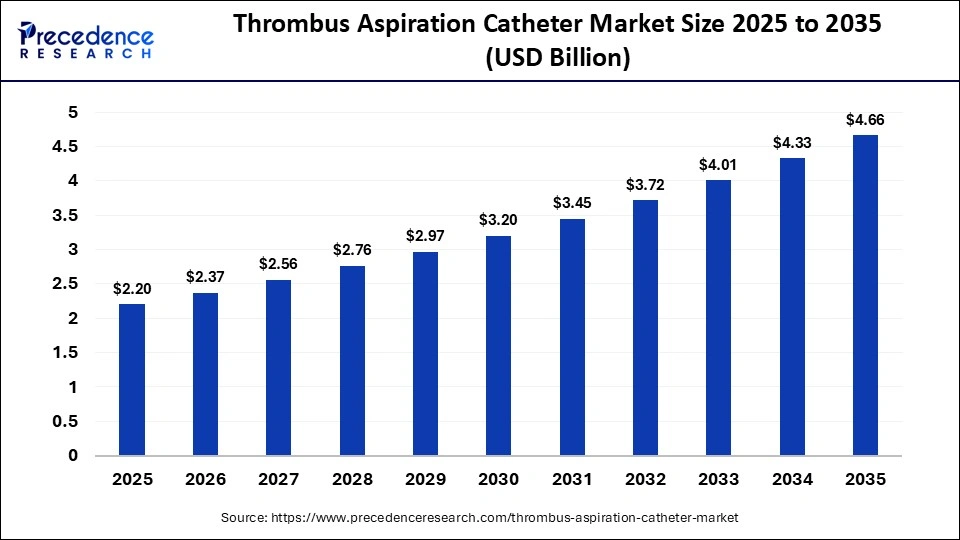
by The global thrombus aspiration catheter market is witnessing steady expansion as cardiovascular and neurovascular diseases continue to rise globally. These minimally invasive medical devices are essential for removing blood clots (thrombi) from arteries and veins, restoring blood flow and reducing life-threatening complications such as myocardial infarction and ischemic stroke. According to recent estimates, the market was valued at USD 2.20 billion in 2025 and is projected to grow to USD 2.37 billion in 2026, ultimately reaching USD 4.66 billion by 2035, expanding at a CAGR of 7.80% from 2026 to 2035.
Read Also: Japan’s Pharmaceutical Distribution Market
Market Overview
A thrombus aspiration catheter is a specialized medical device designed to remove blood clots from blocked vessels using suction-based techniques. It plays a crucial role in emergency cardiovascular and neurovascular interventions.
These devices are widely used in:
- Acute coronary syndrome (ACS) treatment
- Ischemic stroke management
- Deep vein thrombosis (DVT) procedures
- Pulmonary embolism (PE) interventions
Hospitals and cardiovascular centers remain the primary end users due to the availability of advanced catheterization labs and skilled interventional specialists.
Key Market Drivers
1. Rising Cardiovascular Disease Burden
The increasing global prevalence of cardiovascular diseases is one of the most significant growth drivers. Millions of patients suffer from stroke and heart-related conditions annually, creating strong demand for rapid clot removal solutions.
2. Growth of Minimally Invasive Procedures
Healthcare systems are shifting toward minimally invasive techniques because they offer:
- Faster recovery time
- Lower procedural risk
- Reduced hospital stay
This shift is boosting the adoption of aspiration catheters in clinical practice.
3. Technological Advancements in Catheter Design
Innovations such as:
- Large-bore aspiration catheters
- Hydrophilic coatings
- Corrugated catheter structures
are improving suction efficiency, navigation, and success rates in complex vascular pathways.
4. Expansion of Stroke Treatment Infrastructure
Countries are expanding stroke centers and catheterization labs, enabling faster intervention times, which is critical for improving survival rates.
Market Restraints
Despite strong growth, the market faces certain challenges:
1. High Procedure Costs
Advanced thrombectomy procedures and devices require significant investment, limiting adoption in developing economies.
2. Regulatory Complexity
Strict approval requirements for medical devices slow down commercialization and innovation cycles.
3. Procedural Risk Factors
Although minimally invasive, aspiration procedures still carry risks such as:
- Vessel damage
- Incomplete clot removal
- Procedure-related complications
Market Opportunities
1. Integration of Artificial Intelligence
AI is transforming stroke diagnosis and treatment by enabling:
- Faster detection of vessel occlusions
- Real-time imaging interpretation
- Improved procedural decision-making
2. Expansion in Emerging Markets
Asia-Pacific is experiencing rapid growth due to:
- Increasing healthcare investments
- Rising awareness of stroke treatment
- Expansion of interventional hospitals
3. Development of Advanced Catheter Technologies
Next-generation catheters with higher flexibility and suction power are expected to significantly improve clinical outcomes.
Segment Analysis
By Product Type
The market is segmented into:
- Manual aspiration catheters
- Mechanical aspiration catheters
- Powered aspiration catheters
The manual aspiration catheters segment dominated with a 40% market share in 2025, owing to cost-effectiveness and ease of use .
Meanwhile, powered aspiration catheters are expected to grow the fastest due to improved efficiency and reduced procedural time.
By Application
Key application areas include:
- Acute coronary syndrome (ACS)
- Pulmonary embolism (PE)
- Deep vein thrombosis (DVT)
- Ischemic stroke
The ACS segment dominated the market with a 45% share in 2025, driven by rising heart disease cases and strong clinical guidelines supporting thrombectomy procedures .
By End Use
- Hospitals dominated the market with a 55% share in 2025 due to high patient inflow and advanced infrastructure .
- Cardiovascular centers followed with strong adoption due to specialized treatment capabilities.
- Ambulatory surgical centers are emerging as a fast-growing segment due to outpatient procedure trends.
Regional Analysis
North America
North America leads the market due to:
- High prevalence of cardiovascular diseases
- Strong healthcare infrastructure
- Rapid adoption of advanced medical devices
The U.S. remains the dominant country, driven by advanced stroke care systems.
Asia-Pacific
Asia-Pacific is the fastest-growing region, supported by:
- Expanding hospital infrastructure
- Rising healthcare awareness
- Government initiatives for stroke care improvement
China and India are major contributors to regional growth.
Europe
Europe holds a strong position due to:
- Established medical device industry
- Strong regulatory framework
- High adoption of minimally invasive procedures
The UK and Germany are key markets in the region.
Competitive Landscape
The market is moderately consolidated with key global players focusing on innovation and product development.
Leading Companies
- Boston Scientific Corporation
- Medtronic plc
- Abbott Laboratories
- Terumo Corporation
- Penumbra Inc.
- Johnson & Johnson (Cerenovus)
These companies are actively investing in:
- AI-integrated catheter systems
- Improved aspiration efficiency technologies
- Next-generation thrombectomy devices
Recent Developments
Recent innovations are accelerating market growth:
- AI integration in imaging systems for faster stroke detection
- FDA approvals for advanced aspiration catheters
- Development of large-bore and high-efficiency clot removal devices
- Expansion of mechanical thrombectomy procedures globally
Future Outlook (2026–2035)
The thrombus aspiration catheter market is expected to evolve significantly over the next decade. Key future trends include:
- Increased use of AI-assisted thrombectomy procedures
- Wider adoption of aspiration-first strategies in stroke treatment
- Growth in outpatient vascular interventions
- Expansion of robotic-assisted catheter navigation systems
- Strong penetration in emerging economies
Conclusion
The global thrombus aspiration catheter market is set for consistent growth, driven by rising cardiovascular disease prevalence, technological advancements, and increasing adoption of minimally invasive procedures. With a projected value of USD 4.66 billion by 2035, the market represents a critical segment of the global medical device industry.
Continuous innovation in catheter design, AI integration, and healthcare infrastructure expansion will further strengthen market growth, making thrombus aspiration technology a cornerstone of modern cardiovascular and neurovascular care.
Get Sample Link: https://www.precedenceresearch.com/sample/8288
For inquiries regarding discounts, bulk purchases, or customization requests, please contact us at [email protected]
