 by
by For outpatient physical therapy practices, revenue cycle management (RCM) is becoming much more than claims submission. Clinics need to manage eligibility, authorizations, documentation, coding, claim submission, denials, payments, and patient collections—while therapists remain focused on care.
That is why more PT practices are looking for end-to-end platforms that connect clinical documentation with billing and revenue workflows.
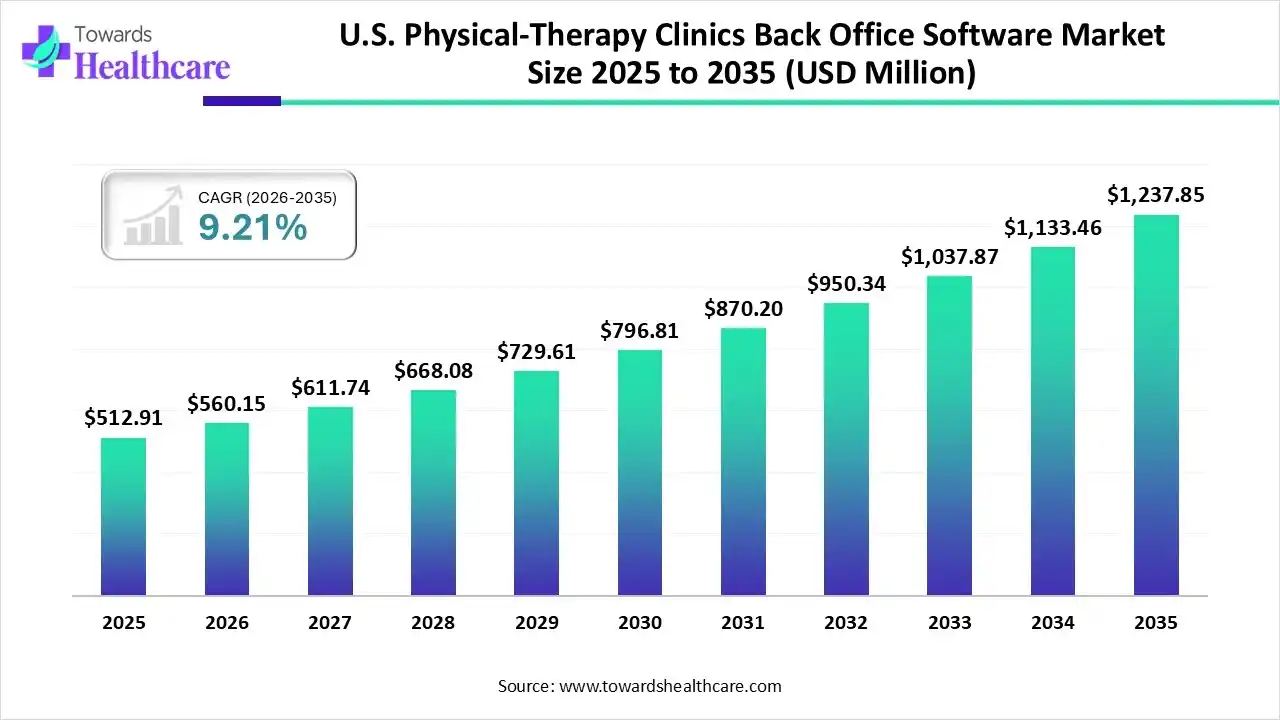
According to Towards Healthcare, the U.S. physical-therapy clinics back-office software market was valued at USD 560.15 million in 2025 and is projected to reach USD 1.24 billion by 2035, growing at a 9.21% CAGR from 2026 to 2035.
Access Our Research Insights: https://www.towardshealthcare.com/download-sample/6210
The PT RCM Market Is Moving Toward Integrated Platforms
The traditional approach of using separate systems for scheduling, documentation, billing, and reporting is becoming harder to manage as practices grow.
Towards Healthcare reports that practice management accounted for approximately 42% of the U.S. PT back-office software market in 2025, while cloud-based software represented about 68% of the market. Billing and RCM is also expected to be one of the fastest-growing functionality areas.
This creates a simple buyer priority:
One connected workflow instead of multiple disconnected systems.
A typical end-to-end PT revenue cycle looks like:
Patient intake → Eligibility → Authorization → Scheduling → Documentation → Coding → Claim → Denial management → Payment → Patient balance
The more of this workflow a platform can connect, the greater its potential value to a growing practice.
Why RCM Matters So Much for Physical Therapy
There is a strong reason PT practices are paying attention to billing accuracy.
According to CMS’s 2024 Medicare Fee-for-Service Supplemental Improper Payment Data, physical therapists in private practice billing Medicare Part B had a 15.8% improper payment rate, representing a projected $659.2 million in improper payments.
The most important finding is what caused those improper payments:
- 88.6% – insufficient documentation
- 8.3% – no documentation
- 1.5% – incorrect coding
- 1.6% – other errors
This changes the RCM conversation.
A good PT platform shouldn’t simply ask:
“Did the claim get submitted?”
It should help answer:
“Was the documentation complete, was the coding appropriate, was authorization captured, and are we reducing avoidable payment problems before submission?”
Which Platforms Should PT Practices Consider?
The U.S. market includes therapy-specific platforms as well as broader healthcare RCM systems. Towards Healthcare identifies companies including WebPT, Clinicient, Raintree Systems, TheraOffice, Prompt EMR, AdvancedMD, athenahealth, Practice Perfect, OptimisPT, and MPN Software Systems in the broader physical-therapy back-office software landscape.
1. WebPT
WebPT is one of the best-known therapy-focused technology platforms and is designed around rehabilitation workflows.
Its ecosystem can support areas such as:
- Clinical documentation
- Scheduling
- Practice management
- Billing
- Patient engagement
- Reporting
For PT practices, its biggest advantage is its therapy-specific orientation rather than trying to adapt a general medical platform to physical therapy.
Best suited for: outpatient rehabilitation practices wanting a recognized therapy-focused ecosystem.
2. Raintree Systems
Raintree Systems is particularly relevant for larger rehabilitation organizations and multi-location practices.
Its broader platform approach can connect clinical, operational, and financial workflows.
For larger buyers, the attraction is less about having a basic billing tool and more about creating standardized workflows across multiple locations.
Best suited for: growing rehabilitation groups and complex multi-site organizations.
3. Clinicient
Clinicient focuses heavily on rehabilitation documentation and revenue-cycle workflows.
For practices that want clinical documentation and financial processes connected, it is a platform worth evaluating alongside WebPT and other therapy-focused options.
Best suited for: PT organizations prioritizing integrated clinical and RCM workflows.
4. Prompt EMR
Prompt EMR represents a newer generation of rehabilitation software with a strong focus on modern workflows and automation.
For buyers, the attraction is the possibility of reducing administrative work while maintaining a therapy-specific workflow.
Best suited for: technology-focused PT practices looking for modern usability and automation.
5. TheraOffice
TheraOffice provides therapy-focused capabilities spanning documentation, scheduling, billing, and practice management.
This makes it relevant for clinics that want to reduce the number of separate systems used across their revenue cycle.
Best suited for: practices seeking an established therapy-specific platform.
Broader Healthcare RCM Platforms Also Have a Role
Not every PT practice needs a therapy-specific system.
Platforms such as AdvancedMD and athenahealth can be relevant for organizations that want broader healthcare practice-management and revenue-cycle capabilities.
The trade-off is important:
Therapy-specific platforms: deeper rehabilitation workflows.
General healthcare platforms: broader healthcare infrastructure and potentially wider integration capabilities.
For a small independent PT practice, therapy-specific functionality may be more valuable. For a large healthcare organization with PT as one department among many, a broader platform may make more sense.
Real U.S. Healthcare Data Shows Why the Market Is Growing
The demand for PT services itself is expanding.
According to the U.S. Bureau of Labor Statistics (BLS), there were approximately 267,200 physical therapists employed in the U.S. in 2024. Employment is projected to reach 296,400 by 2034, representing an 11% increase. BLS also projects approximately 13,200 physical-therapist openings each year over the decade.
That is considerably faster than the 3% projected growth for all occupations.
The broader outpatient rehabilitation workforce is also expanding. BLS projects employment in the industry category “offices of physical, occupational and speech therapists, and audiologists” to grow from 493,100 in 2024 to 607,900 in 2034, a 23.3% increase.
That means more therapists, more patients, more appointments—and potentially more administrative and billing complexity.
PT Assistants Are Growing Even Faster
The staffing picture makes the software opportunity even more interesting.
BLS projects employment of physical therapist assistants and aides to increase 16% from 2024 to 2034, compared with 3% for all occupations. There were approximately 157,100 PT assistants and aides in 2024, projected to reach 182,900 by 2034.
For PT practices, workforce growth can translate into:
More providers → more visits → more documentation → more claims → more RCM workload
That makes automation and workflow integration increasingly valuable.
What Are PT Buyers Actually Looking For?
The market numbers tell us what is growing, but buyer priorities tell us what actually matters when selecting a platform.
Based on the operational requirements highlighted by the market and the CMS payment data, PT practices should evaluate platforms around these areas:
1. Documentation-to-billing connection
This is perhaps the biggest priority.
CMS’s 88.6% documentation-related share of improper payments shows why clinical documentation and RCM cannot be treated as completely separate workflows.
2. Authorization management
A platform should make it easy for staff to see:
Authorization received → visits approved → visits used → additional authorization required
3. Denial prevention
The best RCM workflow tries to identify potential problems before the claim reaches the payer.
4. Automated eligibility
Automated eligibility checks can reduce manual verification and help staff identify coverage issues earlier.
5. Payment visibility
Practice owners want to understand:
- Claims submitted
- Claims paid
- Outstanding A/R
- Denials
- Patient balances
- Payer performance
6. Multi-location support
This becomes critical as independent clinics grow into regional or national PT groups.
7. Ease of use
A platform can have excellent functionality but still fail if therapists and billing teams struggle to use it.
Cloud Is Becoming the Default
Towards Healthcare estimates that cloud-based deployment represented approximately 68% of the U.S. physical-therapy clinics back-office software market in 2025.
This is important for multi-site PT practices.
A cloud platform can help centralize:
Scheduling + EMR + Billing + RCM + Reporting
across multiple clinics.
For a growing PT organization, that can make it easier to standardize processes and compare performance across locations.
What Does the Buyer Really Want?
The ideal platform is increasingly less about having a long feature list and more about removing friction from the revenue cycle.
A PT practice owner may not care whether a platform has 100 features.
They care about questions such as:
- Are my claims going out correctly?
- Why are claims being denied?
- How much money is sitting in A/R?
- Are therapists completing documentation on time?
- Can my staff see authorization status?
- Can I manage five locations from one dashboard?
- Will this system save administrative time?
These are the questions that should drive the buying decision.
End-to-End RCM Comparison
| Platform | Strongest potential fit | Key buyer consideration |
|---|---|---|
| WebPT | Therapy-focused practices | PT-specific ecosystem |
| Raintree Systems | Large rehabilitation groups | Enterprise workflows & implementation |
| Clinicient | PT organizations | Clinical + RCM integration |
| Prompt EMR | Modern PT practices | Automation & usability |
| TheraOffice | Therapy organizations | Documentation + billing |
| AdvancedMD | Broader medical practices | General healthcare RCM |
| athenahealth | Larger healthcare organizations | Enterprise healthcare integration |
The Bigger Market Opportunity
The numbers point to a sustained expansion of PT technology.
Towards Healthcare estimates:
- U.S. PT back-office software: USD 560.15 million in 2025
- Forecast for 2035: USD 1.24 billion
- CAGR: 9.21%
- Cloud deployment share in 2025: 68%
- Practice-management functionality share: 42%
- Billing & RCM: one of the fastest-growing areas
At the same time, government data show that the underlying PT workforce is growing rapidly, with physical-therapist employment expected to increase 11% through 2034 and the broader offices-of-PT/OT/SLP industry projected to grow 23.3%.
That combination creates a powerful demand driver:
Growing patient volumes + expanding practices + complex payer requirements = greater demand for integrated RCM technology.
Get smarter healthcare insights with our dedicated Ecosystem Dashboard: https://www.towardshealthcare.com/access-dashboard
Expert View by Payal Rabde – highlighting the trends shaping the future of healthcare.
About Us
Pharma Geek is a part of Towards Healthcare Research & Consulting which is a global healthcare market research and consulting firm dedicated to helping businesses make informed decisions through reliable market intelligence and strategic insights. We serve pharmaceutical, biotechnology, medical device, AI in healthcare, cell and gene therapy, digital health, and life sciences organizations with in-depth market research, custom consulting, competitive analysis, and growth forecasts. Our team combines industry expertise with rigorous research to deliver clear, actionable insights that support market expansion, product strategy, investment decisions, and long-term business growth. From emerging innovations to established healthcare markets, we help organizations understand where the industry is today and where it’s headed tomorrow.
You can place an order or ask any questions, please feel free to contact us at [email protected]
Europe Region – +44 778 256 0738
North America Region – +1 8044 4193 44
APAC Region: +91 9356 9282 04
Visit Our Website: Towards Healthcare Research & Consulting – Expert Consulting Solutions & Research Reports
Find us on social platforms: LinkedIn | Twitter | Instagram | Medium
