
 by
by The global intracranial pressure monitor market is witnessing steady growth, driven by the rising burden of neurological disorders and increasing demand for real-time monitoring in critical care settings. Industry estimates indicate that the market will expand from USD 2.26 billion in 2026 to approximately USD 4.29 billion by 2035, growing at a CAGR of 7.4%.
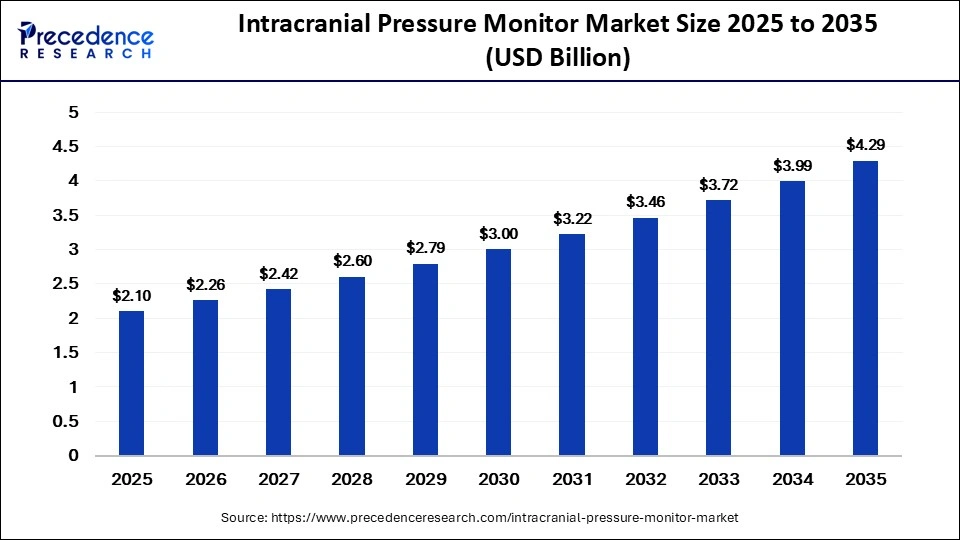
This growth highlights the increasing importance of advanced neuromonitoring technologies in improving patient outcomes, particularly in cases of traumatic brain injuries, stroke, and hydrocephalus.
Read Also: Medical Device Vigilance and Patient Safety Software Market
The Critical Role of ICP Monitoring in Modern Healthcare
Intracranial pressure monitoring is a vital component of neurocritical care, enabling clinicians to measure pressure inside the skull and detect life-threatening conditions such as brain swelling and hemorrhage.
These systems provide continuous, real-time data that helps guide treatment decisions in intensive care units (ICUs), neurosurgery departments, and trauma centers. As neurological conditions continue to rise globally, ICP monitoring is becoming an indispensable tool for early diagnosis and intervention.
AI and Smart Sensors Transforming Neuromonitoring
Artificial intelligence is emerging as a key driver of innovation in the ICP monitoring market. AI-powered algorithms can analyze continuous waveform data, identify early signs of intracranial hypertension, and support predictive clinical decision-making.
Additionally, advancements in sensor technologies—including fiber-optic systems, MEMS (microelectromechanical systems), and telemetric monitoring—are enhancing accuracy, portability, and long-term usability. These innovations are enabling healthcare providers to move toward more proactive and personalized neurological care.
Key Growth Drivers
Rising Burden of Neurological Disorders
The increasing prevalence of neurological conditions—including traumatic brain injuries (TBI), stroke, and neurodegenerative diseases—is a major driver of market growth. Globally, billions of people are affected by neurological disorders, creating a strong demand for advanced monitoring solutions.
Growing Demand for Real-Time Monitoring
Continuous ICP monitoring is essential in emergency and critical care scenarios, helping clinicians prevent secondary brain damage and improve survival rates.
Expansion of Neurosurgical Procedures
The increasing number of complex brain surgeries is fueling demand for precise intraoperative and postoperative monitoring technologies.
Emerging Trends Shaping the Market
Shift Toward Non-Invasive Monitoring
While invasive ICP monitoring devices currently dominate due to their accuracy, non-invasive technologies are gaining traction due to their safety, ease of use, and reduced risk of complications.
Rise of Remote and Home-Based Monitoring
Advancements in telemetric and wearable technologies are enabling remote monitoring of intracranial pressure, supporting long-term patient management outside hospital settings.
Focus on Patient Safety and Outcomes
Healthcare providers are increasingly prioritizing solutions that minimize complications, improve recovery rates, and enhance overall patient care.
Segment Insights: Invasive Leads, Non-Invasive Gains Momentum
Invasive ICP monitoring devices dominate the market, accounting for approximately 70% of the share in 2025, due to their high accuracy and widespread use in neuro-ICUs.
However, non-invasive devices—holding around 30% share—are expected to grow at the fastest pace, driven by increasing demand for safer and more accessible monitoring solutions.
By technology, fiber-optic sensors lead the market with about 35% share, while telemetric systems are emerging as a high-growth segment due to their ability to enable continuous, wireless monitoring.
In terms of application, traumatic brain injury (TBI) monitoring dominates, accounting for around 35% of the market, reflecting the critical role of ICP monitoring in emergency care.
Regional Outlook: Asia Pacific Emerges as a High-Growth Region
North America currently leads the ICP monitoring market, holding approximately 40% of the share in 2025, supported by advanced healthcare infrastructure and early adoption of innovative technologies.
However, Asia Pacific is expected to witness the fastest growth, with a projected CAGR of 10.5% between 2026 and 2035.
This growth is driven by expanding healthcare infrastructure, rising awareness of neurological disorders, and increasing investments in advanced medical technologies across countries such as India and China.
Challenges: High Costs and Accessibility Barriers
Despite promising growth, the market faces challenges related to the high cost of ICP monitoring devices and neurosurgical procedures.
Budget constraints in developing regions can limit adoption, particularly in smaller healthcare facilities. Additionally, the need for specialized training and infrastructure further complicates implementation.
Opportunities: Innovation in Sensors and Remote Care
Ongoing advancements in sensor technologies, particularly fiber-optic and minimally invasive systems, present significant opportunities for market expansion.
The growing adoption of telemedicine and remote monitoring solutions is also opening new avenues, enabling continuous patient monitoring beyond traditional hospital environments.
Competitive Landscape and Future Outlook
The intracranial pressure monitor market is becoming increasingly innovation-driven, with companies focusing on AI integration, miniaturization, and enhanced connectivity.
As healthcare systems continue to prioritize precision medicine and patient-centric care, ICP monitoring technologies will play a central role in neurological treatment and research.
Looking ahead, the convergence of AI, advanced sensors, and remote monitoring capabilities is expected to redefine neuromonitoring, making it more accessible, efficient, and predictive.
Conclusion
The intracranial pressure monitor market is evolving into a critical pillar of modern neurocritical care.
With rising neurological disease prevalence and continuous technological advancements, these systems are set to play an increasingly vital role in improving patient outcomes and reducing mortality. As innovation accelerates, the market is poised for sustained growth, shaping the future of neurological healthcare worldwide.
Get Sample Copy: https://www.precedenceresearch.com/sample/8354
For inquiries regarding discounts, bulk purchases, or customization requests, please contact us at [email protected]
