 by
by Small-molecule APIs remain a critical part of pharmaceutical manufacturing, but developing an API is very different from producing it at commercial scale. Pharma and biotech companies need CDMO partners that can move a molecule from route scouting and gram-scale laboratory work to kilogram, pilot, and multi-ton GMP manufacturing without losing control of quality, cost, or timelines.
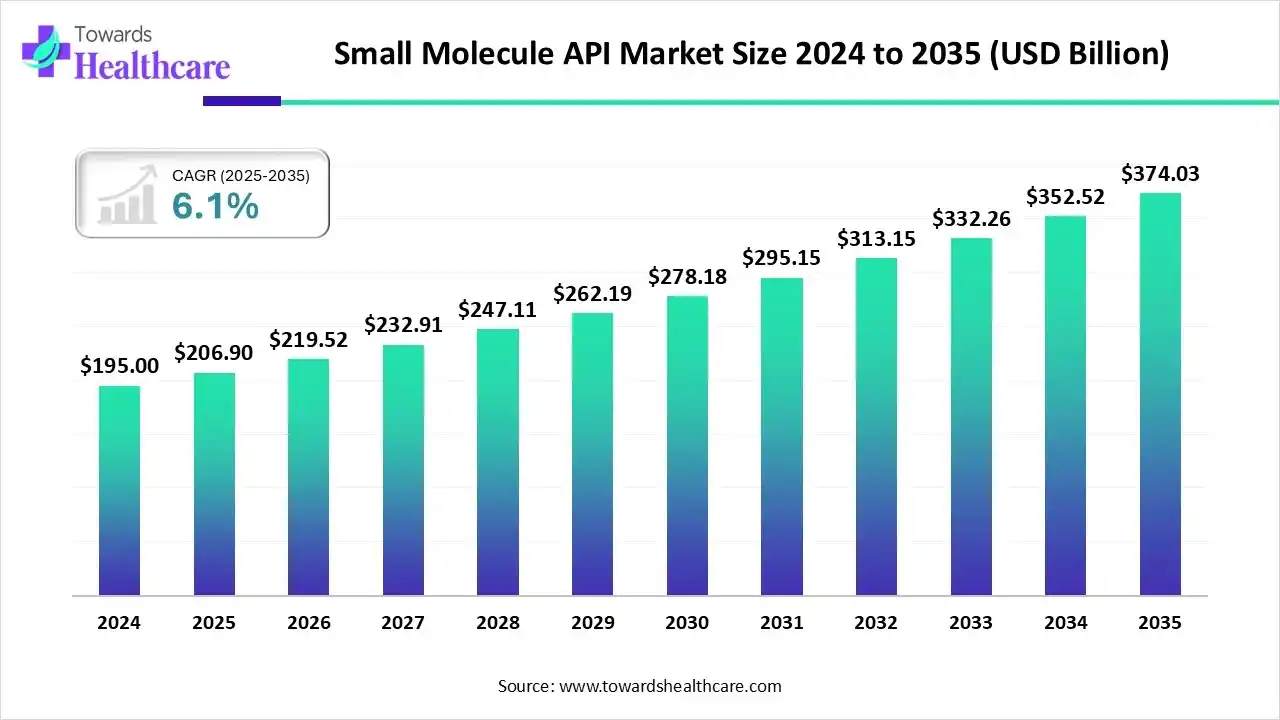
According to Towards Healthcare, the global small-molecule API market was valued at USD 206.9 billion in 2025, reached USD 219.52 billion in 2026, and is projected to reach USD 374.03 billion by 2035, expanding at a 6.1% CAGR. North America accounted for approximately 45% of the market in 2025.
Get a Preview of Our Industry Analysis: https://www.towardshealthcare.com/download-sample/6439
For buyers, however, the question is not simply which CDMO has the largest manufacturing plant. The more important question is:
Which CDMOs can maintain technical continuity from early development through commercial-scale API production?
Leading CDMOs for End-to-End Small-Molecule API Manufacturing
Based on Towards Healthcare’s competitive analysis, several companies stand out for broad small-molecule capabilities:
- Lonza
- WuXi STA
- Cambrex
- Piramal Pharma Solutions
- CordenPharma
- Evonik Healthcare
- Siegfried
- Curia
- Almac Group
- Seqens
- Axplora
- Thermo Fisher Scientific (Patheon)
- SK pharmteco
- Sterling Pharma Solutions
- EUROAPI
Not every company has the same scale or specialization, so the right choice depends heavily on the molecule, development stage, potency, chemistry, and expected commercial volume.
1. Lonza: Strong End-to-End Capability
Lonza is one of the strongest options for complex small-molecule programs requiring a transition from development to commercial manufacturing.
Towards Healthcare highlights Lonza’s capabilities in route development, process development, HPAPI manufacturing, particle engineering, continuous manufacturing, and commercial production. The company also has more than three decades of HPAPI experience.
For buyers, its biggest advantage is the ability to support complex programs across multiple development stages.
Best suited for: complex molecules, HPAPIs, commercial programs, and companies seeking an integrated global CDMO.
2. WuXi STA: Development Through Commercial Scale
WuXi STA has built an extensive global network covering API development and manufacturing.
Towards Healthcare highlights its capabilities across small molecules, peptides, oligonucleotides, complex conjugates, and continuous manufacturing, with R&D and production campuses across Asia, North America, and Europe.
Its global footprint can be particularly valuable for pharmaceutical companies that want development and manufacturing capabilities across multiple regions.
Best suited for: innovative small molecules, complex chemistry, peptides, and programs requiring global development support.
3. Cambrex: Strong Small-Molecule Chemistry Expertise
Cambrex is particularly well positioned for small-molecule API development and manufacturing.
Towards Healthcare highlights its experience with innovator and generic APIs, biocatalysis, continuous-flow chemistry, solid-state chemistry, analytical services, and commercial manufacturing in the U.S. and Europe.
This combination is important for companies that need to optimize a process before moving into larger production.
Best suited for: process development, complex chemistry, innovator APIs, and commercial small-molecule manufacturing.
4. Piramal Pharma Solutions: Global Manufacturing Network
Piramal Pharma Solutions offers API development and manufacturing across a network spanning North America, the U.K., and Asia.
Towards Healthcare highlights its capabilities in end-to-end API services and highly potent API manufacturing, making it relevant for pharmaceutical companies handling complex or potent molecules.
Its geographic footprint can also help buyers diversify manufacturing and supply-chain requirements.
Best suited for: complex APIs, HPAPIs, clinical-to-commercial programs, and global supply.
5. CordenPharma: Complex Chemistry and HPAPI Strength
CordenPharma is another strong candidate for sophisticated small-molecule programs.
Towards Healthcare highlights its capabilities in complex chemistry, peptide synthesis, HPAPI manufacturing, and large-scale production. Its containment capabilities are particularly relevant for highly potent compounds.
For buyers working with oncology compounds or other potent molecules, containment can be just as important as reactor capacity.
Best suited for: HPAPIs, complex chemistry, peptides, and large-scale manufacturing.
6. Siegfried: Integrated Development and Commercial Manufacturing
Siegfried operates across multiple facilities and provides API development, process optimization, and commercial manufacturing.
Towards Healthcare reports that the company operates 16 global facilities across four continents and has expanded its U.S. small-molecule API capacity.
That combination makes it relevant for pharmaceutical companies looking for a partner that can support both development and commercial supply.
7. Curia: Explicit Gram-to-Multi-Ton Capability
Curia is particularly relevant to the exact requirement in the question.
Towards Healthcare describes Curia as supporting small molecules, biologics, and HPAPIs while scaling production from gram quantities to multi-ton commercial batches.
This makes Curia one of the clearest examples of a CDMO built around the development-to-commercial scale-up journey.
Best suited for: early-stage development, process chemistry, clinical manufacturing, and multi-ton commercial API production.
What Does the FDA Say About API Manufacturing?
The scale of a manufacturing operation is only useful if it operates within an appropriate quality framework.
The FDA’s Q7A guidance establishes GMP expectations for API manufacturing and states that manufacturing includes activities such as material receipt, production, packaging, labeling, quality control, release, storage, and distribution.
The FDA also emphasizes that appropriate GMP controls should apply during clinical development, including when APIs are produced in small-scale facilities or laboratories. Equipment must be appropriately calibrated, clean, and suitable for its intended use.
That is particularly important for the gram-to-multi-ton model.
A buyer needs confidence that the process developed at laboratory scale can be transferred and controlled as production volume increases.
Why Scale-Up Is a Major Buyer Requirement
The transition can look like:
Gram scale → Kilogram scale → Pilot scale → Commercial scale → Multi-ton production
At every stage, the process may encounter new challenges involving:
- Heat transfer
- Mixing
- Reaction kinetics
- Impurity formation
- Crystallization
- Solvent recovery
- Equipment compatibility
- Worker safety
- Batch consistency
- Waste management
A process that works at 100 grams does not automatically behave identically at 1,000 kilograms.
That is why process-development expertise and manufacturing infrastructure need to work together.
FDA Data Also Highlights the Importance of Reliable API Supply
The FDA maintains a drug-shortage database because shortages can arise from manufacturing and quality problems, regulatory delays, active-ingredient shortages, manufacturing discontinuations, shipping delays, and demand increases.
The FDA’s openFDA shortage dataset currently contains 1,651 records in its availability visualization, including records classified as available, unavailable, or having limited availability.
This does not mean that all shortages are caused by API manufacturing. However, it demonstrates why pharmaceutical buyers increasingly evaluate CDMOs on supply continuity and manufacturing resilience, not just price.
Thermo Fisher Scientific: Clinical-to-Commercial Infrastructure
Thermo Fisher Scientific through Patheon is another major option for pharmaceutical companies seeking integrated manufacturing support.
Towards Healthcare highlights its capabilities across small-molecule API development, cGMP manufacturing, analytical services, and global clinical-to-commercial supply.
The company’s broader life-science infrastructure can be advantageous for pharmaceutical companies that require multiple development and manufacturing services.
Best suited for: integrated development, clinical supply, commercial manufacturing, and complex pharmaceutical programs.
Sterling Pharma Solutions: Broad Manufacturing Capacity
Sterling Pharma Solutions is particularly notable for its manufacturing capacity.
Towards Healthcare reports more than 835 m³ of reactor capacity across its U.S., U.K., and European locations, with batch sizes ranging from less than 1 kg to more than 300 metric tonnes per year.
That makes Sterling particularly relevant when buyers are evaluating a CDMO based on manufacturing scale.
EUROAPI: Large Industrial API Infrastructure
EUROAPI is another major API manufacturer with significant industrial capacity.
Towards Healthcare reports approximately 2,000 m³ of cGMP organic-synthesis capacity and 6,000 m³ for microbial fermentation, with industrial-scale production capabilities spanning multiple European sites.
Its positioning makes it particularly relevant for companies prioritizing large-scale API manufacturing and European supply infrastructure.
Lonza vs. Curia: Which Is Better for Scale-Up?
Lonza is particularly strong when the project involves complex chemistry, HPAPIs, advanced manufacturing technologies, and global commercial requirements.
Curia has a particularly clear positioning around moving programs from gram-scale development to multi-ton commercial batches.
So the difference can be viewed as:
Lonza → Complex chemistry + advanced technologies + global commercial scale
Curia → Development chemistry + scale-up + gram-to-multi-ton manufacturing
The final decision should depend on the molecule and manufacturing process rather than company size alone.
Cambrex vs. CordenPharma
Cambrex stands out for its expertise in small-molecule chemistry, process optimization, biocatalysis, and continuous-flow manufacturing.
CordenPharma has a particularly strong position in complex chemistry, peptides, and highly potent APIs.
Therefore:
Cambrex → Process chemistry and scalable small-molecule manufacturing
CordenPharma → Complex chemistry + HPAPI + peptide manufacturing
Insights by Payal Rabde – exploring the ideas, trends, and opportunities transforming healthcare.
What Do Pharmaceutical Buyers Actually Want?
For pharma and biotech companies selecting an API CDMO, manufacturing volume is only one consideration.
1. Scale-up continuity
Can the same process move smoothly from laboratory development into commercial manufacturing?
2. GMP compliance
Does the organization have robust quality systems and regulatory experience?
3. Analytical capability
Can the CDMO characterize impurities, intermediates, polymorphs, and final API quality?
4. Potent-compound handling
Can the facility safely manufacture HPAPIs when required?
5. Commercial capacity
Can the CDMO accommodate demand increases without forcing another technology transfer?
6. Supply-chain resilience
Can the company provide reliable raw-material sourcing and production continuity?
7. Global footprint
Can manufacturing be supported across North America, Europe, and Asia when needed?
8. Cost competitiveness
Can the process be optimized to reduce raw-material use, cycle time, waste, and overall COGS?
Discover healthcare data, trends, and companies – all in one dashboard: https://www.towardshealthcare.com/access-dashboard
Towards Healthcare’s Market View
Towards Healthcare estimates that the global small-molecule innovator API CDMO market was approximately USD 27.6 billion in 2025, is expected to reach USD 28.46 billion in 2026, and could reach approximately USD 50.54 billion by 2035, representing a 6.59% CAGR.
The report identifies Asia Pacific as the leading region, supported by established CDMO infrastructure, pharmaceutical R&D expansion, government initiatives, and increasing outsourcing from global pharmaceutical companies. North America is also expected to experience strong growth.
This creates an increasingly competitive landscape in which CDMOs are investing in:
Process intensification + continuous manufacturing + HPAPI containment + automation + green chemistry + larger reactor capacity
About Us
Pharma Geek is a part of Towards Healthcare Research & Consulting which is a global healthcare market research and consulting firm dedicated to helping businesses make informed decisions through reliable market intelligence and strategic insights. We serve pharmaceutical, biotechnology, medical device, AI in healthcare, cell and gene therapy, digital health, and life sciences organizations with in-depth market research, custom consulting, competitive analysis, and growth forecasts. Our team combines industry expertise with rigorous research to deliver clear, actionable insights that support market expansion, product strategy, investment decisions, and long-term business growth. From emerging innovations to established healthcare markets, we help organizations understand where the industry is today and where it’s headed tomorrow.
You can place an order or ask any questions, please feel free to contact us at [email protected]
Europe Region – +44 778 256 0738
North America Region – +1 8044 4193 44
APAC Region: +91 9356 9282 04
Visit Our Website: Towards Healthcare Research & Consulting – Expert Consulting Solutions & Research Reports
Find us on social platforms: LinkedIn | Twitter | Instagram | Medium
