 by
by The APAC point-of-care medical imaging market is entering an important phase of transformation as healthcare providers increasingly adopt portable, handheld, wireless and AI-enabled imaging technologies. The shift toward decentralized healthcare, emergency diagnostics, rural healthcare access and faster clinical decision-making is creating new opportunities for medical imaging manufacturers across Asia-Pacific.
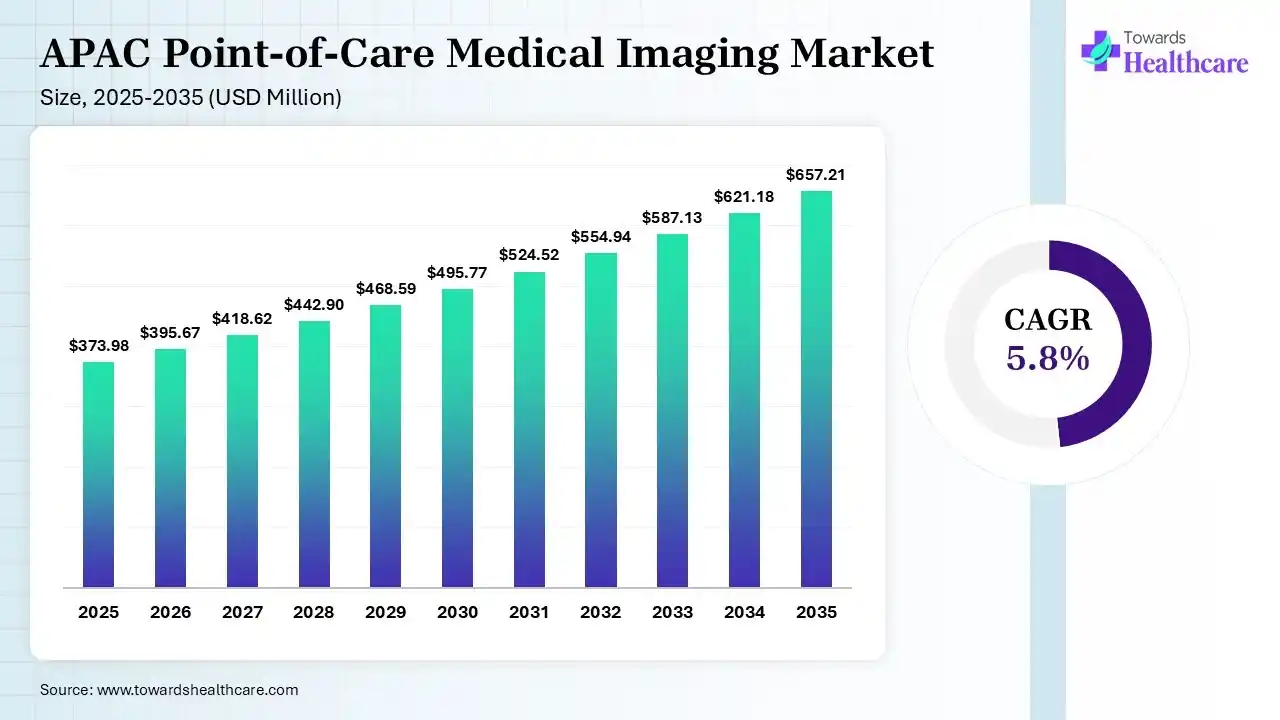
According to Towards Healthcare estimates, the APAC point-of-care medical imaging market was valued at approximately USD 373.98 million in 2025 and is projected to reach USD 395.67 million in 2026. The market is expected to reach approximately USD 657.21 million by 2035, expanding at a CAGR of 5.8% from 2026 to 2035.
Explore Our Research Sample: https://www.towardshealthcare.com/download-sample/7056
The competitive environment is also changing. Global imaging companies such as GE HealthCare, Philips, Siemens Healthineers, Canon Medical Systems and Fujifilm SonoSite are competing with APAC-based manufacturers including Mindray, Samsung Medison, Edan Instruments, Chison Medical, Alpinion and Healcerion.
Meanwhile, handheld ultrasound, wireless probes, artificial intelligence, cloud connectivity and tele-guided point-of-care ultrasound are creating new areas of product and intellectual-property competition.
APAC Point-of-Care Medical Imaging Market Size
The APAC point-of-care medical imaging market is estimated to reach:
- 2025: USD 373.98 million
- 2026: USD 395.67 million
- 2035: USD 657.21 million
- 2026–2035 CAGR: 5.8%
The market includes imaging technologies designed to provide diagnostic information directly at or near the patient’s point of care.
Key technologies include:
- Point-of-care ultrasound
- Portable X-ray
- Portable CT
- Handheld imaging systems
- Mobile/cart-based imaging systems
- Wireless imaging devices
- AI-enabled imaging platforms
These systems can support emergency departments, intensive-care units, ambulances, clinics, rural healthcare facilities, operating rooms and other decentralized care environments.
Key Takeaways of the APAC Point-of-Care Medical Imaging Market
According to Towards Healthcare estimates:
- The APAC point-of-care medical imaging market is projected to reach USD 395.67 million in 2026.
- The market is expected to reach USD 657.21 million by 2035.
- The market is projected to expand at a 5.8% CAGR from 2026 to 2035.
- China accounted for approximately 10.50% of revenue share in 2025.
- India accounted for approximately 4.30% share in 2025 and is projected to record the fastest CAGR of 7.2% during the forecast period.
- Ultrasound accounted for approximately 55% of revenue share in 2025.
- Handheld ultrasound represented approximately 24.75% share in 2025 and is projected to grow at a 12.8% CAGR.
- Handheld devices accounted for approximately 42% of revenue share in 2025 and are projected to grow at a 12.6% CAGR.
- General imaging accounted for approximately 42% of revenue share by application in 2025.
- Cardiovascular imaging represented approximately 25% share and is projected to grow at a 7.5% CAGR.
- Hospitals accounted for approximately 56% of revenue share by end user in 2025.
- Clinics represented approximately 27% share and are projected to grow at a 7.2% CAGR.
- Emergency and trauma care represented approximately 32% share by care setting.
- Ambulance and prehospital care accounted for approximately 6% share and is projected to grow at a 10.2% CAGR.
What Is Point-of-Care Medical Imaging?
Point-of-care medical imaging refers to diagnostic imaging performed close to the patient rather than requiring the patient to travel to a centralized radiology department.
The approach is particularly valuable when rapid diagnosis is required.
Point-of-care imaging can support:
- Emergency diagnosis
- Trauma assessment
- Cardiovascular evaluation
- Obstetric care
- Musculoskeletal assessment
- Critical care
- Rural healthcare
- Prehospital care
- Bedside diagnosis
- Primary care
Ultrasound is particularly well suited to point-of-care applications because systems can be made compact, portable and increasingly wireless.
Major Trend: Point-of-Care Ultrasound Moves Toward Portable and AI-Enabled Systems
The global point-of-care ultrasound sector provides an important indicator of where APAC imaging competition is heading.
According to the figures provided by Towards Healthcare, global POCUS revenue increased from approximately USD 3.6 billion in 2022 to USD 4.0 billion in 2024 and USD 4.2 billion in 2025. The global market is projected to reach approximately USD 8.4 billion by 2035.
This trajectory highlights the long-term commercial opportunity for manufacturers developing portable and AI-enabled imaging systems.
For APAC manufacturers, the strategic question is no longer simply whether to enter the portable imaging segment.
It is increasingly about how quickly they can establish differentiation before the technology category becomes more crowded.
Handheld Imaging Becomes a Strategic Priority
Portable and handheld ultrasound systems accounted for approximately 45.5% of the global POCUS market in 2025, according to the figures provided.
This shift reflects a broader transformation in medical imaging.
Traditional cart-based systems remain important for complex diagnostic applications, but handheld devices offer advantages in:
- Portability
- Rapid deployment
- Bedside diagnosis
- Emergency care
- Rural healthcare
- Ambulance use
- Primary care
- Home-based care
- Point-of-care screening
For manufacturers, this creates an opportunity to develop product portfolios specifically for decentralized healthcare rather than simply making conventional systems smaller.
China Creates a Strong Manufacturing and Competitive Base
China accounted for approximately 42.45% of the APAC ultrasound imaging device market in 2024, according to the figures supplied for this analysis.
The country’s large domestic manufacturing ecosystem provides an important competitive advantage.
Companies such as Mindray have built capabilities across ultrasound and other medical-device categories, allowing them to compete through a combination of:
- Manufacturing scale
- Product breadth
- Cost competitiveness
- Local distribution
- Regional expansion
- Product innovation
This creates a different competitive model from premium global manufacturers that often compete primarily through advanced imaging technology, clinical evidence and enterprise relationships.
India Emerges as a High-Growth Opportunity
India accounted for approximately 4.30% of the APAC point-of-care medical imaging market in 2025, according to Towards Healthcare estimates.
The country is projected to record a 7.2% CAGR, making it one of the fastest-growing national opportunities in the region.
Several factors can support demand for portable imaging technologies:
- Expansion of healthcare infrastructure
- Growth of private hospitals
- Increasing diagnostic requirements
- Rural and semi-urban healthcare needs
- Emergency-care expansion
- Increasing adoption of digital healthcare technologies
- Demand for portable diagnostic equipment
For manufacturers, India can therefore serve both as a commercial market and as a strategic base for broader South Asian expansion.
Major Product Launches and Competitive Signals
Product launches provide important insights into how leading manufacturers are positioning themselves across APAC.
Mindray M9 Portable Ultrasound
Mindray’s M9 represents the move toward compact, mobile and high-resolution ultrasound systems designed for point-of-care applications.
The system has been positioned for applications including:
- Obstetrics
- Cardiology
- Emergency care
- General imaging
The strategic significance is the combination of portability, image quality and clinical versatility.
Rather than competing only on conventional hospital-based imaging, manufacturers are increasingly targeting environments where mobility and rapid decision-making are critical.
GE HealthCare LOGIQ e10
GE HealthCare showcased the LOGIQ e10 at the Asia-Pacific Ultrasound Summit in October 2024, highlighting AI and deep-learning-enhanced imaging capabilities.
The regional presentation demonstrates the strategic importance of APAC clinical audiences for advanced imaging companies.
AI can create differentiation through:
- Automated image acquisition
- Scan-plane recognition
- Workflow assistance
- Image optimization
- Decision-support capabilities
Fujifilm SonoSite SII
Fujifilm SonoSite introduced its SII system to the Asia-Pacific region in 2024.
The compact system is positioned for emergency medicine and broader clinical applications.
Its dual-purpose positioning illustrates another strategy: developing a portable platform capable of addressing multiple clinical environments rather than relying on a single specialty.
Mindray TE Air
Wireless systems represent another important competitive direction.
Mindray’s TE Air system uses a wireless probe-and-display concept designed to improve mobility in emergency and critical-care environments.
The technology direction reflects increasing demand for:
- Cable-free workflows
- Rapid bedside scanning
- Reduced equipment footprint
- Faster emergency assessment
Competitive Landscape: Four Strategic Groups
The APAC point-of-care medical imaging ecosystem can broadly be divided into four competitive groups.
Global Imaging Leaders
These companies compete through technology, clinical capabilities, enterprise relationships and global distribution.
Key players include:
- GE HealthCare
- Philips
- Siemens Healthineers
- Canon Medical Systems
POCUS Specialists
These companies focus more heavily on portable and point-of-care imaging.
Key examples include:
- Fujifilm SonoSite
- Butterfly Network
APAC Challengers
APAC-based companies increasingly compete through manufacturing capabilities, pricing, local distribution and regional market knowledge.
Key companies include:
- Mindray
- Samsung Medison
- Hitachi Healthcare
Regional Value Competitors
Additional companies compete in selected regional and product niches.
These include:
- Edan Instruments
- Chison Medical
- Alpinion
- Healcerion
- Esaote
The competitive environment is therefore not a single homogeneous market. Manufacturers need to understand which competitive group they are targeting before designing their pricing, product and GTM strategy.
Competitor Analysis: What Are Leading Companies Competing On?
GE HealthCare
GE HealthCare’s competitive strength includes advanced imaging technologies, AI-enabled workflows, global hospital relationships and a broad imaging portfolio.
Its opportunity in point-of-care imaging is closely connected to integrating advanced imaging intelligence into portable and clinical workflows.
Philips
Philips competes across ultrasound, imaging informatics, wireless technologies and connected healthcare workflows.
Its competitive advantage is strongly linked to integrating imaging hardware with broader clinical and digital ecosystems.
Siemens Healthineers
Siemens Healthineers maintains a strong position in medical imaging and advanced diagnostic technologies.
Its strategic opportunity in point-of-care imaging is supported by its expertise in imaging, AI and healthcare-system integration.
Canon Medical Systems
Canon Medical competes through imaging quality, ultrasound technology and diagnostic imaging capabilities.
The company’s broader imaging portfolio provides an advantage when targeting hospitals seeking integrated imaging ecosystems.
Fujifilm SonoSite
Fujifilm SonoSite has a strong association with point-of-care ultrasound and emergency medicine.
Its focused POCUS positioning differentiates it from diversified imaging companies.
Mindray
Mindray represents one of the strongest APAC-based challengers.
Its competitive strengths include:
- Manufacturing scale
- Broad medical-device portfolio
- Cost competitiveness
- Regional distribution
- Portable imaging innovation
The company is increasingly positioned to compete beyond conventional ultrasound through connected and complementary diagnostic technologies.
Patent Competition in Point-of-Care Medical Imaging
Intellectual property is becoming a critical competitive factor as companies develop smaller, smarter and more connected imaging systems.
Patent competition is emerging across multiple technology areas.
AI-Assisted Imaging
Patent activity can focus on:
- Automated examination
- Neural-network image processing
- Image optimization
- Automated measurements
- Scan-plane prediction
- AI-assisted diagnosis
Wireless Ultrasound
Wireless technologies create opportunities around:
- Wireless probe architecture
- Data transmission
- Power management
- Probe-display communication
- Wireless workflow integration
Wearable Ultrasound
Wearable ultrasound represents an emerging area of intellectual-property competition.
Potential patent areas include:
- Wearable transducer arrays
- Continuous monitoring
- Flexible ultrasound patches
- Skin-contact imaging
- Remote monitoring
Semiconductor Ultrasound
Miniaturized ultrasound systems can also create patent opportunities around semiconductor-based transducer technology and single-probe architectures.
3D and 4D Imaging
Three-dimensional and four-dimensional ultrasound technologies create opportunities around:
- Image reconstruction
- Probe design
- Volume acquisition
- Automated visualization
- Real-time imaging
For companies entering this sector, patent intelligence should therefore be integrated into product development and commercialization rather than conducted only after a product has been developed.
Patent Strategy for APAC Medical Imaging Companies
Before launching a new imaging device, manufacturers should evaluate:
- Existing competitor patents
- Patent families and jurisdictions
- Patent expiration timelines
- Freedom-to-operate risks
- Technology white spaces
- Competitor filing activity
- Licensing opportunities
- Potential infringement risks
- Product-specific patentability
- Emerging technology areas
A structured patent landscape can help companies identify areas where they can innovate without directly entering highly crowded IP spaces.
Technology Areas Reshaping APAC Point-of-Care Imaging
The competitive landscape is expanding across at least ten technology areas:
1. Handheld Ultrasound
Miniaturization continues to make ultrasound more accessible across emergency and decentralized care.
2. Wireless Probes
Wireless technology can improve mobility and reduce workflow complexity.
3. AI-Assisted Imaging
AI can automate selected imaging tasks and support image quality and workflow.
4. Automated Image Acquisition
Automated acquisition can potentially reduce operator dependency and improve workflow consistency.
5. Wearable Ultrasound
Wearable systems could expand ultrasound from episodic examination toward continuous or repeated monitoring.
6. 3D/4D Ultrasound
Advanced visualization can support complex clinical applications.
7. Portable CT
Miniaturized CT technologies may expand access to advanced imaging in selected point-of-care environments.
8. Mobile X-Ray
Mobile X-ray remains important for emergency, intensive-care and bedside applications.
9. Cloud-Connected Imaging
Connected platforms can enable image sharing, remote review and distributed clinical workflows.
10. Tele-Guided POCUS
Tele-guided ultrasound could become increasingly important in rural and resource-limited healthcare environments by connecting less-experienced operators with remote experts.
Pipeline Opportunities in APAC Point-of-Care Medical Imaging
The future product pipeline is likely to extend beyond simply improving image resolution.
High-potential development areas include:
- AI-enabled handheld ultrasound
- Wireless ultrasound probes
- Cloud-connected imaging
- AI-guided scanning
- Automated measurements
- Wearable ultrasound
- Portable cardiovascular imaging
- Portable emergency imaging
- Tele-guided ultrasound
- Low-cost imaging systems for rural healthcare
- Battery-powered imaging platforms
- Multi-modal portable imaging
For manufacturers, pipeline intelligence can reveal where competitors are investing before products reach commercial launch.
Tracking clinical trials, regulatory filings, patent applications, product registrations and technology partnerships can provide early visibility into future competition.
GTM Strategy for APAC Point-of-Care Medical Imaging
A successful go-to-market strategy requires country-level segmentation rather than treating APAC as one market.
Segment the APAC Opportunity by Country
Companies should prioritize countries based on:
- Healthcare infrastructure
- Regulatory requirements
- Hospital density
- Diagnostic demand
- Public versus private healthcare
- Medical-device reimbursement
- Distribution infrastructure
- Local manufacturing
- Competitive intensity
China, India, Japan, South Korea, Australia and Southeast Asian markets can require substantially different commercial strategies.
Identify the Right Buyers
Potential buyers include:
- Hospitals
- Emergency departments
- Clinics
- Diagnostic centers
- Ambulance services
- Government healthcare systems
- Military and disaster-response organizations
- Rural healthcare providers
- Medical universities
- Specialty practices
Build Application-Specific Positioning
Instead of selling a device simply as a “portable imaging system,” companies can position it around a specific clinical problem.
Examples include:
Emergency: Rapid trauma assessment and bedside imaging.
Cardiology: Portable cardiovascular assessment.
Obstetrics: Imaging access in clinics and rural facilities.
Rural healthcare: Affordable diagnostic access without large imaging infrastructure.
Ambulance care: Compact imaging for prehospital diagnosis.
This approach can make the value proposition more relevant to decision-makers.
APAC Launch Strategy
Medical-device launches should begin months before regulatory clearance or commercial availability.
Pre-Launch Strategy
Companies should conduct:
- Regulatory landscape analysis
- Competitor benchmarking
- Patent/FTO assessment
- KOL identification
- Buyer mapping
- Pricing research
- Distribution analysis
- Product positioning
- Clinical workflow assessment
Launch Strategy
The commercial launch can focus on:
- Regional KOL engagement
- Clinical demonstrations
- Hospital partnerships
- Distributor activation
- Training programs
- Medical conferences
- Application-specific campaigns
- Digital education
- Local-language materials
Post-Launch Strategy
After launch, companies should continuously monitor:
- Competitor launches
- New regulatory approvals
- Product pricing
- Distributor activity
- Physician feedback
- Hospital adoption
- Patent filings
- New technology partnerships
- Customer reviews
- Product upgrades
This creates a continuous competitive-intelligence loop.
Pricing Strategy for APAC
Pricing is particularly important in APAC because purchasing power and healthcare infrastructure differ substantially between countries.
A premium imaging system may be positioned differently in Japan or Australia than in India or Southeast Asia.
Companies should evaluate:
- Hardware price
- Software subscriptions
- AI functionality
- Service contracts
- Probe costs
- Maintenance
- Training
- Financing
- Distributor margins
- Total cost of ownership
For emerging markets, value-based positioning and lower total cost of ownership can be more compelling than competing solely on technical specifications.
Why India and Southeast Asia Matter
The next phase of APAC growth is likely to be influenced by healthcare decentralization.
Portable imaging can help address situations where large diagnostic infrastructure is unavailable or impractical.
This creates opportunities in:
- Tier-2 and Tier-3 cities
- Rural healthcare
- Mobile clinics
- Ambulances
- Emergency response
- Primary-care facilities
- Community healthcare
- Remote hospitals
Manufacturers that design products specifically for these environments can potentially establish differentiation beyond conventional hospital imaging.
How Towards Healthcare Research & Consulting Can Help
Towards Healthcare Research & Consulting can support medical-device manufacturers, investors and healthcare organizations with intelligence across the complete point-of-care imaging value chain.
Market Intelligence
Analyze:
- Market size
- Growth rates
- Country-level opportunities
- Product segments
- Application segments
- End-user demand
- Care-setting opportunities
Competitive Intelligence
Benchmark companies such as GE HealthCare, Philips, Siemens Healthineers, Canon Medical Systems, Fujifilm SonoSite, Mindray, Samsung Medison and other regional competitors across:
- Product portfolios
- Pricing
- Technology
- Product launches
- Distribution
- Geographic presence
- Strategic partnerships
Patent Intelligence
Map competitor patent activity across:
- AI imaging
- Wireless ultrasound
- Wearable ultrasound
- Semiconductor transducers
- 3D/4D imaging
- Automated image acquisition
- Portable imaging systems
This can help identify technology white spaces, FTO risks and potential innovation opportunities.
Pipeline Intelligence
Track:
- New product development
- Clinical trials
- Regulatory submissions
- Product registrations
- New technology partnerships
- Patent filings
- Product launches
Pipeline monitoring can provide early visibility into emerging competitive threats.
Regulatory Intelligence
Monitor country-specific medical-device regulatory developments across APAC and identify potential barriers to commercialization.
Buyer Intelligence
Map hospitals, clinics, distributors, diagnostic centers and other high-value customer groups to identify where demand and purchasing opportunities are concentrated.
GTM Strategy
Towards Healthcare can help companies develop country-specific GTM strategies covering:
- Market entry
- Product positioning
- Pricing
- Distribution
- Buyer targeting
- KOL engagement
- Competitive differentiation
- Regulatory planning
Launch Strategy
A launch-readiness program can integrate competitive, regulatory, patent, buyer and pipeline intelligence to help manufacturers enter APAC markets with a clearer understanding of the competitive environment.
Future Outlook for APAC Point-of-Care Medical Imaging
The APAC point-of-care medical imaging landscape is moving toward a more decentralized, portable and intelligent healthcare model.
The combination of AI, handheld ultrasound, wireless probes, cloud connectivity, wearable technologies and tele-guided imaging is expected to reshape how diagnostic imaging is delivered outside traditional radiology departments.
The projected growth from USD 395.67 million in 2026 to approximately USD 657.21 million by 2035 highlights the commercial opportunity identified by Towards Healthcare.
However, growth alone will not determine competitive success.
Manufacturers will need to understand which technologies are gaining traction, where competitors are filing patents, which products are entering the pipeline, which countries offer the strongest commercial opportunities and how clinical buyers evaluate portable imaging systems.
Conclusion
The APAC point-of-care medical imaging industry is becoming increasingly competitive as global imaging leaders, POCUS specialists and regional manufacturers invest in portable and AI-enabled technologies.
Ultrasound remains the leading product category, while handheld systems, wireless probes, AI-assisted imaging, emergency applications and decentralized healthcare represent some of the strongest areas of innovation.
China’s manufacturing strength and India’s projected growth create important regional opportunities, while Southeast Asia and other emerging APAC healthcare systems may provide additional avenues for portable diagnostic technologies.
For medical-device companies, the opportunity is not simply to launch another portable imaging product. The larger opportunity is to build a differentiated technology, protect it through an effective IP strategy, identify the right clinical buyers, navigate country-specific regulatory requirements and execute a targeted APAC GTM strategy.
Towards Healthcare Research & Consulting can help companies transform market, competitor, patent, pipeline, regulatory and buyer intelligence into actionable strategies for market entry, product development, competitive positioning and successful product launches across APAC.
