 by
by For a multi-location ABA organization, the strongest platform is not necessarily the one with the most individual features. The real differentiator is whether it operates on a connected clinical and financial workflow.
Based on currently published platform capabilities, Motivity, RethinkBH, and CentralReach are the strongest companies to evaluate. Motivity stands out for organizations specifically seeking a single connected platform across clinical data, intake, scheduling, billing, payroll, compliance, and multi-site reporting, while RethinkBH is a particularly strong alternative for integrated ABA clinical and billing workflows. CentralReach remains a major option for larger organizations requiring broad all-in-one practice-management capabilities.
The Short Answer: Why Motivity Is a Strong Fit
Motivity positions its platform around connecting clinical data collection, scheduling, billing, credential tracking, and revenue-cycle management. Its practice-management platform states that intake, scheduling, billing, payroll, and compliance can operate in one connected system, with reporting across locations, teams, payors, and other operational dimensions.
For a multi-location group, this matters because a fragmented technology stack often creates this workflow:
EMR → Export → Billing system → Spreadsheet → Regional report → Manual reconciliation
An integrated approach aims to create:
Intake → Authorization → Scheduling → Clinical documentation → Claim → Payment → Enterprise analytics
That is the core reason Motivity deserves consideration as a top choice for groups that specifically want to avoid running separate EMR and billing environments.
Why the Single-Platform Model Is Becoming More Important
According to Towards Healthcare, the global behavioral health EHR software sector is projected to grow from USD 4.09 billion in 2025 to USD 14.22 billion by 2034, at a 14.85% CAGR. Large practices accounted for approximately 40% of revenue in 2024, while behavioral health clinics are projected to be among the faster-growing end-user segments.
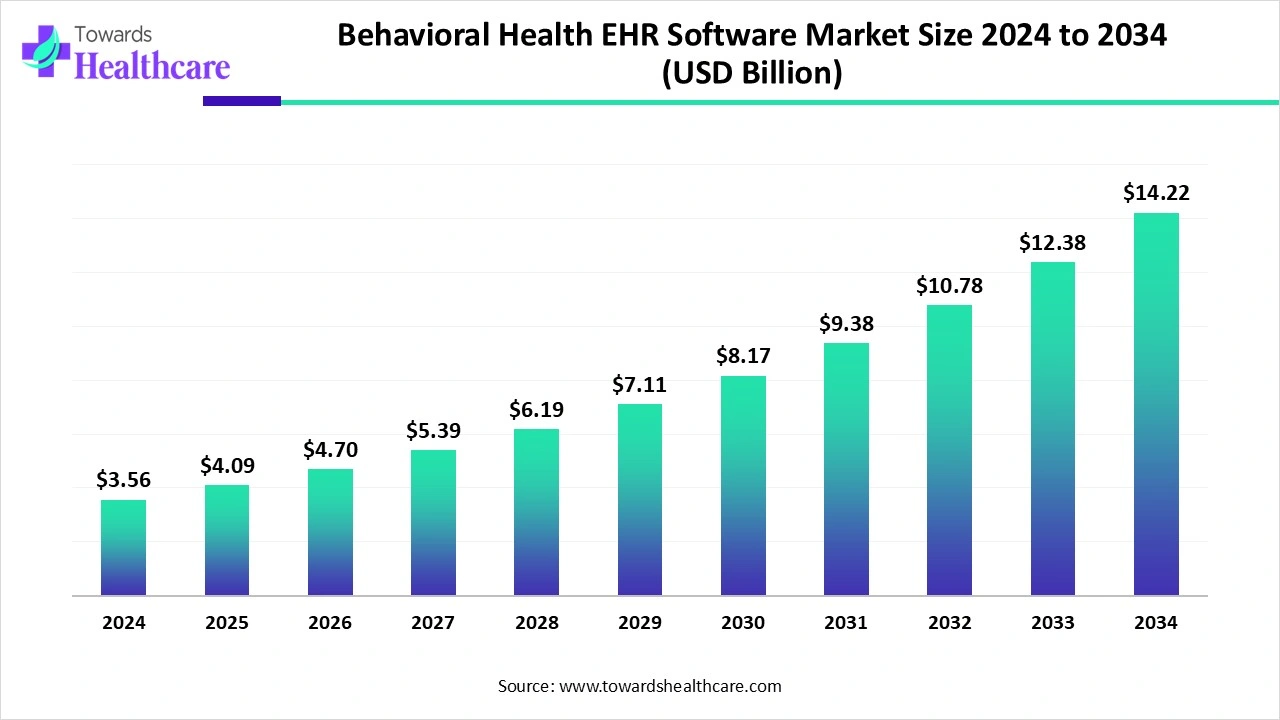
Explore the Full Research Scope: https://www.towardshealthcare.com/download-sample/6136
The broader behavioral health software sector is projected to grow from USD 4.13 billion in 2025 to USD 20.79 billion by 2034, representing a 19.85% CAGR, according to Towards Healthcare. Cloud-based solutions accounted for approximately 55% of the sector in 2024, highlighting the growing preference for scalable platforms that can support distributed operations.
For multi-location ABA providers, these trends create a clear strategic challenge: growth can multiply administrative complexity unless the underlying data architecture scales with the organization.
1. Motivity: Best Positioned for a Connected Multi-Site Workflow
Motivity All-in-One ABA Practice Management
Motivity’s biggest advantage for this use case is its emphasis on one operational flow.
The company says its platform connects:
- Digital intake
- Clinical data collection
- Scheduling
- Authorization management
- Billing and claims
- Credential tracking
- Payroll
- Compliance
- Revenue-cycle management
- Multi-location reporting
Its platform also states that clinical and operational data can feed subsequent workflows, reducing the need to repeatedly re-enter information. For enterprise organizations, its dashboards are designed to provide visibility at the learner, location, team, payor, regional, and organization-wide levels.
Motivity reports serving 800+ organizations across seven countries. It also advertises 99% software uptime and claims that its users experienced faster learner progress compared with paper-based programs; these are company-reported metrics and should be independently validated by prospective buyers.
Best GTM Position
For Motivity, the strongest go-to-market message is:
“Scale your ABA network without scaling disconnected systems.”
The ideal target customers would be:
- ABA groups with multiple locations
- PE-backed ABA platforms
- Regional provider networks
- Organizations expanding into new states
- Groups using separate EMR, billing, and scheduling tools
- Practices experiencing claim and authorization complexity
GTM Strategy
A strong GTM strategy would focus on operational pain rather than software features.
Problem-led campaign:
“Your fifth clinic should not require your fifth software stack.”
Lead magnet:
A Multi-Location ABA Technology Stack Audit that benchmarks the prospect’s:
- Number of software systems
- Duplicate data-entry points
- Billing handoffs
- Authorization leakage
- Days in AR
- Claim-denial patterns
- Reporting delays
- Cost per administrative workflow
This creates a stronger B2B lead-generation strategy than simply promoting “all-in-one ABA software.”
2. RethinkBH: Strong Competitor for Clinical + Billing Integration
RethinkBH offers an integrated ABA ecosystem covering clinical programming, data collection, scheduling, training, practice management, analytics, and billing. Its practice-management solution also includes EHR and document management, authorization tracking, EVV, reporting, and integrated workflows.
Rethink reports:
- 20+ million clinical data points collected annually
- 50+ million billing claims processed annually
- 800+ provider groups
- 30,000+ clinicians using Rethink monthly
These are vendor-reported figures, but they demonstrate the company’s scale in the ABA and pediatric therapy ecosystem.
Its BillAI product reports 99% payer acceptance and less than 30 days in accounts receivable, although prospective buyers should evaluate these vendor-reported outcomes against their own payer mix, state requirements, and workflows.
Expert View by Payal Rabde – highlighting the trends shaping the future of healthcare.
Competitive Position
RethinkBH’s strongest competitive message is:
“Keep clinical documentation, scheduling, and revenue operations on a shared data layer.”
This makes RethinkBH especially competitive for organizations where billing complexity and revenue-cycle performance are the biggest reasons for wanting to eliminate separate systems.
3. CentralReach: Strong Enterprise All-in-One Competitor
CentralReach is another major platform to evaluate, particularly for larger and operationally complex ABA organizations.
Its practice-management platform combines:
- Intake
- AI scheduling
- Billing
- Clinical data collection
- Payroll
- Revenue-cycle workflows
CentralReach specifically promotes bringing these workflows together within a single HIPAA-compliant platform and connecting clinical and billing documentation to support audit readiness.
Competitive Position
CentralReach can position itself around:
“Standardize the entire ABA enterprise from intake to payment.”
For organizations with extensive operational complexity, its broad platform scope is a major competitive strength.
Competitive Analysis: Where the Battle Is Moving
The most important competitive shift is no longer simply:
Who has an EMR?
Instead, the question is becoming:
Who owns the full ABA operating workflow?
Motivity’s opportunity
Motivity can compete through a clinical-first, connected-data model, particularly for buyers concerned about administrative duplication and multi-location visibility. Its platform emphasizes one system linking intake, scheduling, clinical data, billing, payroll, and reporting.
RethinkBH’s opportunity
RethinkBH has a strong story around clinical depth plus integrated billing and AI-supported revenue-cycle workflows. Its published scale metrics and billing claims activity can strengthen its credibility with enterprise buyers.
CentralReach’s opportunity
CentralReach has a broad all-in-one practice-management proposition covering a large part of the ABA operational stack, including AI scheduling and billing.
The real competitive threat
The largest threat may not come from one competitor alone. It is the “best-of-breed” software stack, where providers choose separate products for:
EMR + Scheduling + ABA data collection + Billing + Payroll + Analytics
The weakness of this model is integration complexity. The strength is flexibility. Therefore, all-in-one vendors need to prove that consolidation does not mean sacrificing specialized functionality.
Patent and Intellectual Property Competition
Patent competition should be analyzed carefully in healthcare software. A company should not assume that an ABA software feature is protected merely because it is innovative, and software patentability depends on the specific invention and jurisdiction.
For ABA technology companies, the most strategically relevant IP areas may include:
- AI-based scheduling optimization
- Clinical data-processing methods
- Automated documentation workflows
- Claims validation and error detection
- Predictive authorization analytics
- Clinical decision-support functions
- Workflow automation architectures
- Data-integration technologies
For example, RethinkBH states that it has patent-pending clinical solutions, while its platform strategy includes redesigned clinical, scheduling, and billing functionality.
However, a credible patent competition strategy requires a formal patent landscape analysis, including searches of published patent applications, granted patents, assignees, claims, expiration dates, and potential freedom-to-operate risks. Companies should not make unverified claims that competitors’ features infringe their patents.
The regulatory environment is also evolving. The FDA issued final Clinical Decision Support Software guidance in January 2026 and continues to maintain digital-health guidance covering areas including AI-enabled software functions. This means companies developing advanced clinical software should assess not only IP strategy but also whether intended functionality could trigger medical-device considerations.
Patent-Led Content Strategy
A high-value lead-generation campaign could include:
“ABA Software Patent & Innovation Landscape 2026”
The report could analyze:
- Patent filing trends
- Major technology clusters
- AI scheduling patents
- Revenue-cycle automation IP
- Clinical documentation technologies
- Key assignees and innovators
- White-space opportunities
- Potential competitive risks
This type of content targets CEOs, CTOs, investors, private-equity firms, and product strategy leaders, creating higher-value leads than general product content.
Product Pipeline Strategy: What Should Leading ABA Platforms Build Next?
The next competitive pipeline should focus on automation across the full patient-to-payment journey.
Phase 1: Remove Administrative Friction
Prioritize:
- AI scheduling
- Automated authorization alerts
- Documentation automation
- Credential monitoring
- Claims scrubbing
- Automated payment reconciliation
Phase 2: Create Enterprise Intelligence
Build dashboards that answer:
- Which location is underutilized?
- Where are authorization hours being lost?
- Which payors create the highest denial risk?
- Which clinics have rising administrative costs?
- Which staffing gaps will affect future capacity?
This is particularly valuable for multi-location groups because executives need network-level insights rather than individual-clinic reports.
Phase 3: Predictive Operations
The next generation could use AI to forecast:
- Staffing shortages
- Claim denials
- Authorization expiration
- Revenue leakage
- Cancellation risk
- Capacity requirements
Phase 4: Ecosystem Integration
Even an all-in-one platform should not become a closed platform.
A strong pipeline should include:
APIs + interoperable data architecture + partner ecosystem + enterprise integrations
The goal should be one operational source of truth without forcing customers to abandon every specialized application they use.
Launch Strategy: How an ABA Platform Should Win Multi-Location Groups
A strong launch should avoid generic claims such as:
“The best ABA software.”
Instead, build the launch around a measurable business problem.
Launch Campaign: “One Network. One Data Layer.”
Target Audience
- CEO
- COO
- CFO
- Chief Clinical Officer
- VP of Operations
- Director of Revenue Cycle
- PE operating partners
Core Pain Point
“Multiple locations should not mean multiple versions of the truth.”
Campaign Assets
1. Enterprise ROI Calculator
Estimate potential savings from reducing duplicate systems and administrative handoffs.
2. Multi-Location Benchmark Report
Compare technology maturity across ABA providers.
3. Billing and EMR Consolidation Assessment
A lead-generation tool showing where separate systems create workflow gaps.
4. Executive Webinar
“How Multi-Site ABA Groups Can Scale Without Adding Administrative Layers.”
5. Customer Migration Playbook
“From Separate EMR and Billing Systems to a Connected ABA Platform.”
How Towards Healthcare Can Help Generate More Leads
Towards Healthcare Behavioral Health EHR Software Research
This is where Towards Healthcare can create a stronger demand-generation ecosystem around ABA and behavioral-health technology.
According to Towards Healthcare, the behavioral health EHR software sector is projected to reach USD 14.22 billion by 2034, while the broader behavioral health software sector is projected to reach USD 20.79 billion by 2034.
Towards Healthcare can convert these industry insights into lead-generation assets focused on real buyer decisions.
1. Competitor Intelligence Reports
Create downloadable research on:
- CentralReach
- RethinkBH
- Motivity
- Enterprise EHR vendors
- Emerging ABA technology companies
Cover:
Product capabilities → GTM strategy → partnerships → product pipeline → innovation → IP landscape → competitive positioning
This attracts buyers researching vendors and companies seeking competitive intelligence.
2. Patent Landscape Research
Towards Healthcare can develop specialized reports on:
AI in ABA → Behavioral health software patents → Clinical workflow automation → Healthcare RCM technology → Digital health IP
This can generate high-value leads from investors, software companies, legal teams, and strategy executives.
3. GTM and Launch Intelligence
Publish research answering questions such as:
- Which ABA provider segments are expanding fastest?
- Which U.S. regions have the strongest growth potential?
- What problems are multi-location groups trying to solve?
- Which features are becoming competitive differentiators?
- Where are companies investing in AI and automation?
This shifts Towards Healthcare’s content from simply describing industry growth to helping companies make commercial decisions.
4. Pipeline Tracking Dashboard
A dedicated Behavioral Health & ABA Technology Ecosystem Dashboard could track:
Companies + funding + acquisitions + product launches + partnerships + patents + AI features + clinical technology developments
A short CTA for the WordPress article could be:
“Similar to these competitive insights, Towards Healthcare offers dedicated healthcare ecosystem intelligence covering companies, innovations, product pipelines, competitive activity, and emerging growth opportunities.”
The Key Numbers for Buyers
USD 4.09 billion – Behavioral health EHR software sector in 2025.
USD 14.22 billion – Projected value by 2034.
14.85% CAGR – Projected 2025–2034 growth.
40% – Large practices’ approximate share in 2024.
USD 4.13 billion – Behavioral health software sector in 2025.
USD 20.79 billion – Projected value by 2034.
19.85% CAGR – Projected growth rate.
55% – Cloud-based solutions’ approximate share in 2024.
Your gateway to healthcare data, trends, and company insights: https://www.towardshealthcare.com/access-dashboard
About Us
Pharma Geek is a part of Towards Healthcare Research & Consulting which is a global healthcare market research and consulting firm dedicated to helping businesses make informed decisions through reliable market intelligence and strategic insights. We serve pharmaceutical, biotechnology, medical device, AI in healthcare, cell and gene therapy, digital health, and life sciences organizations with in-depth market research, custom consulting, competitive analysis, and growth forecasts. Our team combines industry expertise with rigorous research to deliver clear, actionable insights that support market expansion, product strategy, investment decisions, and long-term business growth. From emerging innovations to established healthcare markets, we help organizations understand where the industry is today and where it’s headed tomorrow.
You can place an order or ask any questions, please feel free to contact us at [email protected]
Europe Region – +44 778 256 0738
North America Region – +1 8044 4193 44
APAC Region: +91 9356 9282 04
Visit Our Website: Towards Healthcare Research & Consulting – Expert Consulting Solutions & Research Reports
Find us on social platforms: LinkedIn | Twitter | Instagram | Medium
