
 by
by What is the DNA Data Storage Market Size?
The global DNA Data Storage Market was valued at USD 150.63 million in 2025 and is projected to reach USD 58,450.83 million by 2035, growing from USD 283.21 million in 2026 at an exceptional CAGR of 81.50% during the forecast period from 2026 to 2035.

Market Highlights
- North America dominated the market, accounting for 55% of the market share in 2025.
- Asia Pacific is expected to expand at the fastest CAGR between 2026 and 2035.
- By storage type, the synthetic DNA storage segment held the largest market share of 50% in 2025.
- By storage type, natural DNA-based storage is growing at a remarkable CAGR between 2026 and 2035.
- By technology type, the DNA synthesis phosphoramidite chemistry segment contributed the highest market share of 50% in 2025.
- By technology type, the enzymatic synthesis segment is expanding at a remarkable CAGR between 2026 and 2035.
Defining the DNA Data Storage Market: From Biological Code to Digital Archive
The DNA Data Storage Market encompasses innovative technologies that store digital information within synthetic DNA molecules, offering unmatched data density, durability, and long-term preservation capabilities. As global data generation continues to surge and traditional storage systems face scalability limitations, DNA-based storage is emerging as a revolutionary solution for secure archival and high-capacity data management.
Advancements in DNA synthesis, sequencing technologies, and error-correction techniques are accelerating market growth across industries such as healthcare, finance, defense, cloud computing, and data centers. While North America remains at the forefront of adoption due to strong research initiatives and technological innovation, Asia Pacific is witnessing the fastest growth, fueled by expanding cloud infrastructure and increasing investments in next-generation data storage technologies.
Innovation Frontiers: DNA Synthesis, Sequencing, and Encoding Algorithms
A major technological breakthrough in the DNA data storage market is the shift from traditional chemical oligonucleotide synthesis to enzymatic and multiplexed DNA synthesis techniques. These innovations significantly reduce production costs, improve scalability, and enhance data reliability through advanced error-correction mechanisms. Enzymatic synthesis enables faster and more efficient DNA assembly while lowering reagent consumption and supporting the development of compact, next-generation storage systems.
At the same time, advancements in locality-aware encoding methods, molecular indexing, and random-access architectures are improving data retrieval speeds, addressing one of DNA storage’s key challenges. On the decoding side, high-throughput sequencing technologies, including nanopore and parallel sequencing platforms, are increasing read efficiency while reducing operational costs. Combined with cloud-native software frameworks, metadata management, and intelligent indexing systems, these innovations are transforming DNA storage from an experimental laboratory concept into a practical, scalable solution for long-term archival data management. The convergence of biotechnology, information theory, and digital infrastructure is paving the way for the commercial adoption of DNA-based data storage systems.
DNA Data Storage Market Regional Insights
How Big is the North America DNA Data Storage Market Size?
North America remains a key hub for innovation in DNA-based data storage technologies. The North America DNA Data Storage Market was valued at USD 82.85 million in 2025 and is projected to reach approximately USD 32.44 billion by 2035.
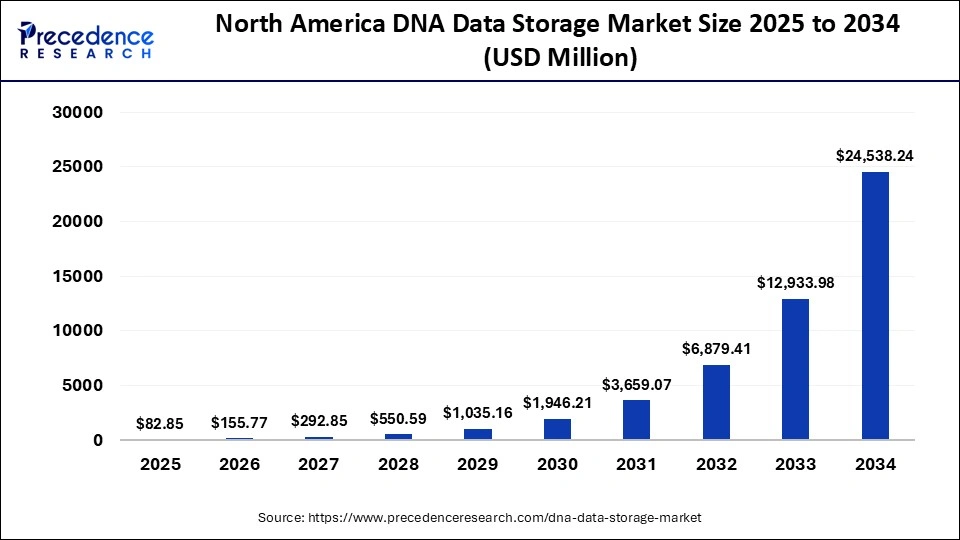
Will North America Anchor Humanitys Long-Term Memory in Synthetic Molecules?
North America dominates the DNA data storage landscape, buoyed by a confluence of world-class synthetic-biology research, deep-pocketed cloud providers, and an appetite for cutting-edge archival solutions. The regions academic institutions and national labs incubate core technologies synthesis, sequencing, and molecular computing, feeding a robust entrepreneurial ecosystem. Major hyperscalers and archival consortia provide pilot opportunities and potential offtake agreements that de-risk scale-up. Venture capital availability and permissive translational grant programs further accelerate commercial ventures from bench prototypes to demonstrators. This ecosystemic advantage consolidates North Americas leadership in both innovation and early customer deployments.
Can Asia Pacific Convert Manufacturing Scale into Molecular-Scale Data Sovereignty?
Asia Pacific is the fastest-growing region for DNA data storage, propelled by expansive data generation, state-led investments in advanced biomanufacturing, and a strategic imperative to localize critical data infrastructure. Nations across the region are investing in synthetic-biology hubs and sequencing capacity, thereby reducing barriers to pilot deployments. Large cloud operators and research consortia are exploring DNA vault pilots to diversify archival strategies and to assert data sovereignty. Cost-sensitive manufacturing ecosystems in the region also promise scale advantages as synthesis industrializes. Consequently, Asia Pacifics rapid ascent reflects both demand-side scale and emerging supply-side capability.
China Market Analysis
China is an increasingly important market for DNA data storage research and innovation, with active university groups and national labs publishing novel encoding schemes and synthesis techniques, and industry academic collaborations advancing rapidly. Chinese researchers reported breakthroughs in encoding efficiency and palette design for DNA-based storage in recent years, and several institutions are exploring applications for medical data archiving and research data preservation.
DNA Data Storage Market Segment Insights
Storage Type Insights
Why Is Synthetic DNA Storage Dominating the DNA Data Storage Market?
The synthetic DNA storage segment dominates the DNA data storage market, accounting for 55% of the total market share, primarily due to its high precision, scalability, and the maturity of established phosphoramidite-based DNA synthesis technologies. This approach enables digital information to be encoded into carefully engineered DNA sequences, delivering exceptional data density, sequence accuracy, and long-term reliability.
Its ability to maintain data integrity under a wide range of environmental conditions makes synthetic DNA particularly well-suited for long-term archival storage and ultra-secure data preservation. Additionally, synthetic DNA supports advanced encoding techniques and sophisticated error-correction mechanisms, enhancing storage efficiency and retrieval accuracy. Seamless compatibility with existing DNA sequencing platforms further strengthens its position as the preferred solution for molecular data storage, enabling reliable data access and interoperability across emerging DNA-based storage ecosystems.
Technology Insights
Why Is DNA Synthesis –Phosphonamidite Chemistry Is Dominating the DNA Data Storage Market?
The DNA synthesis phosphoramidite chemistry segment leads the DNA data storage market, accounting for 50% of the market share, owing to its exceptional precision, reproducibility, and long-standing adoption as the industry standard for oligonucleotide synthesis. Refined over decades of research and commercial application, this well-established method enables the accurate construction of DNA sequences with high purity, consistent quality, and predictable production yields.
For DNA data storage applications, where sequence accuracy and data integrity are critical, phosphoramidite chemistry provides a highly reliable foundation for encoding and preserving digital information. Its widespread use across biotechnology companies, research institutions, and sequencing facilities ensures strong manufacturing infrastructure, proven performance, and dependable supply chains. Moreover, compatibility with automated high-throughput synthesis platforms allows the production of thousands of oligonucleotides simultaneously, supporting the scalability required for large-scale DNA-based data storage systems and commercial deployment.
Market Scope
| Report Coverage | Details |
| Market Size in 2025 | USD 150.63 Million |
| Market Size in 2026 | USD 283.21 Million |
| Market Size by 2035 | USD 58,450.83 Million |
| Market Growth Rate from 2026 to 2035 | CAGR of 88.01% |
| Dominating Region | North America |
| Fastest Growing Region | Asia Pacific |
| Base Year | 2025 |
| Forecast Period | 2026 to 2035 |
| Segments Covered | Storage Type, Technology |
Other Companies in the DNA Data Storage Market
- Catalog Technologies: Catalog Technologies is developing a DNA-based computation and storage platform, utilizing a proprietary method of encoding data into synthetic DNA for high-density information storage. The companys approach enables mass parallel writing of data, significantly reducing the time and cost associated with DNA data storage. Catalogs research focuses on archival and exascale data management applications.
- IBM Corporation: IBM is exploring DNA and molecular storage as part of its long-term innovation strategy in nanotechnology and quantum data systems. The companys R&D efforts emphasize AI-driven algorithms for DNA encoding and decoding, aiming to enhance reliability and speed in molecular data retrieval. IBMs involvement positions it as a major technology contributor to scalable and automated DNA-based storage systems.
- DNA Script: DNA Script specializes in enzymatic DNA synthesis, a breakthrough technology that enables faster, more sustainable, and decentralized DNA writing. Its SYNTAX platform provides on-demand DNA synthesis capabilities, crucial for scalable DNA data storage applications. By replacing chemical synthesis with enzymatic methods, DNA Script enhances both environmental sustainability and production efficiency in the DNA storage workflow.
- Evonetix: Evonetix develops a silicon chip-based DNA synthesis platform enabling parallel, high-accuracy DNA writing. Its patented thermal control technology facilitates error correction and scalability, making it ideal for data storage applications requiring high precision and throughput.
- Ginkgo Bioworks: Ginkgo Bioworks leverages synthetic biology to optimize DNA design and assembly processes. Its advanced biofoundry infrastructure supports large-scale DNA synthesis and manipulation, enabling more efficient encoding of digital information into biological formats.
- Microsoft Research (Project Silica): Project Silica, a Microsoft Research initiative, explores long-term data storage using DNA and glass quartz-based molecular systems. The project aims to develop archival storage solutions that are highly durable, compact, and resistant to environmental degradation.
Check this report to: ICU ECG Patient Market
Get this report to explore global market size, share, CAGR, and trends, featuring detailed segmental analysis and an insightful competitive landscape overview: https://www.precedenceresearch.com/sample/7105
📩You can place an order or ask any questions. Please feel free to contact us at [email protected] |+1 804 441 9344
