
 by
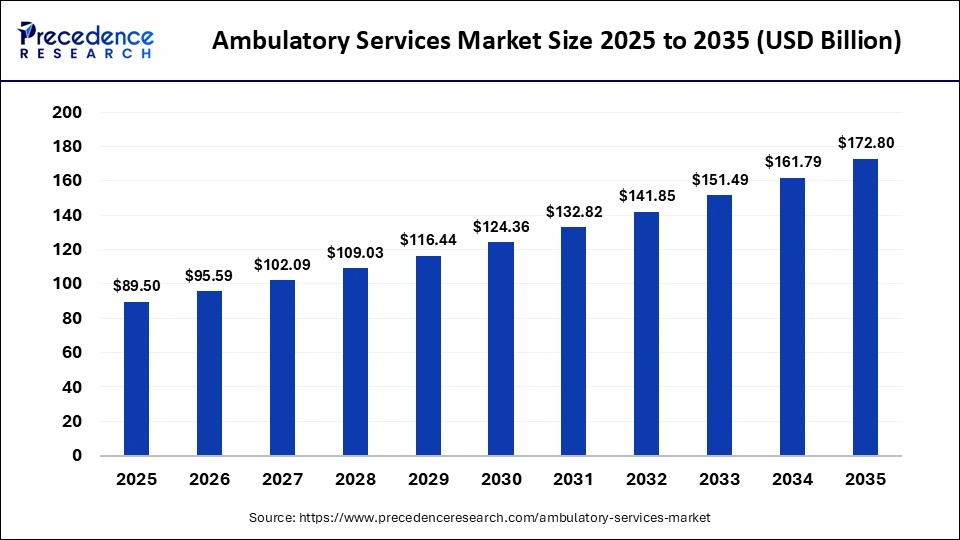
by The global ambulatory services market size was valued at USD 89.50 billion in 2025 and is projected to grow from USD 95.59 billion in 2026 to approximately USD 172.80 billion by 2035, expanding at a CAGR of 6.80% from 2026 to 2035. The market is witnessing strong momentum as healthcare providers and patients increasingly shift from inpatient hospital stays to cost-effective outpatient care models. Ambulatory services are becoming the preferred option for surgeries, diagnostics, preventive care, and specialty consultations due to shorter recovery times, lower costs, and greater convenience.
Read Also: Inpatient Services Market
Quick Insights: What is Driving the Ambulatory Services Market?
- The global ambulatory services market is expected to rise from USD 95.59 billion in 2026 to USD 172.80 billion by 2035.
- North America held the largest market share of 35% in 2025 due to its advanced healthcare infrastructure and high adoption of outpatient services.
- Asia Pacific is projected to expand at the fastest CAGR of 8.0% during the forecast period because of improving healthcare access and rising outpatient demand.
- Surgical services emerged as the leading service type, accounting for 55% of total market revenue in 2025.
- Orthopedic surgery dominated the specialization segment with a 25% share in 2025.
- Private ownership accounted for 60% of the market in 2025 due to greater operational flexibility and strong investment capacity.
- Private insurance remained the dominant payer segment with a 40% share in 2025.
Market Revenue Snapshot
| Category | 2025 | 2026 | 2035 |
|---|---|---|---|
| Global Market Size | USD 89.50 Billion | USD 95.59 Billion | USD 172.80 Billion |
| North America Market Size | USD 31.33 Billion | – | USD 61.34 Billion |
| U.S. Market Size | USD 23.49 Billion | – | USD 46.31 Billion |
How is AI Transforming the Ambulatory Services Market?
Artificial intelligence is playing a crucial role in improving the efficiency and effectiveness of ambulatory care settings. AI-driven diagnostic tools are enabling healthcare providers to identify diseases earlier and with greater accuracy. Predictive analytics is helping physicians assess patient risk profiles and recommend preventive interventions before conditions worsen.
AI is also being integrated into telehealth platforms, patient scheduling systems, and electronic health records to streamline operations and reduce administrative burden. Virtual assistants, chatbots, and remote patient monitoring technologies are improving patient engagement while supporting better clinical outcomes. As healthcare providers focus more on value-based care, AI is expected to become a central pillar of ambulatory service delivery.
What are the Major Growth Factors Supporting the Ambulatory Services Market?
The market is expanding because of several important factors:
- Increasing prevalence of chronic diseases such as diabetes, cardiovascular conditions, and musculoskeletal disorders.
- Rising demand for minimally invasive surgical procedures with faster recovery times.
- Greater patient preference for outpatient care because of affordability and convenience.
- Growth of telehealth and digital health technologies that support remote consultations and follow-up care.
- Expanding elderly population requiring long-term monitoring and treatment.
- Supportive government reimbursement policies and investments in healthcare modernization.
Why is Preventive and Outpatient Care Becoming More Important?
Preventive care is becoming a major focus area in ambulatory settings because healthcare systems are trying to reduce the burden on hospitals and lower treatment costs. Ambulatory centers now offer preventive screenings, vaccinations, wellness programs, and early disease detection services. These services help identify health conditions before they become severe, reducing emergency room visits and lengthy hospital stays.
Patients are also choosing outpatient care because it allows them to receive treatment without disrupting their daily routines. This trend is especially visible in specialties such as orthopedics, cardiology, gastroenterology, and ophthalmology, where same-day procedures are becoming increasingly common.
Segment Analysis
Why Did Surgical Services Dominate the Market?
The surgical services segment accounted for 55% of the market in 2025, making it the largest service type category. This dominance is driven by increasing volumes of minimally invasive surgeries, outpatient orthopedic procedures, cataract surgeries, and same-day gastrointestinal interventions. Patients prefer outpatient surgical centers because they offer lower treatment costs, reduced infection risks, and shorter recovery periods.
Which Service Type is Expected to Grow the Fastest?
The diagnostic and therapeutic services segment is expected to grow at the fastest CAGR of 7.5% through 2035. The rising focus on early diagnosis, preventive care, imaging technologies, laboratory testing, and personalized treatment plans is fueling this growth.
Why Did Orthopedic Surgery Lead the Specialization Segment?
Orthopedic surgery held the highest share of 25% in 2025 because of the increasing prevalence of musculoskeletal disorders, sports injuries, arthritis, and joint replacement procedures. Advances in minimally invasive techniques and rehabilitation services have made orthopedic procedures more suitable for ambulatory care settings.
What is Driving Growth in Cardiology and Gastroenterology?
Cardiology is expected to grow strongly due to rising rates of heart disease and the increasing use of outpatient angioplasty, catheterization, and cardiac monitoring services. Gastroenterology is also expected to expand rapidly because of higher demand for colonoscopies, endoscopies, and digestive health procedures.
Regional Analysis
Why Did North America Lead the Market?
North America dominated the ambulatory services market with a 35% share in 2025. The region benefits from well-developed outpatient care networks, strong insurance coverage, high healthcare spending, and supportive reimbursement systems. The growing elderly population and rising incidence of chronic diseases are further strengthening demand for ambulatory services across the region.
In the United States, outpatient care continues to gain traction because of a robust network of ambulatory surgery centers, diagnostic centers, and telehealth providers. Government-supported reimbursement frameworks such as Medicare and Medicaid also support continued market expansion.
Why is Asia Pacific Emerging as the Fastest-Growing Region?
Asia Pacific is expected to grow at the fastest CAGR of 8.0% through 2035 because of rapid healthcare modernization, rising outpatient demand, and increased healthcare spending. Countries such as China, India, Japan, and South Korea are investing heavily in outpatient clinics, telemedicine, and diagnostic infrastructure. Growing awareness of preventive care and increasing middle-class populations are also contributing to market growth.
What Role is Europe Playing in the Market?
Europe accounted for 30% of the global market in 2025 and remains a major growth region due to its aging population, strong public healthcare systems, and increasing emphasis on cost-effective outpatient treatment. Countries such as Germany, France, and the UK are expanding ambulatory services to reduce hospital overcrowding and improve access to care.
Ambulatory Surgical Center Market Companies
- HCA Healthcare, Inc.
- Tenet Healthcare Corporation
- Mednax, Inc.
- Surgical Care Affiliates (SCA)
- UnitedHealth Group (Optum Health)
- AmSurg Corporation (Envision Healthcare)
- Ramsay Healthcare
- DaVita Inc.
- MediPost, Inc.
- Fresenius Medical Care
- USPI (Universal Surgical Partners, Inc.)
- Northwell Health
- Community Health Systems, Inc.
- Regents Health Services
- Alcon, Inc.
Challenges Facing the Market
Despite its strong outlook, the ambulatory services market faces certain barriers. One of the biggest concerns is the risk of delayed or incorrect diagnosis in outpatient settings, especially when patient interaction time is limited or clinical information is fragmented. Misdiagnosis can lead to serious complications, particularly in chronic diseases and cancer care.
Another challenge is the financial burden associated with advanced outpatient treatments and technologies. Although ambulatory services are generally more affordable than inpatient care, specialized procedures and digital technologies can still create cost pressures for providers and patients.
Case Study: How Outpatient Orthopedic Surgery is Changing Patient Care
Orthopedic ambulatory care centers are increasingly performing knee arthroscopy, joint repair, and minor fracture surgeries without requiring overnight hospitalization. Patients benefit from shorter waiting times, quicker rehabilitation, and lower medical bills. This model has proven particularly effective in urban healthcare systems where hospitals are under pressure to manage high patient volumes efficiently.
Get Sample Copy: https://www.precedenceresearch.com/sample/8311
For inquiries regarding discounts, bulk purchases, or customization requests, please contact us at sales@precedenceresearch.com

