
 by
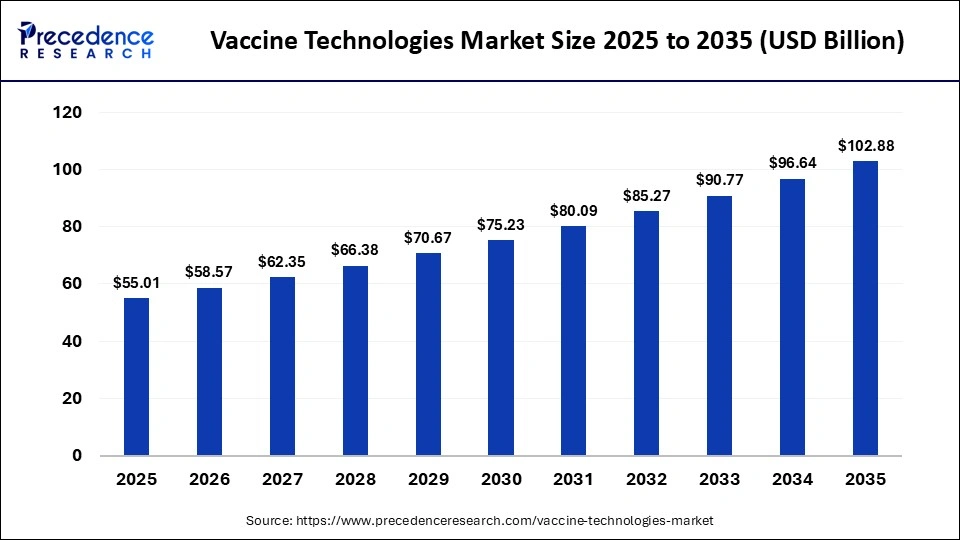
by The global Vaccine Technologies Market size was valued at USD 55.01 billion in 2025 and is projected to grow from USD 58.57 billion in 2026 to approximately USD 102.88 billion by 2035, expanding at a CAGR of 6.46% from 2026 to 2035. The market is witnessing strong expansion driven by breakthroughs in mRNA platforms, recombinant technologies, nanoparticle-based vaccines, and AI-powered drug discovery systems, enhancing pandemic preparedness, accelerating production timelines, and improving vaccine stability and distribution efficiency worldwide.
Read Also: Pediatric Vitrectomy Market
Market Overview
Vaccine technologies play a critical role in reducing global morbidity and mortality by preventing infectious diseases and supporting public health systems. The market encompasses multiple vaccine platforms, including:
-
Live-attenuated vaccines
-
Inactivated vaccines
-
Recombinant, conjugate, and subunit vaccines
-
mRNA and DNA vaccines
-
Toxoid vaccines
The COVID-19 pandemic significantly accelerated the adoption of advanced genetic vaccine platforms, particularly mRNA technologies, setting the stage for rapid-response vaccine development for future outbreaks.
Growing demand for combination vaccines, RSV vaccines, influenza strain updates, and needle-free delivery systems is further fueling global market expansion.
Key Takeaways
-
North America dominated the global market in 2025.
-
Asia-Pacific is projected to grow at the fastest CAGR during 2026–2035.
-
By technology, recombinant, conjugate, and subunit vaccines held the largest share in 2025.
-
Inactivated vaccines are expected to grow at the fastest CAGR.
-
By delivery method, parenteral vaccines accounted for the highest revenue share in 2025.
-
Oral vaccines are expected to expand rapidly.
-
By type, multivalent vaccines dominated in 2025.
-
Monovalent vaccines are projected to grow at the fastest CAGR through 2035.
What is Driving the Vaccine Technologies Market?
1. Shift Toward Genetic-Based Vaccines
mRNA and DNA vaccines enable rapid antigen design, faster production cycles, and improved safety by eliminating the need for live pathogens.
2. Growing Demand for Combination Vaccines
Multivalent vaccines reduce the number of injections and improve compliance, especially in pediatric immunization programs.
3. Government Immunization Initiatives
Expanded public vaccination programs across developed and emerging economies are increasing procurement volumes.
4. Rapid R&D Investments and Strategic Partnerships
Public-private collaborations are accelerating vaccine discovery, manufacturing scale-up, and global distribution.
Role of AI in Vaccine Technologies
Artificial Intelligence (AI) is transforming vaccine development by:
-
Analyzing genomic and proteomic datasets
-
Identifying immunogenic antigens
-
Predicting B-cell and T-cell epitopes
-
Enhancing protein structure modeling
-
Accelerating candidate screening
Machine learning (ML) algorithms significantly reduce development timelines by predicting immunogenicity and antigenic epitopes early in the preclinical stage. AI-driven vaccine discovery platforms are reducing costs and improving efficacy outcomes.
Key Market Trends
Genetic-Based Vaccines
mRNA and DNA platforms allow vaccine design within weeks instead of years. These platforms are scalable and adaptable to new variants, making them ideal for pandemic response.
Advanced Delivery Systems (ADS)
Advanced delivery technologies improve:
-
Antigen stability
-
Controlled immune response
-
Cold-chain reliability
-
Alternative administration routes (oral, nasal, microneedles)
Digital & AI Integration
AI-driven analytics improve antigen selection and variant coverage, while digital systems optimize clinical trial design and pharmacovigilance monitoring.
Segmental Insights
By Technology
Recombinant, Conjugate, and Subunit Vaccines – Market Leader
This segment dominated in 2025 due to:
-
High safety profiles
-
Targeted immune responses
-
Cost-effective manufacturing
-
Stability without ultra-cold storage
These vaccines are widely used in addressing pandemic threats and infectious diseases.
Inactivated Vaccines – Fastest Growing
Inactivated vaccines are projected to grow rapidly because they:
-
Offer proven safety
-
Provide a broad immune response
-
Require standard refrigeration
-
Support immunization in low-resource settings
They remain essential in vaccines against polio, hepatitis A, rabies, and influenza.
By Delivery Method
Parenteral Vaccines – Dominant Segment
Parenteral administration (intramuscular, subcutaneous, intradermal) led in 2025 due to:
-
High bioavailability
-
Rapid immune activation
-
Reliable dosing
-
Compatibility with mRNA and subunit vaccines
Oral Vaccines – Rapid Expansion
Oral vaccines are gaining traction due to:
-
Needle-free administration
-
Enhanced mucosal immunity
-
Cost-effective manufacturing
-
Large-scale distribution feasibility
These vaccines are especially valuable in pediatric immunization and pandemic settings.
By Type
Multivalent Vaccines – Largest Share
Multivalent vaccines dominated in 2025 because they:
-
Protect against multiple strains
-
Reduce clinic visits
-
Improve compliance
-
Enhance logistical efficiency
Monovalent Vaccines – Fastest Growing
Monovalent vaccines are expanding due to:
-
Targeted immunity against dominant strains
-
Easier rapid development
-
Higher strain-specific immune response
For inquiries regarding discounts, bulk purchases, or customization requests, please contact us at sales@precedenceresearch.com

