 by
by For pharmaceutical and biotechnology companies, choosing a sterile injectable CDMO is not simply about finding available filling capacity. The real challenge is finding a partner that can consistently protect sterility, product quality, manufacturing capacity, timelines, and regulatory compliance from clinical batches through commercial supply.
This is especially important for injectable drugs because the manufacturing process is more complex and less forgiving than many oral dosage forms. FDA has noted that sterile injectables can be particularly vulnerable to shortages because there may be fewer manufacturers, limited production capacity, long manufacturing lead times, and complex production requirements.
According to Towards Healthcare, the global sterile injectables CDMO sector was valued at USD 37.85 billion in 2025 and is projected to reach USD 109.82 billion by 2035, expanding at a 11.24% CAGR from 2026 to 2035.
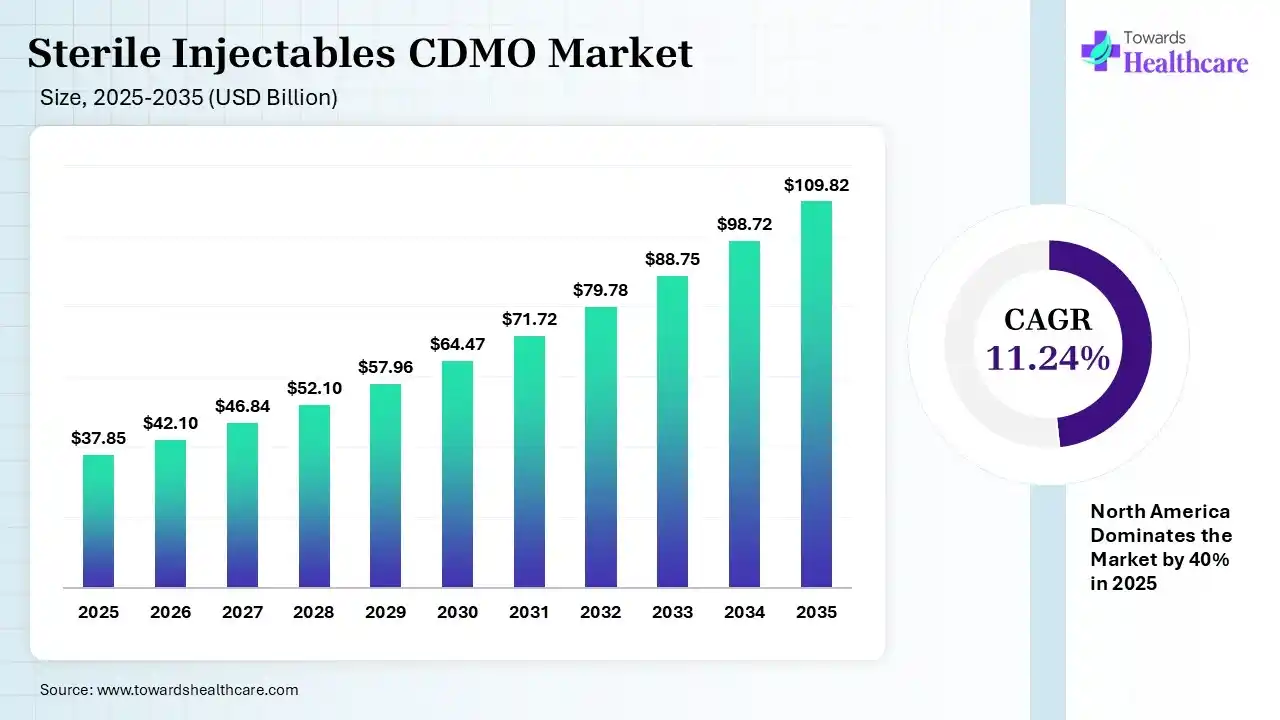
Get a Preview of Our Industry Analysis: https://www.towardshealthcare.com/download-sample/6793
So, which U.S. CDMOs stand out for sterile injectable and aseptic fill-finish services and what are pharmaceutical buyers actually looking for?
Leading U.S. Sterile Injectable CDMOs
Towards Healthcare identifies several important U.S.-based players, including Simtra BioPharma Solutions, PCI Pharma Services, INCOG BioPharma Services, Grand River Aseptic Manufacturing, Baxter BioPharma Solutions, Thermo Fisher Scientific, Catalent, and Alcami.
For this comparison, two particularly interesting U.S. providers are Simtra BioPharma Solutions and INCOG BioPharma Services because they represent different approaches to sterile injectable manufacturing.
Simtra BioPharma Solutions vs. INCOG BioPharma Services
| Factor | Simtra BioPharma Solutions | INCOG BioPharma Services |
|---|---|---|
| U.S. presence | Strong | Strong |
| Sterile injectable manufacturing | Yes | Yes |
| Aseptic fill-finish | Core capability | Core capability |
| Lyophilization | Yes | Focused capability |
| Biologics support | Yes | Yes |
| Clinical-to-commercial support | Yes | Yes |
| Key strength | Scale and established sterile manufacturing | Newer, purpose-built injectable/biologics infrastructure |
| Best fit | Larger or complex sterile programs | Emerging and growth-stage injectable programs |
Towards Healthcare identifies Simtra, headquartered in Bloomington, Indiana, as one of the largest dedicated sterile injectable CDMOs, offering sterile injectables, lyophilization, and aseptic manufacturing. It identifies INCOG, headquartered in Fishers, Indiana, as a rapidly expanding provider focused on biologics manufacturing and fill-finish.
Simtra BioPharma Solutions
Simtra is particularly relevant for companies looking for an established sterile manufacturing partner.
Towards Healthcare describes Simtra as a dedicated sterile injectable CDMO with capabilities spanning sterile injectables, lyophilization, and aseptic manufacturing.
That combination matters because injectable products do not always arrive as straightforward liquid fills. Some products require lyophilization, specialized vial configurations, controlled environments, and extensive quality controls.
For a pharmaceutical company planning commercial supply, manufacturing scale and experience can be just as important as the filling technology itself.
INCOG BioPharma Services
INCOG represents a newer generation of U.S. sterile manufacturing infrastructure.
Towards Healthcare identifies the company as an Indiana-based provider expanding biologics and injectable capacity, with capabilities covering biologics manufacturing and fill-finish.
This type of infrastructure can be particularly relevant to biotechnology companies developing newer injectable and biologic therapies that need a U.S.-based manufacturing partner.
What Do Pharmaceutical Buyers Actually Want From a Sterile Injectable CDMO?
This is where government data becomes particularly useful.
There is no single FDA or U.S. government survey that assigns a percentage ranking to what CDMO buyers want. Therefore, it would be misleading to say, for example, “70% of buyers prioritize sterility.”
However, FDA and U.S. Government Accountability Office evidence shows which manufacturing factors repeatedly create supply and quality problems. These are strong indicators of what buyers should prioritize when evaluating a sterile injectable CDMO.
1. Sterility Assurance Comes First
This is arguably the most fundamental requirement.
GAO reported that FDA officials and manufacturers identified lack of assurance of sterility and particulate matter among the most common manufacturing problems affecting sterile injectable drugs.
That means buyers should look beyond whether a CDMO simply says it offers “aseptic fill-finish.”
They should examine:
- Aseptic processing controls
- Environmental monitoring
- Sterility testing
- Media-fill performance
- Contamination-control strategy
- Facility design
- Personnel qualification
- Cleaning and sterilization validation
The lesson is simple: filling a vial is not enough; maintaining sterility throughout the process is the real requirement.
2. Reliable Manufacturing Capacity
Capacity is another major concern.
FDA explains that sterile injectable shortages can become more severe when only a limited number of firms have production lines capable of making particular products. Limited capacity, long lead times, and manufacturing complexity can make it difficult for another manufacturer to quickly replace lost supply.
GAO similarly found that constrained manufacturing capacity can prevent other manufacturers from making up for supply disruptions.
For buyers, this means asking:
Can the CDMO manufacture my product when I actually need it—not simply when capacity happens to be available?
That makes capacity planning, expansion plans, scheduling flexibility, and redundancy important purchasing considerations.
3. Strong Quality Systems
Government data also highlights why quality history matters.
GAO found that quality problems were an immediate cause of many drug shortages reviewed in its analysis, with sterile injectable shortages particularly affected by manufacturing-quality issues.
For a buyer, this translates into a much broader due-diligence checklist:
How mature is the CDMO’s quality system?
A buyer should evaluate:
- FDA inspection history
- Deviation management
- CAPA systems
- Change control
- Batch-release processes
- Environmental monitoring
- Data integrity
- Validation programs
A low-cost CDMO with inconsistent quality can ultimately become much more expensive if batches are delayed, rejected, or recalled.
4. Commercial-Scale Manufacturing
A CDMO that can manufacture clinical batches is not automatically the right partner for commercial supply.
Towards Healthcare highlights the importance of clinical-to-commercial-scale production within the sterile injectable CDMO landscape. Simtra, for example, is identified as providing sterile injectable manufacturing and support across different production stages.
For buyers, the question becomes:
Can the same partner help us move from clinical supply to commercial production without rebuilding the manufacturing process from scratch?
That can reduce technology-transfer risk and simplify long-term supply planning.
5. Lyophilization Capability
Lyophilization can be an important differentiator for injectable products that require improved stability.
Towards Healthcare identifies lyophilization as one of Simtra’s key sterile injectable capabilities.
For buyers developing products that require freeze-drying, the availability of integrated formulation, filling, and lyophilization capabilities can reduce the need to coordinate multiple manufacturing partners.
6. Support for Complex Injectables and Biologics
The injectable pipeline is becoming more sophisticated.
Biologics, biosimilars, oncology products, high-potency therapies, and advanced injectable formulations can require specialized containment, formulation, filling, and packaging capabilities.
Towards Healthcare identifies the increasing adoption of outsourced sterile injectable manufacturing, aseptic fill-finish technologies, biologics and biosimilar manufacturing, and lyophilized sterile injectable production as important drivers of the sector.
For buyers, this means the CDMO’s technology platform needs to match the product—not the other way around.
7. U.S. Manufacturing Matters More Than Ever
Another important consideration is supply-chain resilience.
FDA notes that sterile injectable drugs can be particularly vulnerable when there are few manufacturers and limited production capacity.
This is helping maintain interest in U.S.-based manufacturing capacity.
Towards Healthcare’s U.S. pharmaceutical CDMO analysis identifies companies including Thermo Fisher Scientific, Catalent, Baxter BioPharma Solutions, Alcami, PCI Pharma Services, and others within the U.S. CDMO landscape.
For companies selling products in the United States, domestic manufacturing can offer potential advantages in supply-chain planning, logistics, and responsiveness.
Why Aseptic Fill-Finish Is Becoming a Strategic Decision
Aseptic fill-finish is no longer simply the final manufacturing step.
It can influence:
Product quality → regulatory compliance → supply reliability → launch timelines → cost → patient access
A failure at the fill-finish stage can affect an entire batch even when upstream drug-substance manufacturing has gone perfectly.
This is why CDMO selection should involve manufacturing, quality, regulatory, procurement, and supply-chain teams not just the sourcing department.
The Market Is Growing Rapidly
The growth numbers reinforce the importance of this decision.
Towards Healthcare estimates:
- USD 37.85 billion – global sterile injectables CDMO sector in 2025
- USD 42.1 billion – projected value in 2026
- USD 109.82 billion – projected value by 2035
- 11.24% CAGR – expected growth from 2026 to 2035
Towards Healthcare also identifies Tier 1 companies as accounting for approximately 58% of market influence, followed by Tier 2 at 29% and Tier 3 at 13%.
This indicates that a relatively concentrated group of experienced providers has significant influence over sterile injectable manufacturing capacity.
What Should Buyers Ask Before Selecting a CDMO?
Instead of asking only “What is your fill-finish capacity?”, pharmaceutical companies should ask:
Quality
- What is your contamination-control strategy?
- How are media fills qualified?
- How do you manage deviations and CAPAs?
- What is your recent regulatory inspection history?
Capacity
- What filling lines are currently available?
- How much capacity is reserved for new customers?
- Can capacity scale with commercial demand?
- Is there manufacturing redundancy?
Technology
- Can you handle vials, syringes, or cartridges?
- Do you offer lyophilization?
- Can you handle biologics or high-potency products?
- What formulation and analytical services are available?
Commercialization
- Can you support clinical through commercial manufacturing?
- How do you manage technology transfer?
- What are your typical manufacturing lead times?
- Can you support launch volumes?
Supply Chain
- Where are critical raw materials sourced?
- How do you manage supply disruptions?
- What contingency plans exist for equipment or facility downtime?
These questions are especially important given FDA and GAO findings around sterility, quality problems, limited capacity, and supply disruptions.
Expert Perspective by Payal Rabde – uncovering key trends and opportunities across the healthcare industry.
Explore the latest healthcare insights, all in one dashboard.
https://www.towardshealthcare.com/access-dashboard
About Us
Pharma Geek is a part of Towards Healthcare Research & Consulting which is a global healthcare market research and consulting firm dedicated to helping businesses make informed decisions through reliable market intelligence and strategic insights. We serve pharmaceutical, biotechnology, medical device, AI in healthcare, cell and gene therapy, digital health, and life sciences organizations with in-depth market research, custom consulting, competitive analysis, and growth forecasts. Our team combines industry expertise with rigorous research to deliver clear, actionable insights that support market expansion, product strategy, investment decisions, and long-term business growth. From emerging innovations to established healthcare markets, we help organizations understand where the industry is today and where it’s headed tomorrow.
You can place an order or ask any questions, please feel free to contact us at [email protected]
Europe Region – +44 778 256 0738
North America Region – +1 8044 4193 44
APAC Region: +91 9356 9282 04
Visit Our Website: Towards Healthcare Research & Consulting – Expert Consulting Solutions & Research Reports
Find us on social platforms: LinkedIn | Twitter | Instagram | Medium
