by
by What is the Viral and Non-Viral Vectors Market Size in 2026?
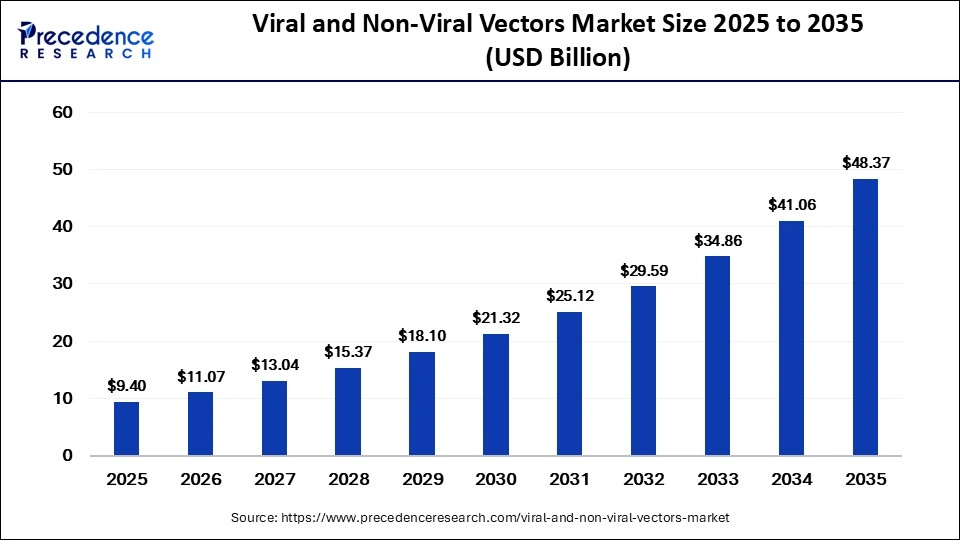
The global viral and non-viral vectors market was valued at USD 9.40 billion in 2025 and is projected to grow from USD 11.07 billion in 2026 to USD 48.37 billion by 2035, registering a CAGR of 17.80% during the forecast period from 2026 to 2035.
Key Takeaways
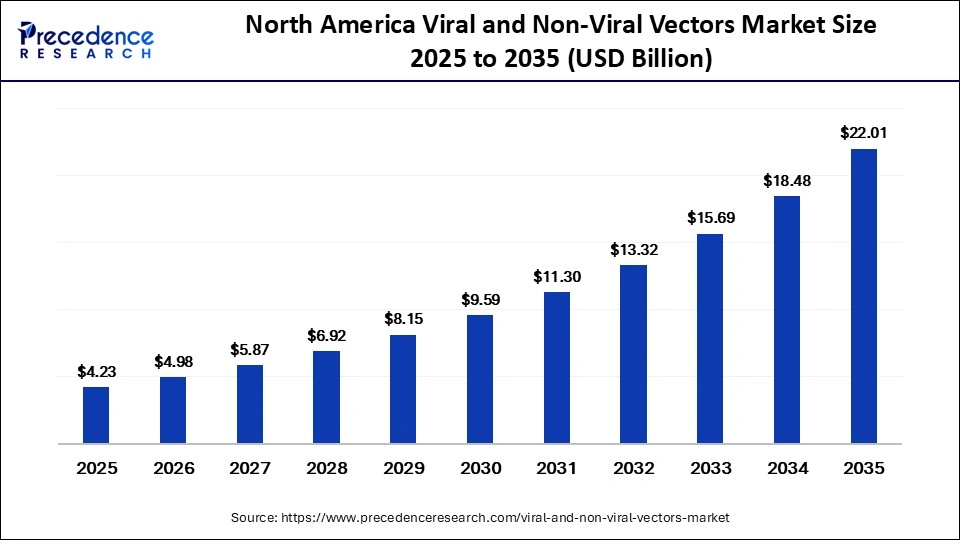
- North America led the viral and non-viral vectors market in 2025 with a 45% share.
- Asia Pacific is observed to grow at the fastest CAGR of 22.5% during the forecast period.
- By vector type, the viral vectors segment led the market with a 70% share in 2025.
- By vector type, the non-viral vectors segment is expected to grow at the fastest CAGR of 22.5% in the upcoming period.
- By disease indication, the oncology segment led the global market in 2025 with a 40% share and is expected to grow at the fastest CAGR of 19% in the foreseeable period.
- By application, the gene therapy segment led the global market in 2025 with a 35% share.
- By application, the cell therapy segment is expected to grow at the fastest CAGR of 20% in the coming years.
- By end-use, the pharmaceutical & biotechnology companies segment led the global market in 2025 with a 50% share.
- By end-use, the CROS/CDMOS segment is observed to expand at the fastest CAGR of 20.5% in the upcoming period.
- By delivery mode, the in vivo gene delivery segment led the global market in 2025 with a 55% share and is expected to grow at the fastest CAGR of 18.5% over the forecast period.
Impact of Artificial Intelligence on the Viral and Non-Viral Vectors Market
Artificial intelligence (AI) is playing a pivotal role in improving treatment efficiency across the healthcare sector. AI-powered models and algorithms are enabling the development of advanced targeted gene delivery systems capable of overcoming extracellular and intracellular barriers by leveraging mechanisms that mimic viral behavior. The integration of AI with viral and non-viral vector platforms is expected to accelerate the development of safer, more effective, and consistently administered gene therapies, offering significant potential for the treatment of a wide range of genetic and acquired disorders.
Viral and Non-Viral Vectors Market Overview
Viral vectors are engineered from viruses and leverage their natural ability to enter cells and deliver genetic material directly into the nucleus. Non-viral vectors, on the other hand, include naked DNA, particle-based carriers, and chemical-based delivery systems. These vectors can be introduced through direct plasmid or naked DNA delivery, as well as various chemical and physical transfection techniques.
Viral transfection is widely preferred due to its high efficiency, strong specificity, and effectiveness in difficult-to-transfect cells, while also offering relatively lower operational complexity and cost. However, non-viral approaches provide significant advantages in terms of safety, reduced immunogenicity, and greater flexibility for targeting specific cell types and diseases. The complementary benefits of both vector types are driving innovation and creating substantial growth opportunities in the viral and non-viral vectors market.
Market Scope
| Report Coverage | Details |
| Market Size in 2025 | USD 9.40 Billion |
| Market Size in 2026 | USD 11.07 Billion |
| Market Size by 2035 | USD 48.37 Billion |
| Market Growth Rate from 2026 to 2035 | CAGR of 17.80% |
| Dominating Region | North America |
| Fastest Growing Region | Asia Pacific |
| Base Year | 2025 |
| Forecast Period | 2026 to 2035 |