
 by
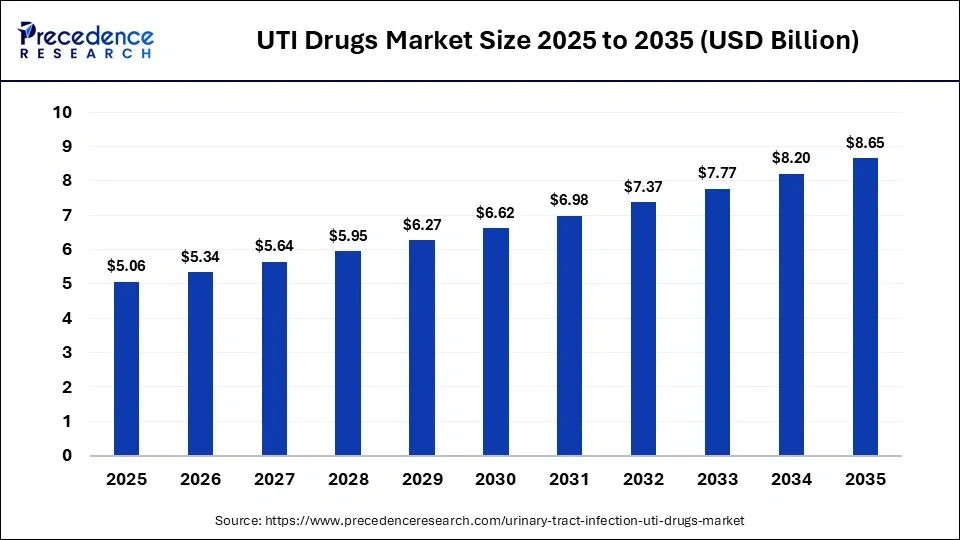
by The global UTI drugs market is experiencing steady growth due to the rising prevalence of urinary tract infections (UTIs) and increasing concerns around antibiotic resistance. The market size was valued at USD 5.06 billion in 2025 and is projected to grow from USD 5.34 billion in 2026 to approximately USD 8.65 billion by 2035, expanding at a CAGR of 5.50% during the forecast period.
Read Also: Quantum Skin Care Market
Market Overview
The UTI drugs market includes prescription therapies used to treat and prevent urinary tract infections such as uncomplicated cystitis, complicated UTIs, pyelonephritis, and recurrent infections. UTIs are among the most common bacterial infections globally, particularly affecting women and older adults.
Growing healthcare awareness, improved diagnostic tools, and increasing investments in pharmaceutical innovation are driving the demand for more targeted and effective treatment options. Additionally, the shift toward combination therapies and precision medicine is reshaping the treatment landscape.
Key Market Highlights
-
North America dominated the market with a 33.6% share in 2025
-
Asia Pacific is expected to grow at the fastest CAGR.
-
Fluoroquinolones segment led the market with 22.4% share
-
Carbapenems expected to grow at a 6.2% CAGR
-
Oral administration dominated with 63.7% share
-
Uncomplicated UTI segment accounted for 68.6% share
-
Hospital pharmacies led distribution with 39.6% share
-
Online pharmacies expected to grow fastest at 7.9% CAGR
What is Driving the UTI Drugs Market?
The growth of the UTI drugs market is primarily driven by the high prevalence of infections, especially among women and elderly populations. Increasing antibiotic resistance is also pushing the development of new and advanced treatment options.
Key growth drivers include:
-
Rising incidence of UTIs globally
-
Growing elderly population and diabetes prevalence
-
Increasing antibiotic resistance among pathogens
-
Advancements in rapid diagnostic technologies
-
Rising demand for targeted and combination therapies
Untreated UTIs can lead to severe complications such as kidney infections and sepsis, making early diagnosis and treatment critical. This has significantly increased the demand for effective drug therapies.
Role of AI in the UTI Drugs Market
Artificial Intelligence (AI) is transforming the UTI drugs market by enabling faster drug discovery and improving diagnostic accuracy. AI systems can analyze patient data to recommend the most effective antibiotics, reducing reliance on broad-spectrum drugs.
AI also helps in:
-
Identifying new antimicrobial compounds
-
Predicting drug resistance patterns
-
Enhancing personalized treatment plans
-
Accelerating clinical research and development
This shift toward precision medicine is improving treatment outcomes and addressing the global challenge of antimicrobial resistance.
Key Market Trends
Rising Incidence of UTIs
Increasing cases of UTIs due to aging populations, diabetes, and lifestyle changes are driving market demand.
Rapid Diagnostics and Precision Treatment
Advanced diagnostic tools are enabling targeted therapies, reducing unnecessary antibiotic usage.
Growth of Non-Antibiotic Therapies
There is increasing adoption of alternatives such as probiotics, vaccines, cranberry extracts, and D-mannose for long-term management.
Shift Toward Personalized Medicine
Healthcare providers are focusing on individualized treatment approaches to improve effectiveness and reduce recurrence.
Segment Insights
Drug Class Insights
The fluoroquinolones segment dominated the market in 2025 due to its broad-spectrum activity, high effectiveness, and ease of use.
The carbapenems segment is expected to grow rapidly as it serves as a critical treatment option for multidrug-resistant infections.
Route of Administration Insights
The oral segment led the market with a 63.7% share in 2025 due to its convenience, cost-effectiveness, and suitability for treating most uncomplicated UTIs.
The intramuscular segment is expected to grow steadily, especially for severe infections requiring rapid drug absorption.
Indication Type Insights
The uncomplicated UTI segment dominated the market due to its high occurrence and ease of treatment with oral antibiotics.
The complicated UTI segment is projected to grow at a notable rate due to increasing antibiotic resistance and rising elderly population.
Distribution Channel Insights
The hospital pharmacy segment led the market due to the high volume of severe and complicated cases treated in hospitals.
The online pharmacy segment is expected to grow fastest due to convenience, home delivery, and integration with telemedicine services.
Regional Analysis
North America
North America held the largest market share in 2025, driven by advanced healthcare infrastructure, high awareness, and strong pharmaceutical R&D investments.
Asia Pacific
Asia Pacific is expected to grow at the fastest rate due to increasing population, rising infection rates, and improving healthcare systems.
Europe
Europe is witnessing steady growth supported by increasing focus on antimicrobial resistance and improved healthcare access.
Latin America & Middle East
These regions are emerging markets with growing healthcare investments and increasing adoption of modern treatment options.
Competitive Landscape
Key players in the UTI drugs market include:
-
Pfizer Inc.
-
AbbVie Inc.
-
Bayer AG
-
Novartis International AG
-
Sanofi S.A.
-
Teva Pharmaceutical Industries Ltd
-
Cipla Ltd
-
AstraZeneca plc
-
Merck & Co. Inc
-
GlaxoSmithKline plc
Recent Developments
-
In August 2025, Iterum Therapeutics launched Orlynvah, the first oral penem antibiotic for uncomplicated UTIs in over 25 years.
-
In August 2025, GSK received approval for Blujepa (gepotidacin), a novel antibiotic effective against drug-resistant UTI pathogens.
Conclusion
The global UTI drugs market is poised for steady growth as the burden of infections continues to rise. With advancements in AI, rapid diagnostics, and the development of new therapies, the market is evolving toward more precise and effective treatment solutions. Increasing focus on antimicrobial resistance and personalized medicine will further shape the future of this market.
Get Sample Link: https://www.precedenceresearch.com/checkout/8091
For inquiries regarding discounts, bulk purchases, or customization requests, please contact us at sales@precedenceresearch.com

- UTI Drugs Market Size to Reach USD 8.65 Billion by 2035 - March 20, 2026
- Quantum Skin Care Market Size to Hit USD 11.21 Billion by 2035 - March 20, 2026
- Financial Smart Cards Market Size to Reach USD 47.46 Billion by 2035 - March 17, 2026
