
 by
by Smart Drugs Market Size in 2026
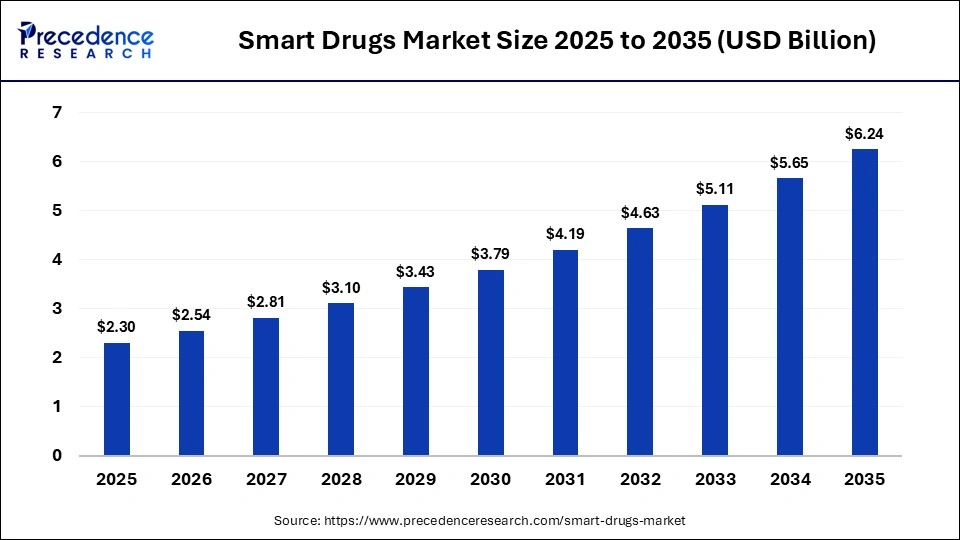
The global smart drugs market is witnessing substantial growth, driven by increasing demand for cognitive enhancement and rising awareness of mental health. The market size was valued at USD 2.30 billion in 2025 and is projected to grow from USD 2.54 billion in 2026 to approximately USD 6.24 billion by 2035, expanding at a compound annual growth rate (CAGR) of 10.50% during the forecast period.
This growth is fueled by the rising prevalence of neurological disorders, increasing adoption of cognitive enhancers among students and professionals, and advancements in neurotechnology and biotechnology. Additionally, the growing interest in non-invasive and performance-enhancing solutions is further accelerating market expansion.
Read Also: Oral Obesity Therapies Market
Key Takeaways
- North America dominated the global smart drugs market with a 39.60% share in 2025
- Asia Pacific is expected to be the fastest-growing region during the forecast period
- By drug class, the stimulants segment held the largest share of 36.70% in 2025
- By indication, attention deficit hyperactivity disorder (ADHD) accounted for 33.60% market share
- By distribution channel, retail pharmacies dominated with 55.70% share in 2025
- By dosage form, tablets led the market with 56.60% share
- Specialty neurology and psychiatry clinics emerged as the leading end-user segment
What are Smart Drugs?
Smart drugs, also known as nootropics, are pharmacological substances designed to improve cognitive functions such as memory, focus, alertness, and learning ability. These drugs are primarily prescribed for conditions like ADHD, Alzheimer’s disease, narcolepsy, and other cognitive impairments.
The market includes various drug classes such as stimulants, wakefulness-promoting agents, cholinesterase inhibitors, and NMDA receptor antagonists. These medications are distributed through hospital pharmacies, retail pharmacies, and online platforms, catering to both clinical and off-label cognitive enhancement needs.
Market Dynamics
Key Growth Drivers
1. Rising Prevalence of Neurological Disorders
Increasing cases of ADHD, Alzheimer’s disease, and sleep disorders are significantly boosting demand for smart drugs worldwide.
2. Growing Demand for Cognitive Enhancement
Students, professionals, and aging populations are increasingly adopting nootropics to improve productivity, focus, and mental performance.
3. Technological Advancements in Neuropharmacology
Innovations such as smart pills, ingestible sensors, and AI-driven drug discovery are enhancing treatment efficiency and patient outcomes.
4. Expansion of Digital Healthcare Ecosystems
The integration of wearable devices, biosensors, and connected health platforms is supporting continuous monitoring and personalized treatment.
Role of Technology in the Smart Drugs Market
Technology plays a crucial role in transforming the smart drugs industry:
- Artificial Intelligence (AI): Accelerates drug discovery by predicting molecular interactions and reducing research timelines
- Smart Pills: Equipped with sensors for real-time monitoring of drug ingestion and patient response
- Internet of Medical Things (IoMT): Enables continuous cognitive and physiological monitoring through wearable devices
These innovations are not only improving treatment accuracy but also enhancing patient compliance and clinical outcomes.
Smart Drugs Market Trends
1. Personalized Nootropics
AI and big data analytics are enabling the development of customized cognitive enhancers based on individual genetics, lifestyle, and health data.
2. Growing Demand for Clean-Label Products
Consumers are increasingly preferring natural and organic nootropics such as plant-based supplements due to safety concerns.
3. Integration of Wearable Technology
Wearable devices and biosensors are being used to track cognitive performance and optimize drug effectiveness in real time.
4. Rising Popularity of Smart Pills
Smart pills with ingestible sensors are gaining traction for their ability to monitor medication adherence and treatment progress.
Segmental Analysis
By Drug Class
The stimulants segment dominated the market in 2025, accounting for 36.70% of the total share. These drugs are widely used to treat ADHD and narcolepsy by improving focus, alertness, and cognitive performance.
Meanwhile, the other drug classes segment is expected to grow at the fastest CAGR due to increasing research in niche neurological conditions and emerging therapeutic applications.
By Indication
The ADHD segment led the market with a 33.60% share in 2025, driven by increasing diagnosis rates and growing awareness of mental health conditions.
On the other hand, cognitive enhancement in healthy adults is projected to grow rapidly, fueled by rising demand among students and working professionals seeking improved productivity and mental performance.
By Distribution Channel
The retail pharmacy segment dominated the market in 2025, contributing over 55% of the total share. Easy accessibility and widespread availability of both prescription and OTC drugs are key factors supporting this dominance.
The online pharmacy segment is expected to grow at the fastest rate due to increasing internet penetration and rising demand for digital healthcare services.
By Dosage Form
The tablets segment held the largest market share in 2025 due to its convenience, cost-effectiveness, and ease of administration.
The transdermal patches segment is anticipated to witness the fastest growth, offering controlled drug release, improved bioavailability, and enhanced patient compliance.
By End User
The specialty neurology and psychiatry clinics segment led the market in 2025 and is expected to maintain its dominance. These facilities provide advanced diagnostics and personalized treatment solutions for cognitive disorders.
Regional Insights
North America
North America dominated the global smart drugs market in 2025, accounting for 39.60% of total revenue. The region benefits from:
- Advanced healthcare infrastructure
- High prevalence of neurological disorders
- Strong presence of pharmaceutical companies
- Rapid adoption of innovative technologies
The United States remains the key contributor, driven by increasing demand for cognitive enhancers and ongoing research in neuropharmacology.
Asia Pacific
Asia Pacific is expected to be the fastest-growing region during the forecast period. Growth is driven by:
- Rising aging population
- Increasing academic and professional competition
- Expanding digital healthcare infrastructure
- Growing availability of retail and online pharmacies
Countries like China and India are emerging as significant markets due to increasing awareness and accessibility of smart drugs.
Competitive Landscape
The smart drugs market is highly competitive, with major players focusing on innovation, strategic partnerships, and product development to strengthen their market presence.
Key Companies Include:
- Teva Pharmaceutical Industries
- Novartis
- Pfizer
- Johnson & Johnson
- Takeda Pharmaceutical
- AbbVie
- Eli Lilly and Company
- Otsuka Holdings
- Viatris
- Sun Pharmaceutical Industries
- Dr. Reddy’s Laboratories
- Cipla
Recent Developments
- October 2025: Researchers initiated clinical trials exploring the use of existing therapies for long COVID-related cognitive symptoms
- July 2025: A major collaboration was announced to develop AI-driven multimodal research for neurological disease treatment
These developments highlight the growing integration of advanced technologies in cognitive healthcare.
Future Outlook
The smart drugs market is expected to witness robust growth over the next decade, driven by increasing demand for cognitive enhancement, technological innovation, and expanding healthcare access.
The shift toward personalized medicine, combined with advancements in AI and digital health, is set to redefine the future of cognitive therapeutics. As awareness and acceptance continue to grow, smart drugs are likely to become an integral part of modern healthcare and performance optimization strategies.
Conclusion
The global smart drugs market is entering a transformative phase, supported by rapid technological advancements and rising demand for cognitive health solutions. With a projected CAGR of 10.50% from 2026 to 2035, the industry presents significant opportunities for pharmaceutical companies, healthcare providers, and investors.
As the boundaries between healthcare, technology, and performance enhancement continue to blur, smart drugs are poised to play a pivotal role in shaping the future of cognitive wellness.
Get Sample Copy: https://www.precedenceresearch.com/sample/8114
For inquiries regarding discounts, bulk purchases, or customization requests, please contact us at sales@precedenceresearch.com

- Medical Humidifier Market Size to Hit USD 1,160 Million by 2035 - March 25, 2026
- Smart Drugs Market Size to Hit USD 6.24 Billion by 2035 - March 25, 2026
- Oral Obesity Therapies Market Size to Hit USD 9.34 Billion by 2035 - March 25, 2026
