 by
by Choosing physical therapy software is no longer simply about finding an electronic medical record (EMR). For outpatient rehabilitation clinics, the decision increasingly involves pricing transparency, billing performance, customer support, documentation efficiency, interoperability, scalability, and the vendor’s product roadmap.
TheraOffice has established itself as a physical therapy-focused EMR and practice-management platform, integrating scheduling, patient intake, clinical documentation, billing, accounting, reporting, and other administrative workflows. But how does it compare with alternatives such as WebPT and Raintree Systems, and what should clinic owners consider before making a purchasing decision?
Current 2026 review data provides a useful starting point.
Physical Therapy Market Size, Growth and Top Key Players
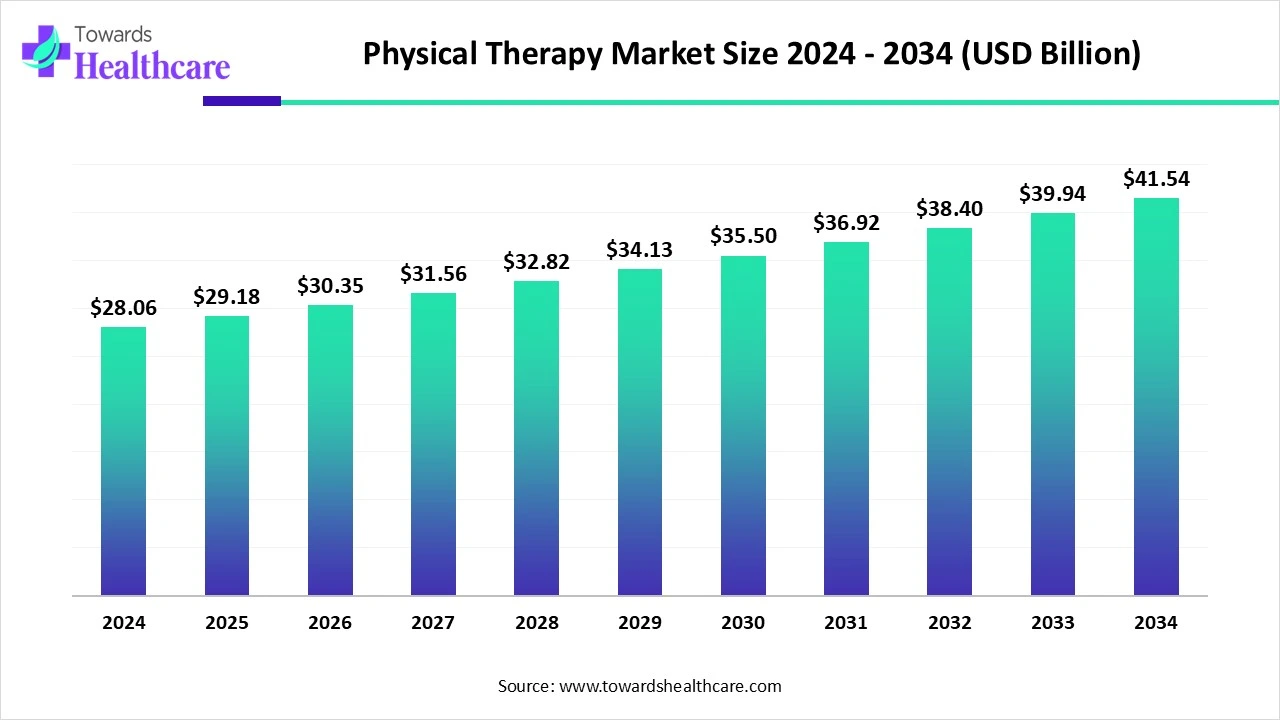
The global physical therapy market size is calculated at USD 28.06 billion in 2024, grew to USD 29.18 billion in 2025, and is projected to reach around USD 41.54 billion by 2034. The market is expanding at a CAGR of 4% between 2025 and 2034.
Get a Preview of Our Industry Analysis : https://www.towardshealthcare.com/download-sample/5929
TheraOffice Pricing: What Do Outpatient Clinics Actually Pay?
One of the biggest challenges for buyers is that TheraOffice does not currently publish a standard starting price on Capterra.
As of August 2026, Capterra lists TheraOffice as Custom Quote / Per User and reports that there is no publicly listed free trial or free version. The platform’s listed plan includes features such as 175+ reports, API integrations, customizable documentation, integrated billing and accounting, scheduling, telehealth, patient portal capabilities, and dedicated account management.
An older Capterra comparison had listed TheraOffice at approximately $125 per month, but because the current 2026 listing says “Contact Vendor for Pricing,” buyers should treat the historical figure as an older reference rather than a confirmed current price.
For an outpatient rehab clinic, the real total cost of ownership should therefore include more than the subscription:
- Software licenses
- Number of providers and locations
- Implementation
- Data migration
- Training
- Billing/RCM services
- Integrations
- Patient communication
- Support
- Custom reporting
- Hardware or deployment requirements
- Contract and cancellation terms
This creates a major opportunity for competitive differentiation: transparent pricing calculators and ROI-based packages can reduce friction during the software-buying journey.
How Large Is the Opportunity for Physical Therapy Software?
The underlying demand for digital practice-management infrastructure is substantial.
Towards Healthcare estimates that the global physical-therapy clinics back-office software sector was approximately $1.36 billion in 2025 and is projected to reach $3.3 billion by 2035, representing a 9.26% CAGR from 2026 to 2035.
Request a Customized Report Sample: https://www.towardshealthcare.com/download-sample/6190
The U.S. opportunity alone was estimated at $560.15 million in 2025/2026 and is projected to reach approximately $1.24 billion by 2035, representing a 9.21% CAGR.
The segmentation also reveals what buyers increasingly prioritize.
Cloud-based platforms represented approximately 62% of the global sector in 2025, while medium-sized clinics represented approximately 44% by practice size. Billing and claims management represented the largest core functionality at approximately 28%, while telehealth integration was identified as a faster-growing functionality.
That means the competitive battle is moving beyond “EMR versus EMR.”
The stronger opportunity is to combine:
EMR + scheduling + billing + RCM + analytics + interoperability + patient engagement + automation.
TheraOffice Customer Support: A Strength With Some Mixed Feedback
Customer support is an important differentiator for physical therapy software because implementation problems can directly affect scheduling, documentation, claims, and cash flow.
Capterra currently gives TheraOffice a 4.5/5 customer-service rating based on 25 ratings. The platform lists email/help-desk support, FAQs/forum resources, a knowledge base, phone support, chat, and 24/7 live-representative support. Training options include in-person training, live online sessions, webinars, documentation, and videos.
Several users have praised the support experience.
One verified reviewer described the implementation team as excellent and said the company provided strong customer support during the transition. Another long-term user gave customer service a 5/5 rating and described the team as friendly, knowledgeable, and efficient.
However, the review data is not uniformly positive.
A 2022 Capterra reviewer gave TheraOffice a 1/5 and complained about update-related problems and difficulty reaching customer service. A 2025 reviewer similarly criticized the platform for being cumbersome and slow and rated customer service 1/5.
Therefore, the appropriate buyer conclusion is not that TheraOffice has “good” or “bad” support.
Instead:
TheraOffice has strong aggregate customer-service ratings, but individual experiences vary significantly depending on implementation, workflow requirements, and technical issues.
Clinics should test support responsiveness before signing a contract.
What Do Users Actually Say About TheraOffice?
The latest Capterra data provides a relatively favorable overall picture:
4.4/5 from 27 reviews
with:
- 4.3/5 for ease of use
- 4.5/5 for customer service
- 4.1/5 for value for money
- 18 five-star reviews
- 7 four-star reviews
- 2 one-star reviews
- No two- or three-star reviews in the current Capterra distribution.
Capterra also reports 93% positive review sentiment and 7% negative sentiment.
Common positive themes include:
- Integrated clinical and billing workflows
- Customizable reports
- PT-specific functionality
- Scheduling and patient intake
- Strong accounts-receivable reporting
- Customer support
- Integrated billing
- Documentation templates
But recurring criticisms include:
- Slow performance
- Dated or cumbersome workflows
- Limited customization in certain areas
- Too many clicks for some tasks
- Update-related problems
- Documentation limitations reported by some therapists
One reviewer, for example, praised the billing side but said therapists felt the documentation side was weaker.
TheraOffice vs. WebPT: Competitive Positioning
WebPT is one of the most important benchmarks for TheraOffice.
As of 2026, Capterra reports WebPT at 4.2/5 from 484 reviews, compared with TheraOffice’s 4.4/5 from 27 reviews. WebPT’s customer-service score is 4.1/5, while TheraOffice’s is 4.5/5.
The difference is particularly important from a competitive-intelligence perspective.
WebPT’s advantage is review scale and broader ecosystem visibility.
With 484 Capterra reviews, WebPT has a much larger publicly visible customer-review footprint than TheraOffice’s 27 reviews. That gives buyers considerably more qualitative information when researching the product.
WebPT also has a broader growth-oriented positioning. Its higher-tier capabilities include lead management, customizable landing pages, online review tools, advanced dashboards, reputation management, SEO, custom reporting, provider reporting, and claims automation.
This means TheraOffice can compete effectively around integrated PT workflows and established practice management, but vendors targeting growth-oriented outpatient clinics can differentiate through:
- Patient acquisition
- Digital marketing
- Online reputation
- Automated communication
- Advanced analytics
- Revenue-cycle intelligence
- AI documentation
- Multi-location business intelligence
TheraOffice vs. Raintree Systems
Raintree Systems is another significant competitive benchmark for larger rehabilitation organizations.
Capterra currently reports Raintree at 4.2/5 from 13 reviews, with a 3.8/5 ease-of-use score and 4.0/5 customer-service score.
Raintree’s positioning emphasizes therapy business intelligence and the use of financial, operational, and clinical metrics to support data-driven decisions. Its listed capabilities include billing, claims management, insurance eligibility, payment processing, charting, SOAP notes, treatment planning, reporting, analytics, workflow management, and access controls.
For larger multi-location organizations, this makes analytics, operational visibility, and scalability important competitive dimensions.
Other Competitors Buyers Should Monitor
The competitive set extends beyond TheraOffice, WebPT, and Raintree.
Relevant platforms include:
- Prompt EMR
- Net Health
- AdvancedMD
- Practice Perfect
- ClinicSource
- OptimisPT
- SimplePractice
- Athenahealth
- Kareo
- WellnessLiving
Towards Healthcare’s 2026 competitive research identifies these companies within the physical-therapy clinics back-office software ecosystem.
The strategic takeaway is important:
No single vendor should be evaluated only on EMR functionality.
A better competitive framework evaluates clinical workflow, RCM, interoperability, patient engagement, analytics, AI, implementation, pricing, customer support, and scalability together.
Government Data Shows Why Billing and Documentation Matter
Software selection is particularly important because outpatient rehabilitation providers operate within complex reimbursement and documentation requirements.
CMS requires outpatient rehabilitation therapy claims to use standardized HCPCS/CPT coding, covering physical therapy, occupational therapy, and speech-language pathology services.
CMS’s 2024 therapy threshold guidance also set the KX modifier threshold at $2,330 for physical therapy and speech-language pathology services combined, and $2,330 for occupational therapy services.
Even more importantly, CMS reported a 45.4% improper-payment rate for Comprehensive Outpatient Rehabilitation Facility services for the 2024 reporting period, with insufficient documentation accounting for 84.3% of improper payments.
This does not mean TheraOffice or other PT software causes or prevents improper payments.
It does demonstrate why documentation quality, coding workflows, claims management, audit readiness, and revenue-cycle controls are critical buying criteria for rehabilitation organizations.
The Workforce Is Also Expanding
The demand for physical therapy infrastructure is supported by employment growth.
The U.S. Bureau of Labor Statistics projects physical therapist employment to increase from approximately 267,200 jobs in 2024 to 296,400 in 2034, an increase of roughly 29,300 jobs or 10.9%.
BLS data also recorded approximately 91,410 physical therapists employed in offices of other health practitioners in May 2024.
More therapists, more appointments, more documentation, and more billing activity increase the importance of scalable digital infrastructure.
TheraOffice GTM Strategy: Where Is the Biggest Growth Opportunity?
For a PT software vendor, the strongest go-to-market strategy should be segmented rather than treating every rehabilitation provider as the same buyer.
Segment 1: Independent PT Clinics
Target:
- Practice owners
- Physical therapists
- Office managers
- Billing managers
Core message:
“Run clinical and business operations from one PT-focused platform.”
The strongest acquisition channels include SEO, Google search, comparison pages, webinars, referral programs, and review platforms.
Segment 2: Multi-Location Rehabilitation Groups
Target:
- CEOs
- COOs
- Directors of Operations
- Revenue-cycle leaders
- Clinical directors
Messaging should shift from basic EMR functionality toward:
multi-location visibility + standardized workflows + centralized billing + analytics + scalability.
Segment 3: Clinics Switching From Legacy Software
This can be a particularly valuable segment.
Pain points include:
- Slow software
- Poor integrations
- Limited reporting
- Manual billing
- Difficult data migration
- Weak customer support
- Poor mobile/cloud experience
SEO pages targeting searches such as “TheraOffice alternatives,” “WebPT alternatives,” “best physical therapy EMR,” and “PT software comparison” can capture high-intent buyers.
Product Launch Strategy for a PT Software Platform
A modern PT software launch should not rely exclusively on a product announcement.
A stronger launch sequence would be:
Phase 1 — Market intelligence
Identify clinic size, specialty, geographic concentration, payer mix, software currently used, switching barriers, and top complaints.
Phase 2 — Competitive positioning
Compare the product against WebPT, TheraOffice, Raintree, Prompt, Net Health, and other relevant platforms.
Phase 3 — Proof of value
Create ROI calculators around:
- Documentation time
- Claims processing
- No-show reduction
- Scheduling utilization
- Days in A/R
- Staff productivity
Phase 4 — Demand generation
Launch:
- Comparison pages
- Case studies
- Demo videos
- PT workflow guides
- Webinars
- Clinical documentation resources
- Billing guides
- Review-generation campaigns
Phase 5 — Conversion
Offer a clear demo path with transparent pricing or at least a pricing framework, implementation timeline, migration plan, and measurable ROI.
Product Pipeline: What Should PT Software Vendors Build Next?
The next competitive battleground is likely to move beyond basic scheduling and EMR.
High-value product roadmap opportunities include:
AI Documentation
Automated note generation and documentation assistance can reduce administrative burden.
Intelligent RCM
Predictive claim-denial identification, automated eligibility workflows, payment posting, and A/R prioritization can directly connect software value to financial outcomes.
Patient Engagement
Automated reminders, digital intake, online scheduling, surveys, home-exercise communication, and personalized follow-up can improve the patient journey.
Interoperability
API-first architecture and standardized healthcare data exchange will become increasingly important as outpatient providers connect systems across referral sources, EHRs, payers, and digital health platforms.
Multi-Location Analytics
Clinic owners increasingly need dashboards showing:
- Visits
- Provider utilization
- Cancellation rates
- Revenue per visit
- A/R
- Payer performance
- Referral sources
- Patient retention
These capabilities can shift software from being an administrative system into a strategic operating platform.
Patent and IP Competition: What Buyers Should Really Evaluate
Patent competition is less straightforward in physical therapy software than it is in pharmaceutical or medical-device markets.
For TheraOffice, the more important competitive moat is not necessarily a publicly visible patent portfolio. Buyers should instead evaluate proprietary software architecture, workflow design, integrations, data structures, documentation templates, analytics, customer relationships, implementation know-how, and switching costs.
A serious competitive-intelligence study should investigate:
- Granted patents
- Pending applications
- Software-related IP
- Trademarks
- Proprietary algorithms
- AI documentation technology
- Integration architecture
- Acquisitions
- Licensing agreements
- Strategic partnerships
- Product-development announcements
This distinction matters because patent counts alone do not indicate which PT software vendor has the strongest competitive position.
TheraOffice’s Referral Strategy Is Also a GTM Signal
TheraOffice has historically operated a formal client referral program.
Its published referral program states that an existing TheraOffice user can refer another practice; if the referred practice becomes a client for at least three months, the referring client can receive one month of complimentary TheraOffice service per qualifying referral, up to $500 in services.
This is strategically important because referrals can reduce customer-acquisition costs while using existing customer relationships as social proof.
For a competing PT software provider, however, this also creates an opportunity:
Build a stronger referral engine around measurable clinic outcomes rather than simply offering referral incentives.
For example:
“Reduced documentation time by X%.”
“Reduced A/R days by X.”
“Improved appointment utilization by X%.”
Outcome-based case studies are generally more persuasive to enterprise buyers than feature lists alone.
What Should an Outpatient Rehab Clinic Ask Before Buying TheraOffice?
Before signing a contract, buyers should ask:
- What is the current per-user and per-location cost?
- Are implementation and migration charged separately?
- What happens when the clinic adds providers?
- What is the cost of adding another location?
- Which integrations are included?
- Is billing included or separately priced?
- What are the response-time commitments for support?
- Is 24/7 support included in the contract?
- How are software updates tested?
- What happens if an update creates workflow problems?
- How easily can data be exported?
- What happens when a clinic leaves the platform?
- Which AI features are currently live?
- What is on the product roadmap?
- Can the vendor provide references from clinics similar to yours?
These questions turn a software demo into a commercial and operational due-diligence exercise.
How Towards Healthcare Can Help PT Software Companies Win More Customers
For healthcare technology companies competing in physical therapy software, simply knowing that TheraOffice has a 4.4/5 rating is not enough.
Towards Healthcare can convert this information into a broader competitive-intelligence and go-to-market framework.
Our research can support:
Competitive Intelligence
Benchmark TheraOffice, WebPT, Raintree, Prompt, Net Health, and other competitors across:
- Pricing
- Product features
- Customer reviews
- Support
- Integrations
- AI
- RCM
- Scheduling
- Documentation
- Multi-location capabilities
- Product positioning
GTM Strategy
Identify the highest-value buyer segments and develop:
- ICP profiles
- Buyer personas
- Competitor displacement strategies
- Channel strategies
- Geographic opportunities
- Demand-generation opportunities
- Partnership opportunities
Product and Pipeline Intelligence
Track competitor:
- Product launches
- AI releases
- Integrations
- Acquisitions
- Partnerships
- Product roadmaps
- Funding
- Executive changes
- Expansion strategies
This allows software companies to identify white spaces before competitors do.
Patent & IP Intelligence
Towards Healthcare can also support structured IP intelligence covering:
- Patent landscapes
- Competitor filings
- Technology themes
- AI-related IP
- Licensing activity
- Strategic partnerships
- Potential technology gaps
Launch Strategy
For new PT software products, we can build a launch framework covering:
Market opportunity → competitor positioning → ICP → pricing → messaging → channels → launch → demand generation → sales enablement → post-launch intelligence.
Lead Generation Through Buyer-Intent Content
The strongest SEO opportunity is not simply publishing “What is physical therapy software?”
High-intent searches include:
- TheraOffice pricing
- TheraOffice alternatives
- TheraOffice competitors
- WebPT vs TheraOffice
- Best physical therapy EMR
- Physical therapy billing software
- Physical therapy practice management software
- PT EMR with integrated billing
- Best software for multi-location PT clinics
- Physical therapy RCM software
These searches can be converted into comparison articles, buyer guides, competitor intelligence reports, downloadable research, and consultation CTAs.
