 by
by Stroke care is no longer about a single device or a single moment of treatment. The strongest healthcare models connect early detection, imaging, clinical decision-making, intervention, monitoring, rehabilitation, and long-term recovery.
That makes the choice of a medtech partner much more strategic. Hospitals and health systems need companies that can contribute to an integrated stroke-care pathway rather than simply supply one product.
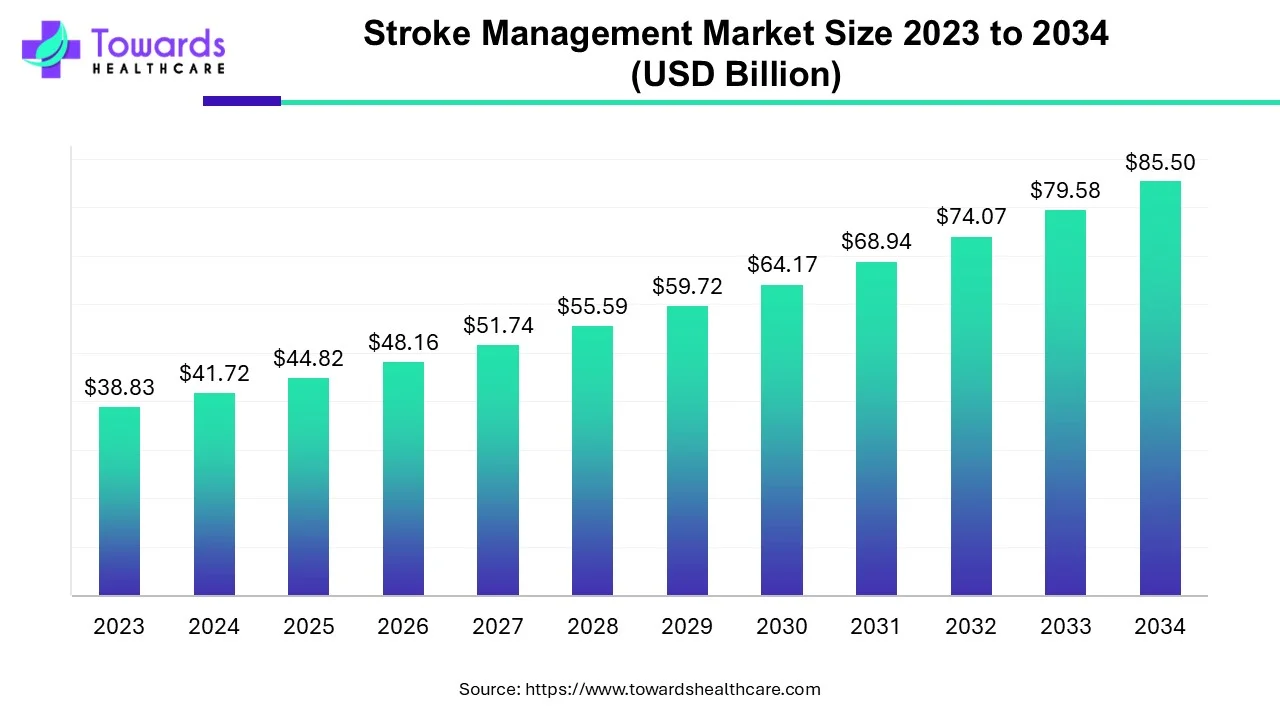
According to Towards Healthcare, the global stroke management market was valued at USD 44.82 billion in 2025 and is projected to reach USD 91.86 billion by 2035, representing a 7.44% CAGR from 2025 to 2035. The market includes diagnostics, therapeutics, and software across ischemic and hemorrhagic stroke care.
Get a Preview of Our Industry Analysis : http://towardshealthcare.com/insights/stroke-management-market-sizing
Which Companies Stand Out?
Based on Towards Healthcare’s analysis of stroke management, stroke diagnostics and therapeutics, telestroke, and stroke rehabilitation, several companies stand out because they contribute to different parts of the care pathway.
1. Medtronic — Strong for Intervention and Connected Stroke Care
Medtronic is one of the most relevant long-term partners for hospitals looking for broad neurovascular capabilities.
Towards Healthcare identifies Medtronic among the leading stroke-management companies and reports that its portfolio includes products and solutions for stroke intervention, post-stroke monitoring, and symptom support.
Its strength is particularly relevant for hospitals building capabilities around mechanical thrombectomy and neurovascular intervention.
Why it stands out: broad clinical footprint + interventional technologies + ability to participate in a wider stroke-care ecosystem.
2. Philips — Strong for Imaging and the Broader Care Pathway
Philips is another credible long-term partner when imaging and hospital infrastructure are central to the strategy.
Towards Healthcare lists Philips among the leading companies in stroke diagnostics and therapeutics. It also reports that Philips entered a two-year partnership with the World Stroke Organization in 2023 focused on improving access to high-quality stroke care, including prevention, treatment, rehabilitation, and support.
This broader orientation is important because stroke management increasingly depends on connecting diagnosis and treatment with longer-term patient recovery.
Why it stands out: imaging capabilities + healthcare infrastructure + involvement across prevention, treatment, and rehabilitation.
3. Siemens Healthineers — Strong for Imaging and Acute Stroke Infrastructure
Siemens Healthineers is particularly relevant for health systems where advanced imaging is a central part of stroke pathways.
Towards Healthcare lists Siemens Healthineers among the major companies in stroke diagnostics and therapeutics. It also reported a two-year partnership between Siemens Healthineers and the World Stroke Organization announced in June 2024, aimed at developing the acute stroke workforce and improving access to mechanical thrombectomy.
For hospitals, this makes Siemens relevant beyond equipment procurement because stroke outcomes depend heavily on rapid imaging, diagnosis, treatment selection, and coordinated workflows.
Why it stands out: diagnostic imaging + acute-care infrastructure + workforce and treatment-access initiatives.
4. Brainomix — Strong for AI-Based Stroke Decision Support
Not every long-term stroke-care partner needs to manufacture a physical device.
Brainomix is an important example of a technology company focused on AI-enabled stroke assessment.
Towards Healthcare identifies the company’s Brainomix 360 stroke platform as an AI-enabled decision-support solution for stroke assessment. It also reports that Medtronic and Brainomix collaborated in February 2025 to combine Brainomix’s AI-driven imaging software with Medtronic’s neurovascular technologies.
That type of integration is particularly interesting because it demonstrates where stroke care is heading: AI and imaging supporting intervention rather than operating as isolated technologies.
Why it stands out: AI-enabled imaging + clinical decision support + integration with neurovascular intervention.
5. Viz.ai — Strong for AI-Enabled Stroke Workflow Coordination
Viz.ai is another important company in the AI side of stroke management.
Towards Healthcare includes Viz.ai among the top companies in its stroke-management analysis. The company is relevant to the movement toward software-enabled stroke pathways where rapid identification and communication can help coordinate care teams.
The value proposition is particularly relevant for hospitals trying to reduce delays between stroke detection, specialist assessment, treatment decisions, and intervention.
Why it stands out: AI + workflow coordination + faster communication across stroke-care teams.
Medtech Partner Comparison
| Company | Strongest contribution | Why it matters for end-to-end stroke care |
|---|---|---|
| Medtronic | Neurovascular intervention | Supports acute intervention and broader stroke solutions |
| Philips | Imaging & healthcare infrastructure | Connects diagnosis with wider care pathways |
| Siemens Healthineers | Medical imaging | Supports rapid diagnosis and treatment planning |
| Brainomix | AI stroke imaging | Helps clinicians assess stroke using AI-enabled decision support |
| Viz.ai | AI & care coordination | Supports rapid communication and workflow coordination |
The key point is that these companies should not necessarily be viewed as direct substitutes. Their strengths sit at different points in the stroke pathway.
Why AI Is Becoming Central to Stroke Care
Stroke is extremely time-sensitive, which makes speed and coordination critical.
Towards Healthcare’s telestroke analysis identifies AI and machine learning as important technologies for diagnosis, treatment, rehabilitation, prognosis, and patient monitoring.
The market is also expanding rapidly. Towards Healthcare estimates that the global telestroke market will grow from USD 2.31 billion in 2026 to approximately USD 7.03 billion by 2035, representing a 13.18% CAGR.
This growth reflects a major change in how stroke services can be delivered.
A smaller or rural hospital, for example, can connect its emergency team with remote neurological specialists rather than depending entirely on specialists being physically present.
The Partnership Model Is Changing
One of the clearest trends is that medtech companies are increasingly working with hospitals, technology companies, and specialist organizations rather than operating independently.
Towards Healthcare highlights several examples:
- Medtronic + Brainomix: combining AI-driven imaging software with neurovascular technologies.
- Philips + World Stroke Organization: collaboration around access to high-quality stroke care.
- Siemens Healthineers + World Stroke Organization: partnership focused on acute stroke workforce development and access to mechanical thrombectomy.
- Queensland Health + Nicolab: deployment of StrokeViewer technology across 36 hospitals in Australia.
These collaborations demonstrate an important shift: the future of stroke care is increasingly based on connected ecosystems rather than standalone products.
Rehabilitation Cannot Be Left Out
An end-to-end stroke strategy should not stop when the patient leaves the acute-care setting.
Rehabilitation is becoming an increasingly important part of the technology ecosystem.
Towards Healthcare estimates that the global stroke rehabilitation market was USD 317.02 million in 2025 and is projected to reach approximately USD 817.06 million by 2034, growing at an 11.24% CAGR from 2025 to 2034.
Access Our Research Insights: https://www.towardshealthcare.com/download-sample/5414
The rehabilitation landscape includes companies such as Pneumbra, Saebo, Zynex Medical, Jogo Health, Cognimate, Amal XR, and TeleRegain, among others.
For a health system, this means a genuine end-to-end strategy should consider:
Detection → Imaging → Diagnosis → Intervention → Monitoring → Rehabilitation → Long-term recovery
rather than focusing exclusively on the acute episode.
What Should Healthcare Buyers Look For?
If a hospital or health system is selecting a long-term medtech partner, product quality is only one part of the decision.
1. Clinical breadth
Can the company support multiple stages of the stroke pathway?
2. Interoperability
Can its technology connect with imaging, hospital information systems, AI platforms, and other clinical tools?
3. Evidence and clinical credibility
Does the technology have meaningful clinical validation and adoption?
4. Innovation pipeline
Will the partner continue investing in AI, imaging, intervention, monitoring, and rehabilitation?
5. Implementation support
Can the company help hospitals train staff and integrate the technology into existing workflows?
6. Long-term partnership capability
Can it collaborate with hospitals, technology companies, researchers, and healthcare organizations?
7. Geographic reach
Can the partner support a health system as it expands across multiple facilities or regions?
Get smarter healthcare insights with our dedicated Ecosystem Dashboard.
https://www.towardshealthcare.com/access-dashboard
About Us
Pharma Geek is a part of Towards Healthcare Research & Consulting which is a global healthcare market research and consulting firm dedicated to helping businesses make informed decisions through reliable market intelligence and strategic insights. We serve pharmaceutical, biotechnology, medical device, AI in healthcare, cell and gene therapy, digital health, and life sciences organizations with in-depth market research, custom consulting, competitive analysis, and growth forecasts. Our team combines industry expertise with rigorous research to deliver clear, actionable insights that support market expansion, product strategy, investment decisions, and long-term business growth. From emerging innovations to established healthcare markets, we help organizations understand where the industry is today and where it’s headed tomorrow.
You can place an order or ask any questions, please feel free to contact us at [email protected]
Europe Region – +44 778 256 0738
North America Region – +1 8044 4193 44
APAC Region: +91 9356 9282 04
Visit Our Website: Towards Healthcare Research & Consulting – Expert Consulting Solutions & Research Reports
Find us on social platforms: LinkedIn | Twitter | Instagram | Medium
