
 by
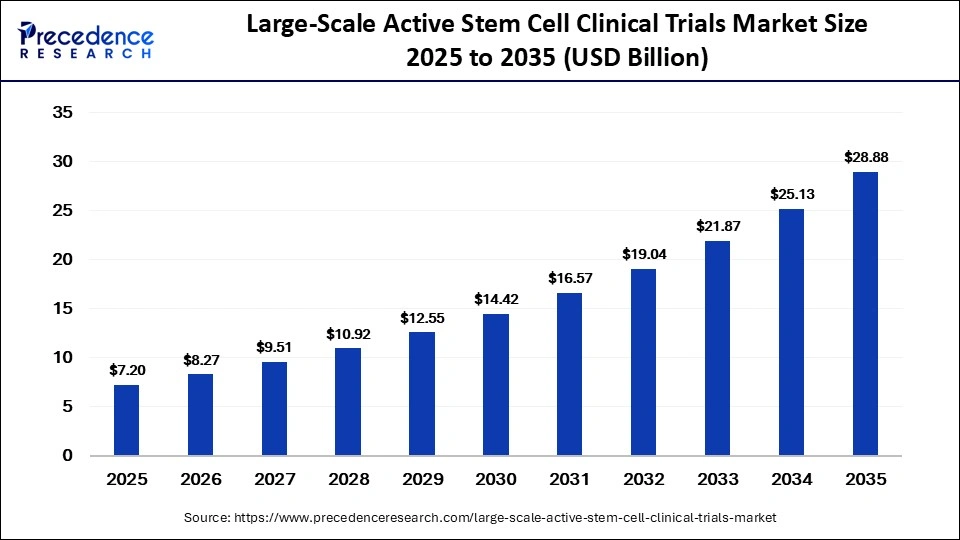
by The global large-scale active stem cell clinical trials market was valued at USD 7.20 billion in 2025 and is projected to grow from USD 8.27 billion in 2026 to approximately USD 28.88 billion by 2035, expanding at a CAGR of 14.90% from 2026 to 2035.
Read Also: Oculoplastic Surgery Market
The market is witnessing strong momentum due to advancements in stem cell technologies, increasing investments in regenerative medicine, and rising demand for innovative therapies targeting oncology, neurological disorders, cardiovascular diseases, and autoimmune conditions.
Quick Insights: What Are the Key Market Highlights?
North America dominated the market with a 42% revenue share in 2025 due to advanced clinical infrastructure and strong funding support.
Asia Pacific is expected to grow at the fastest CAGR of 18.5% between 2026 and 2035, driven by rising clinical trial activity and expanding healthcare investments.
Mesenchymal stem cells (MSCs) led the stem cell type segment with a 35% market share in 2025.
Phase II trials accounted for the largest clinical phase segment with a 40% share due to strong mid-stage pipeline activity.
Oncology dominated the application segment with a 35% share in 2025 as stem cell therapies gain traction in cancer treatment.
Multi-center trials held a dominant 65% share, highlighting the increasing scale and globalization of stem cell research.
Pharmaceutical and biotechnology companies accounted for 50% of total market demand, reflecting growing commercialization efforts.
What Are Large-Scale Active Stem Cell Clinical Trials and Why Are They Important?
Large-scale active stem cell clinical trials are advanced research studies evaluating the safety, efficacy, and scalability of stem cell therapies across large patient populations. These trials are critical for validating regenerative treatments before regulatory approval and commercialization.
Stem cell therapies are being investigated for their ability to repair damaged tissues, regenerate organs, and restore immune function. Their growing use across oncology, neurology, cardiology, and autoimmune disease treatment is reshaping the future of precision medicine.
As more therapies progress from early-stage testing to Phase III trials, the industry is moving closer to widespread clinical adoption and commercial deployment.
AI Role in the Market: How is Artificial Intelligence Transforming Stem Cell Clinical Trials?
Artificial intelligence is becoming a major catalyst in accelerating stem cell clinical trial development. AI-powered analytics platforms help researchers identify ideal patient populations, optimize trial protocols, and improve predictive modeling for treatment outcomes.
Machine learning algorithms are also enhancing stem cell characterization, genomic analysis, and biomarker identification. These technologies improve trial efficiency, reduce operational costs, and accelerate regulatory decision-making.
AI is additionally improving patient monitoring during trials by enabling real-time data analysis and adverse event prediction, helping researchers conduct safer and more efficient studies.
Market Growth Factors: What is Driving Market Expansion?
Why Is Regenerative Medicine Gaining Strong Momentum?
Growing interest in regenerative therapies for chronic and degenerative diseases is significantly increasing clinical trial activity worldwide.
How Are Technological Advancements Supporting Market Growth?
Innovations in stem cell processing, storage, engineering, and delivery technologies are improving scalability and clinical outcomes.
Why Are Pharmaceutical Companies Investing Aggressively?
Biopharmaceutical firms are expanding stem cell pipelines to develop next-generation therapies for oncology, autoimmune diseases, and neurological disorders.
How Does Government Support Accelerate Clinical Trials?
Governments and healthcare agencies are increasing funding for regenerative medicine programs and supporting large-scale clinical research initiatives.
Opportunities & Trends: What’s Shaping the Future of the Market?
Are Induced Pluripotent Stem Cells (iPSCs) Becoming a Major Innovation Area?
Yes, iPSCs are projected to grow at the fastest CAGR of 20.5% due to their versatility in generating multiple cell types for personalized therapies.
Can Multi-Center Global Trials Accelerate Commercialization?
Large-scale multi-center trials are improving patient recruitment, enhancing data reliability, and accelerating regulatory approvals.
Is Oncology Emerging as the Largest Application Area?
Stem cell therapies are increasingly being explored for cancer treatment, immune recovery, and targeted regenerative approaches.
How Are CROs Transforming Clinical Trial Operations?
Contract Research Organizations (CROs) are becoming strategic partners for trial management, data handling, and regulatory compliance, helping reduce development timelines.
Segmentation Analysis: Where Are the Key Revenue Streams?
By Stem Cell Type
- Mesenchymal stem cells (MSCs): 35% share
- Hematopoietic stem cells (HSCs): 30% share
- Induced pluripotent stem cells (iPSCs): fastest-growing segment at 20.5% CAGR
- Embryonic stem cells (ESCs): stable growth segment
By Clinical Phase
- Phase II trials: 40% share
- Phase I trials: 35% share
- Phase III trials: fastest-growing segment at 17.5% CAGR
By Application
- Oncology: 35% share
- Neurological disorders: fastest-growing application segment
- Cardiovascular diseases
- Orthopedic & musculoskeletal disorders
- Autoimmune diseases
By Therapy Type
- Allogeneic stem cell therapies: 55% share
- Autologous stem cell therapies: rapidly growing segment due to personalized treatment potential
By Trial Design
- Multi-center trials: 65% share
- Single-center trials: stable growth segment
By End-Use
- Pharmaceutical & biotechnology companies: 50% share
- Academic & research institutes: 30% share
- CROs: fastest-growing end-use segment
Regional Analysis: Which Regions Are Leading the Market?
Why Does North America Dominate the Market?
North America leads due to strong clinical research infrastructure, substantial biotech funding, favorable regulatory frameworks, and high adoption of regenerative medicine technologies.
How Strong Is Europe’s Position in Stem Cell Research?
Europe remains a significant market due to robust academic research, public-private partnerships, and increasing investments in cell therapy innovation.
Why Is Asia Pacific the Fastest-Growing Region?
Asia Pacific is witnessing rapid growth because of large patient populations, supportive government initiatives, and expanding stem cell research ecosystems in countries like China, Japan, and South Korea.
Competitive Landscape: Who Are the Key Players Driving Innovation?
Major companies operating in the large-scale active stem cell clinical trials market include:
- Novartis AG
- Fate Therapeutics, Inc.
- Mesoblast Limited
- Athersys, Inc.
- BlueRock Therapeutics
- Vertex Pharmaceuticals Incorporated
- CRISPR Therapeutics AG
- Takeda Pharmaceutical Company Limited
- Lonza Group AG
- Catalent, Inc.
These companies are investing heavily in stem cell engineering, clinical scalability, AI integration, and regenerative therapy commercialization.
Latest Breakthroughs Reshaping the Market
Recent developments are accelerating momentum across the regenerative medicine industry:
- Vertex Pharmaceuticals announced positive Phase III results for its stem cell-derived therapy targeting type 1 diabetes in June 2025.
- Mesoblast Limited advanced its allogeneic stem cell therapy into late-stage trials for inflammatory diseases in April 2026.
- BlueRock Therapeutics progressed its Parkinson’s disease stem cell therapy into advanced clinical stages in March 2026.
- The National Institutes of Health expanded funding for multi-center stem cell trials focused on neurological and cardiovascular conditions in January 2026.
Challenges: What Could Restrain Market Growth?
Despite strong growth potential, several challenges remain:
- High clinical trial costs and long development timelines
- Complex regulatory approval pathways
- Ethical concerns surrounding stem cell usage
- Manufacturing and scalability challenges for cell therapies
These barriers may slow commercialization and market penetration in certain regions.
Case Study: Stem Cell Therapy Advancing Parkinson’s Disease Treatment
BlueRock Therapeutics recently advanced its stem cell therapy for Parkinson’s disease into advanced clinical stages using engineered dopaminergic neurons derived from stem cells. This development highlights how regenerative medicine is moving closer to treating previously irreversible neurological disorders.
Conclusion: What Lies Ahead for the Market?
The large-scale active stem cell clinical trials market is poised for substantial growth as regenerative medicine enters a new era of commercialization and clinical validation.
With rising investment, accelerating AI adoption, expanding therapeutic applications, and growing regulatory support, stem cell therapies are expected to transform the future of healthcare. Companies that prioritize innovation, scalable manufacturing, and global trial expansion will be best positioned to lead this rapidly evolving market.
Get Sample Copy: https://www.precedenceresearch.com/sample/8379
For inquiries regarding discounts, bulk purchases, or customization requests, please contact us at [email protected]
