 by
by Germany is becoming an increasingly important European hub for radiopharmaceuticals as cancer care moves toward molecular imaging, targeted radionuclide therapy, and theranostics.
Public industry estimates place the Germany radiopharmaceuticals market at around USD 700 million in 2026 and approximately USD 1.43 billion by 2035, representing a CAGR of about 8.2%. A separate 2025 estimate valued the market at about USD 650 million and also projected approximately USD 1.43 billion by 2035. These estimates indicate a sustained expansion driven by PET and SPECT imaging, radioligand therapies, isotope availability, and precision oncology.
For pharmaceutical companies, isotope producers, radiopharma developers, hospitals, investors, and technology providers, the opportunity is not limited to selling radiopharmaceuticals. The larger opportunity is building a reliable ecosystem covering radioisotope production, radiopharmaceutical development, manufacturing, logistics, imaging infrastructure, clinical development, and patient access.
Germany Radiopharmaceuticals Market at a Glance
| Indicator | Germany Outlook |
|---|---|
| 2026 market size | ~USD 700 million |
| 2035 forecast | ~USD 1.43 billion |
| 2026–2035 CAGR | ~8.2% |
| Leading application | Oncology |
| Major technologies | PET, SPECT and targeted radionuclide therapy |
| Key isotopes | Technetium-99m, Fluorine-18, Gallium-68, Lutetium-177 and emerging alpha emitters |
| Major end users | Hospitals, nuclear medicine centers, diagnostic imaging centers and research institutes |
Public estimates also indicate that oncology accounts for more than half of Germany’s radiopharmaceutical demand, while hospitals remain the largest end-user group.
Radiopharmaceutical Market Size, Trends, Drivers, Opportunities and Competitive Strategies
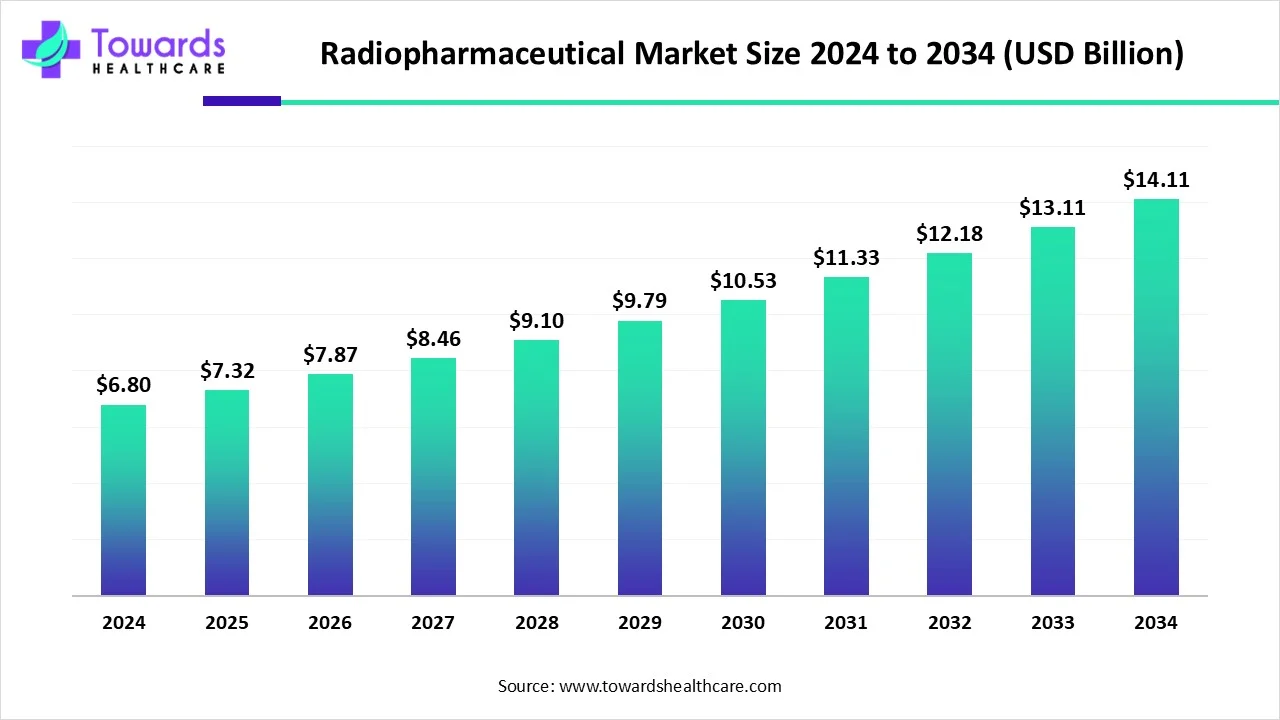
The global radiopharmaceutical market size is calculated at US$ 6.8 in 2024, grew to US$ 7.32 billion in 2025, and is projected to reach around US$ 14.11 billion by 2034. The market is expanding at a CAGR of 7.57% between 2025 and 2034.
Download Sample: https://www.towardshealthcare.com/download-sample/5552
Why Germany Is Becoming Important for Radiopharmaceuticals
Germany already has a strong foundation in nuclear medicine, molecular imaging, pharmaceutical manufacturing, research institutions, and hospital infrastructure.
The opportunity is being strengthened by the increasing use of radiopharmaceuticals in cancer diagnosis and targeted treatment.
Germany recorded 504,166 new cancer cases in 2022, including 267,772 among men and 236,394 among women. The German Centre for Cancer Registry Data also reported more than 228,000 cancer deaths in 2023 among men and women combined.
This creates a significant clinical need for technologies capable of detecting disease, identifying molecular targets, monitoring treatment response, and delivering targeted radiation to cancer cells.
Radiopharmaceuticals address several of these needs through:
- PET imaging
- SPECT imaging
- PSMA-targeted imaging
- Radioligand therapy
- Targeted alpha therapy
- Targeted beta therapy
- Theranostic applications
- Molecular imaging for oncology, cardiology and neurology
Radioligand Therapy Is Changing the Competitive Landscape
One of the most important developments in Germany is the expansion of radioligand therapy (RLT).
RLT combines a targeting molecule with a radioactive isotope. The targeting component identifies specific cancer cells, while the radionuclide delivers radiation to the targeted tissue.
This approach is particularly important in prostate cancer and neuroendocrine tumors and is increasingly being investigated across additional solid tumors.
Novartis is making a major investment in this area. The company plans a new radioligand therapy production facility in Halle, Saxony-Anhalt, with a modern semi-automated production line designed to strengthen local RLT supply. Novartis describes RLT as one of its strategic technology platforms and reported 18 proprietary development projects alongside additional partnered programs in 2025.
The company has also been building operational capabilities around the new site, including project leadership, manufacturing, IT/OT, engineering, validation, and supply functions.
This is strategically important because radiopharmaceuticals are highly time-sensitive products. Manufacturing capacity, isotope availability, quality control, transportation, and proximity to nuclear medicine centers can directly influence patient access.
Germany Radiopharmaceuticals Market Companies
The competitive environment includes pharmaceutical companies, isotope specialists, molecular imaging companies, radiopharmaceutical manufacturers, CDMOs, equipment providers, and emerging biotechnology companies.
Novartis
Novartis has established one of the strongest radioligand therapy positions globally and is expanding its manufacturing footprint in Germany.
The company currently states that it has two radioligand therapies approved in Germany and is developing a broader RLT pipeline across multiple cancer types. Its planned Halle facility is intended to support local production and shorter supply routes for patients and nuclear medicine centers.
Strategic relevance: Radioligand therapy, oncology, manufacturing capacity, isotope supply, clinical development and commercialization.
Bayer
Bayer is another major German player with an established position in radiology, molecular imaging and targeted radionuclide therapy.
In 2026, Bayer announced encouraging Phase I data for its 225Ac-PSMA-Trillium, an investigational targeted alpha therapy for advanced metastatic castration-resistant prostate cancer. Bayer reported that at the expansion dose, at least 80% of patients achieved a PSA50 response.
Bayer is also expanding its molecular imaging portfolio. In January 2026, it agreed to acquire two investigational imaging agents from Attralus for cardiac amyloidosis, including an iodine-124 PET tracer and a technetium-99m imaging agent.
Bayer’s 2026 pipeline also includes multiple actinium-225 programs, including candidates targeting PSMA and GPC3.
Strategic relevance: Targeted alpha therapy, molecular imaging, prostate cancer, precision oncology and cardiovascular imaging.
Dr. Jost Reinhard became President of Bayer’s Radiology business effective August 1, 2026, reporting to Stefan Oelrich, President of Bayer’s Pharmaceuticals Division.
Siemens Healthineers
Siemens Healthineers is positioned across both the imaging infrastructure and radiopharmaceutical supply chain.
Its molecular imaging portfolio covers PET/CT, PET/MR, SPECT and SPECT/CT. The company’s Radiopharma business supplies PET radiopharmaceuticals and provides CDMO capabilities.
In 2025, Siemens Healthineers brought PETNET Solutions and Advanced Accelerator Applications Molecular Imaging under the Siemens Healthineers brand. The combined business operates 60 radiopharmaceutical facilities across nine countries and produces more than 100,000 batches of sterile PET radiopharmaceuticals annually. The European expansion included 13 manufacturing sites acquired through the acquisition of AdAcAp Molecular Imaging, including sites in Germany.
Barry Scott, Head of the Radiopharma business at Siemens Healthineers, is therefore a relevant industry decision-maker to monitor when assessing the evolution of PET radiopharmaceutical manufacturing and molecular imaging infrastructure.
Strategic relevance: PET radiopharmaceuticals, cyclotrons, molecular imaging, CDMO services, PET/CT and SPECT/CT infrastructure.
ITM Isotope Technologies Munich
Munich-based ITM is one of Germany’s most important specialist radiopharmaceutical companies.
The company focuses on diagnostic and therapeutic radionuclides and precision oncology. Its n.c.a. Lutetium-177 is used as a precursor for targeted radionuclide therapy.
ITM expanded its Lutetium-177 production capacity at its Garching facility and has established supply relationships with global pharmaceutical and radiopharmaceutical companies.
In 2025, ITM signed a supply agreement with Radiopharm Theranostics covering n.c.a. Lutetium-177 for programs targeting PD-L1, HER2 and B7-H3 in solid tumors.
ITM’s own pipeline also demonstrates the commercial importance of isotope supply. Its Phase 3 COMPETE program evaluated ^177Lu-edotreotide in gastroenteropancreatic neuroendocrine tumors, with 309 patients randomized in the study.
Strategic relevance: Lutetium-177, isotope supply, targeted radionuclide therapy, precision oncology and radiopharmaceutical development.
Steffen Schuster, who led ITM as CEO from 2011 to 2024, played a major role in expanding its isotope production and strategic partnerships and now serves as Vice Chairman of the company’s Supervisory Board.
Eckert & Ziegler
Berlin-based Eckert & Ziegler is another important German radiopharma and nuclear medicine company.
Its Radiopharma business provides radionuclides, radiopharmaceutical development, GMP production, contract manufacturing, radiosynthesis, quality control and regulatory support. Its portfolio includes Gallium-68, Yttrium-90 and Lutetium-177.
This makes Eckert & Ziegler particularly relevant to companies looking for manufacturing, isotope, development or technology partners.
Germany Radiopharmaceuticals Market Segmentation
By Product Type
The market can be divided into:
- Diagnostic radiopharmaceuticals
- Therapeutic radiopharmaceuticals
- Radiopharmaceutical precursors
- Radioisotope generators
- PET tracers
- SPECT tracers
- Theranostic agents
Diagnostic products remain important because PET and SPECT are already established in German nuclear medicine. However, therapeutic radiopharmaceuticals are gaining strategic importance because of the expansion of targeted radionuclide therapy.
By Radioisotope
Important radioisotopes include:
Fluorine-18: Widely used for PET imaging.
Technetium-99m: A major SPECT isotope used across several diagnostic applications.
Gallium-68: Increasingly important for targeted PET imaging and theranostics.
Lutetium-177: One of the most important therapeutic isotopes for targeted radionuclide therapy.
Actinium-225: Emerging as a major isotope for targeted alpha therapy.
The competitive question is increasingly shifting from simply producing radiopharmaceuticals to securing reliable, scalable isotope supply.
Oncology Will Remain the Core Growth Engine
Oncology is expected to remain the most important application area.
Germany’s cancer burden creates demand for more accurate diagnosis and targeted treatment, while radiopharmaceutical innovation is expanding beyond conventional imaging.
The industry is moving from:
Diagnosis → Molecular Target Identification → Patient Selection → Targeted Treatment → Response Monitoring
This is where theranostics becomes strategically important.
For pharmaceutical companies, the commercial opportunity therefore extends beyond the radiopharmaceutical itself. Companion diagnostics, PET tracers, imaging centers, isotope supply, manufacturing infrastructure and clinical networks can all become part of the value chain.
Supply Chain Is Becoming a Competitive Advantage
Radiopharmaceuticals have a unique supply-chain challenge.
Many radioisotopes have short half-lives, which means that production, quality control, transportation and administration must be tightly coordinated.
Germany therefore offers opportunities for companies operating across:
- Cyclotron manufacturing
- Reactor-based isotope production
- Radiopharmaceutical synthesis
- GMP manufacturing
- Hot-cell technology
- Radioactive logistics
- Quality control
- Contract manufacturing
- Nuclear medicine equipment
- PET and SPECT imaging
- Clinical trial supply
The importance of local capacity is illustrated by Novartis’ decision to establish RLT manufacturing in Halle and Siemens Healthineers’ expansion of its European PET radiopharmaceutical network.
Germany Radiopharmaceuticals Market Trends Through 2035
Shift From Diagnostics to Theranostics
The industry is gradually moving from imaging alone toward integrated diagnostic and therapeutic pathways.
A patient can potentially undergo molecular imaging to determine whether a target is present and then receive a targeted radiopharmaceutical against that same biological target.
Expansion of Lutetium-177
Lutetium-177 is expected to remain strategically important because it connects isotope suppliers, pharmaceutical developers, nuclear medicine centers and oncology treatment pathways.
The presence of ITM and expanding RLT programs from companies such as Novartis reinforces the importance of reliable Lu-177 supply.
Growth of Alpha Emitters
Actinium-225 is becoming an important area of pharmaceutical R&D.
Bayer’s clinical development programs illustrate how German pharmaceutical companies are investing in next-generation targeted alpha therapies.
More Local Manufacturing
Radiopharmaceutical supply cannot be managed like conventional pharmaceutical distribution because radioactive decay introduces time constraints.
This is encouraging investment in strategically located production facilities and radiopharmacy networks.
Increasing Demand for CDMO Partnerships
As biotechnology companies develop new radiopharmaceutical candidates, many will not want to build complete manufacturing infrastructure internally.
This creates opportunities for:
- Radiopharmaceutical CDMOs
- GMP facilities
- Isotope suppliers
- Cyclotron operators
- Radiochemistry companies
- Quality-control providers
- Radioactive logistics companies
What Is Holding the Germany Radiopharmaceuticals Market Back?
The growth opportunity is significant, but companies entering Germany must manage several operational challenges.
Radioisotope Supply
Access to reliable radioisotopes can become a bottleneck as demand for RLT increases.
Manufacturing Complexity
Radiopharmaceutical manufacturing requires specialized facilities, radiation protection, automation and GMP controls.
Logistics
Short half-lives create pressure on transportation, scheduling and inventory management.
Regulatory Requirements
Radiopharmaceutical developers must navigate pharmaceutical, nuclear, manufacturing and clinical requirements.
Limited Specialized Infrastructure
Expansion of RLT requires more than drug production. Hospitals need trained nuclear medicine teams, treatment facilities, imaging capacity and appropriate radiation-protection infrastructure.
High Capital Requirements
Cyclotrons, hot cells, GMP suites, isotope production systems and specialized logistics infrastructure require significant capital investment.
Where Are the Biggest Opportunities for Companies?
The strongest opportunities are likely to emerge at the intersection of radiopharma + oncology + manufacturing + imaging + supply chain.
Companies should assess opportunities in:
- Lutetium-177 supply and processing
- Actinium-225 supply and production
- PET radiopharmaceutical manufacturing
- Radiopharmaceutical CDMO services
- Theranostic platforms
- PSMA-targeted products
- Neuroendocrine tumor therapies
- Molecular imaging
- Cyclotron infrastructure
- Radioactive logistics
- Automated radiopharmacy
- Hospital nuclear medicine infrastructure
For investors and pharmaceutical companies, the critical question is no longer simply “How large is the radiopharmaceutical market?”
The more valuable questions are:
- Which isotope will face the greatest supply constraint?
- Which radiopharmaceutical platforms are approaching commercialization?
- Which German companies control manufacturing capacity?
- Which hospitals are expanding nuclear medicine capabilities?
- Which companies are seeking CDMO partnerships?
- Which technologies are gaining clinical adoption?
- Where are pharmaceutical companies investing?
- Which radiopharmaceutical assets could become acquisition targets?
- Which companies have scalable isotope access?
- Which suppliers can support commercial-scale production?
Competitive Intelligence: What Companies Should Track
A successful Germany strategy requires tracking the complete competitive ecosystem.
Pharmaceutical Companies
Monitor:
- Pipeline assets
- Clinical trials
- Regulatory submissions
- Licensing deals
- Acquisitions
- Manufacturing investments
- Commercial partnerships
Radioisotope Suppliers
Track:
- Production capacity
- New isotope technologies
- Reactor and cyclotron partnerships
- Long-term supply contracts
- Geographic production footprint
Radiopharmaceutical CDMOs
Track:
- GMP capacity
- Manufacturing technologies
- Development capabilities
- Quality systems
- Customer pipeline
- Expansion plans
Hospitals and Nuclear Medicine Centers
Track:
- PET/CT installations
- SPECT/CT capacity
- RLT treatment capabilities
- Patient volumes
- Referral networks
- Regional coverage
Investors
Assess:
- Pipeline maturity
- Manufacturing scalability
- IP position
- isotope security
- partnerships
- clinical probability of success
- commercialization requirements
- acquisition potential
What Towards Healthcare Research & Consulting Can Provide
For companies entering or expanding in Germany, understanding the headline market size is only the starting point.
Towards Healthcare Research & Consulting can support strategic decisions across the Germany radiopharmaceutical ecosystem through:
Market Forecasting and Opportunity Assessment
- Germany radiopharmaceuticals market sizing
- 2035 forecasts
- Segment-level opportunity analysis
- Diagnostic versus therapeutic opportunity
- Radioisotope-level forecasting
- Application and end-user analysis
- TAM, SAM and SOM assessment
Competitive Intelligence
- Company benchmarking
- Competitor revenue and capability assessment
- Product and pipeline tracking
- Manufacturing footprint analysis
- Technology comparison
- Partnership and licensing intelligence
- M&A tracking
- Patent and IP landscape assessment
Radiopharmaceutical Supply Chain Intelligence
- Isotope supplier mapping
- Production capacity analysis
- Cyclotron and reactor ecosystem mapping
- Radiopharmaceutical manufacturing analysis
- CDMO identification
- Radioactive logistics assessment
- Supply-risk analysis
Buyer Intelligence
Towards Healthcare can help identify and understand the needs of:
- Pharmaceutical companies
- Radiopharma developers
- Biotechnology companies
- Nuclear medicine hospitals
- Diagnostic imaging centers
- CDMOs
- Radioisotope suppliers
- Medical technology companies
- Investors
- Healthcare distributors
Go-to-Market Strategy
For companies entering Germany, the analysis can support:
- Target customer identification
- Partner selection
- Distributor strategy
- Hospital targeting
- Pricing intelligence
- Commercial opportunity mapping
- Market-entry strategy
- Regional expansion planning
- Partnership identification
Pipeline and Launch Intelligence
For pharmaceutical and biotechnology companies, this can include:
Pipeline → Clinical Development → Regulatory Milestones → Manufacturing → Commercial Launch → Competitor Response
This gives decision-makers a more practical view of where the opportunity is developing and where commercial risks may appear.
Germany Radiopharmaceuticals Market Outlook to 2035
Germany is moving toward a more integrated radiopharmaceutical ecosystem in which diagnostic imaging, targeted therapy, isotope production, radiopharmacy, manufacturing and precision oncology increasingly operate as one value chain.
The projected increase from roughly USD 700 million in 2026 to USD 1.43 billion by 2035 illustrates the scale of the opportunity, but the strategic opportunity may be broader than the headline revenue number suggests.
Novartis’ planned RLT manufacturing facility, Bayer’s expanding targeted radionuclide therapy and molecular imaging pipeline, Siemens Healthineers’ large PET radiopharmaceutical network, ITM’s Lutetium-177 capabilities and Eckert & Ziegler’s radiopharma manufacturing ecosystem demonstrate how multiple parts of the value chain are developing simultaneously.
For companies looking to participate in this growth, the winning strategy will depend on more than product development. Access to isotopes, manufacturing capacity, clinical infrastructure, partnerships, regulatory execution and commercial intelligence will increasingly determine competitive advantage.
How Towards Healthcare Can Help You Identify the Next Opportunity
The Germany radiopharmaceuticals opportunity is developing across multiple layers, and companies need reliable intelligence to determine where to invest, partner, manufacture or launch.
Towards Healthcare Research & Consulting helps pharmaceutical, biotechnology, medical technology, CDMO and investment teams translate industry developments into actionable business opportunities.
Our analysis can help answer:
Which companies are expanding? Which technologies are gaining adoption? Where is manufacturing capacity being added? Which isotopes may become supply bottlenecks? Which companies are developing competitive pipelines? Which hospitals and providers represent the strongest opportunities? And where should the next investment or partnership be made?
Connect with Towards Healthcare Research & Consulting to access deeper Germany radiopharmaceuticals intelligence, competitive analysis, company benchmarking, pipeline tracking, supply-chain analysis and strategic opportunity assessment.
Frequently Asked Questions
What is the Germany radiopharmaceuticals market size in 2026?
Public industry estimates place the Germany radiopharmaceuticals market at approximately USD 700 million in 2026.
What will the Germany radiopharmaceuticals market be worth by 2035?
A public 2026 estimate projects the Germany radiopharmaceuticals market to reach approximately USD 1.43 billion by 2035.
What is the expected CAGR of the Germany radiopharmaceuticals market?
The market is estimated to grow at approximately 8.2% CAGR from 2026 to 2035 based on a recent public industry estimate.
Which companies are important in Germany’s radiopharmaceuticals industry?
Important companies include Novartis, Bayer, Siemens Healthineers, ITM Isotope Technologies Munich and Eckert & Ziegler, with each participating in different parts of the radiopharmaceutical value chain.
Which radioisotopes are important in Germany?
Key radioisotopes include Fluorine-18, Technetium-99m, Gallium-68 and Lutetium-177, while Actinium-225 is emerging as an important isotope for targeted alpha therapy.
Why is Lutetium-177 important?
Lutetium-177 is widely used as a therapeutic radioisotope in targeted radionuclide therapy. German company ITM has built significant capabilities around n.c.a. Lutetium-177 production and supply.
Why is Germany attractive for radiopharmaceutical companies?
Germany combines established nuclear medicine infrastructure, major pharmaceutical companies, specialized radioisotope manufacturers, advanced molecular imaging capabilities, research institutions and a large oncology patient population.
What opportunities exist for radiopharmaceutical CDMOs?
Opportunities include radiopharmaceutical development, GMP manufacturing, isotope processing, radiochemistry, quality control, clinical trial supply and commercial-scale production.
How can Towards Healthcare support radiopharmaceutical companies?
Towards Healthcare can provide market forecasting, competitive intelligence, company benchmarking, pipeline analysis, isotope and supply-chain intelligence, buyer intelligence, partnership identification, market-entry strategy and commercial opportunity assessment.
