by
by What is the Chromatography Media Market Size in 2026?
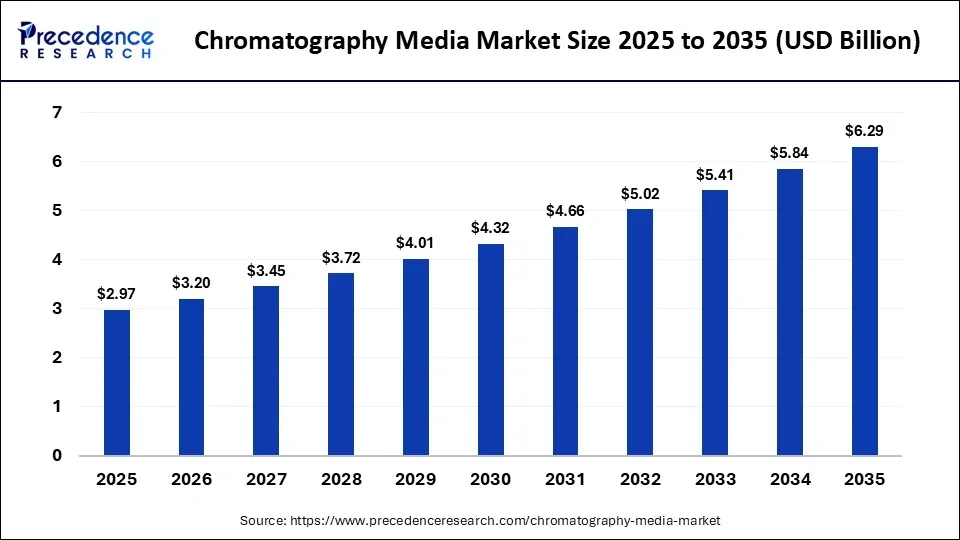
The global chromatography media market was valued at USD 2.97 billion in 2025 and is projected to grow from USD 3.20 billion in 2026 to approximately USD 6.29 billion by 2035, expanding at a CAGR of 7.79% from 2026 to 2035.
The market is witnessing strong growth due to the rising production of biologics, biosimilars, vaccines, and advanced therapies, which require highly efficient purification processes. Chromatography media play a crucial role in separating and purifying complex biomolecules, making them essential components in pharmaceutical and biopharmaceutical manufacturing.
Read Also: Nuclear Medicine Equipment Market
Chromatography Media Market Key Takeaways
-
North America dominated the market with 39.50% share in 2025.
-
Asia Pacific is expected to grow at the fastest rate during the forecast period.
-
By media type, the resins (beaded media) segment held the largest share of 88.50% in 2025.
-
The membranes segment is projected to grow at a CAGR of 7.20%.
-
By separation mechanism, affinity chromatography accounted for 42% market share in 2025.
-
The mixed-mode chromatography segment is expected to grow at a CAGR of 6.50%.
-
By physical format, bulk media dominated with 62% share in 2025.
-
The cassettes and modules segment is expected to expand at a CAGR of 8.50%.
-
By application, pharmaceutical and biopharmaceutical production dominated with 71.50% share in 2025.
-
By scale of operation, the process scale/industrial segment held 69.40% share in 2025.
Market Overview
The chromatography media market refers to the global industry focused on the development, production, and supply of stationary phase materials used in chromatography processes. These materials are used to separate, purify, and analyze compounds within complex mixtures based on differences in chemical or physical properties such as size, charge, hydrophobicity, or biological affinity.
Chromatography media are typically made from materials such as:
-
Silica
-
Agarose
-
Synthetic polymers
-
Functionalized resins
-
Other specialized support materials
These media are widely used in several chromatography techniques, including:
-
Ion exchange chromatography
-
Affinity chromatography
-
Size exclusion chromatography
-
Hydrophobic interaction chromatography
-
Reversed-phase chromatography
Chromatography media are essential in biopharmaceutical manufacturing, research laboratories, food testing, environmental analysis, and forensic investigations. The increasing complexity of modern biologic drugs is significantly increasing the demand for advanced chromatography purification solutions.
Positive Impact of Artificial Intelligence on the Chromatography Media Market
Artificial intelligence is playing an important role in improving chromatography method development, process optimization, and purification efficiency.
AI-driven algorithms analyze large volumes of chromatographic data to identify patterns and predict optimal separation parameters. This allows researchers and manufacturers to optimize flow rates, pH levels, binding conditions, and column configurations more efficiently.
Key benefits of AI integration include:
-
Faster method development and process optimization
-
Reduced trial-and-error experimentation
-
Improved purification yield and separation efficiency
-
Lower production costs for biologics manufacturing
-
Real-time monitoring and predictive maintenance of chromatography systems
Additionally, AI-enabled systems help extend media lifespan, reduce downtime, and improve operational productivity in large-scale manufacturing environments.
Latest Trends in the Chromatography Media Market
Growing Demand from Biologics and Biosimilars Manufacturing
The increasing production of monoclonal antibodies, vaccines, recombinant proteins, and gene therapies is significantly driving demand for chromatography media used in downstream purification processes.
Development of High-Binding Capacity Media
Manufacturers are developing chromatography media with higher binding capacity and improved resolution, which enhances product yield and reduces processing time.
Increasing Adoption of Affinity and Ion Exchange Media
Affinity chromatography and ion exchange chromatography are widely used techniques for highly selective purification of proteins and biomolecules, making them highly important in biopharmaceutical manufacturing.
Rising Use of Single-Use Chromatography Systems
Single-use and pre-packed chromatography systems are becoming increasingly popular because they:
-
Reduce contamination risks
-
Eliminate cleaning validation processes
-
Improve operational efficiency
Expansion of Continuous Chromatography Processes
Continuous chromatography systems are gaining traction because they provide:
-
Higher productivity
-
Lower buffer consumption
-
Improved scalability for large-scale manufacturing
Market Dynamics
Driver: Rising Biologics Production and Regulatory Emphasis on Purity
One of the strongest drivers of the chromatography media market is the rapid growth of biologics manufacturing. Biologic drugs such as monoclonal antibodies, recombinant proteins, vaccines, and cell and gene therapies require multiple purification steps to ensure extremely high purity levels.
Strict regulatory requirements for drug safety, impurity profiling, and batch consistency are encouraging manufacturers to adopt high-performance chromatography media with superior binding capacity and selectivity.
The increasing growth of biosimilars and contract manufacturing organizations (CMOs) is also strengthening demand for chromatography purification technologies globally.
Restraint: High Capital Costs and Operational Complexity
Despite strong market demand, chromatography processes involve high capital investment in purification systems, columns, buffers, and validation procedures.
Additionally, chromatography process development requires skilled personnel and extensive optimization of flow rates, pressure limits, and chemical compatibility, which can increase operational complexity.
These factors may limit adoption among smaller biotechnology companies and cost-sensitive manufacturers.
Opportunity: Technological Innovation and Emerging Markets
Significant opportunities exist in the development of advanced chromatography media designed for continuous processing, high throughput purification, and single-use systems.
Innovations such as improved resin stability, enhanced binding efficiency, and specialized media for gene therapy purification are creating new revenue opportunities.
Furthermore, expanding pharmaceutical manufacturing capacity in Asia Pacific, Latin America, and the Middle East is generating new growth prospects as governments increase investment in healthcare infrastructure.
Key Companies in the Chromatography Media Market
Major companies operating in the global market include:
-
Merck KGaA
-
Thermo Fisher Scientific
-
GE Healthcare
-
Repligen Corporation
-
Danaher Corporation
-
Lonza Group
-
SGE Analytical Science
These companies are focusing on product innovation, advanced resin technologies, and improved purification solutions to strengthen their market positions.
Get Sample: https://www.precedenceresearch.com/checkout/7933
For inquiries regarding discounts, bulk purchases, or customization requests, please contact us at sales@precedenceresearch.com

- Chromatography Media Market Size to Reach USD 6.29 Billion by 2035 - March 12, 2026
- Nuclear Medicine Equipment Market Size to Surge USD 10.00 Billion by 2035 - March 12, 2026
- Anti-Snoring Devices Market Size to Achieve USD 2.94 Billion by 2035 - March 12, 2026