 by
by China is becoming one of the most strategically important markets for antibody-drug conjugates (ADCs) as oncology treatment moves toward increasingly targeted therapies. A combination of high cancer incidence, expanding precision-oncology infrastructure, growing domestic biopharmaceutical capabilities, regulatory support for innovative medicines, and a rapidly developing ADC pipeline is creating a significant commercial opportunity.
According to Towards Healthcare, the China ADC market was valued at approximately US$0.81 billion in 2025 and is projected to reach US$2.34 billion by 2035, representing a CAGR of 11.20%. The market is estimated at approximately US$0.90 billion in 2026.
However, another industry analysis using a broader ADC market definition estimates China’s ADC market at US$1.0 billion in 2025 and US$22.1 billion by 2035, reflecting a much faster 36.2% CAGR.
The substantial difference between published estimates demonstrates an important research consideration: China ADC market sizing depends heavily on product scope, inclusion of domestic pipeline assets, revenue definitions and whether the analysis covers marketed ADCs alone or a broader commercial ecosystem.
For strategic planning, therefore, China should not be viewed merely as a sales market for imported ADCs. It is increasingly becoming a drug-discovery, clinical-development, licensing and ADC manufacturing hub.
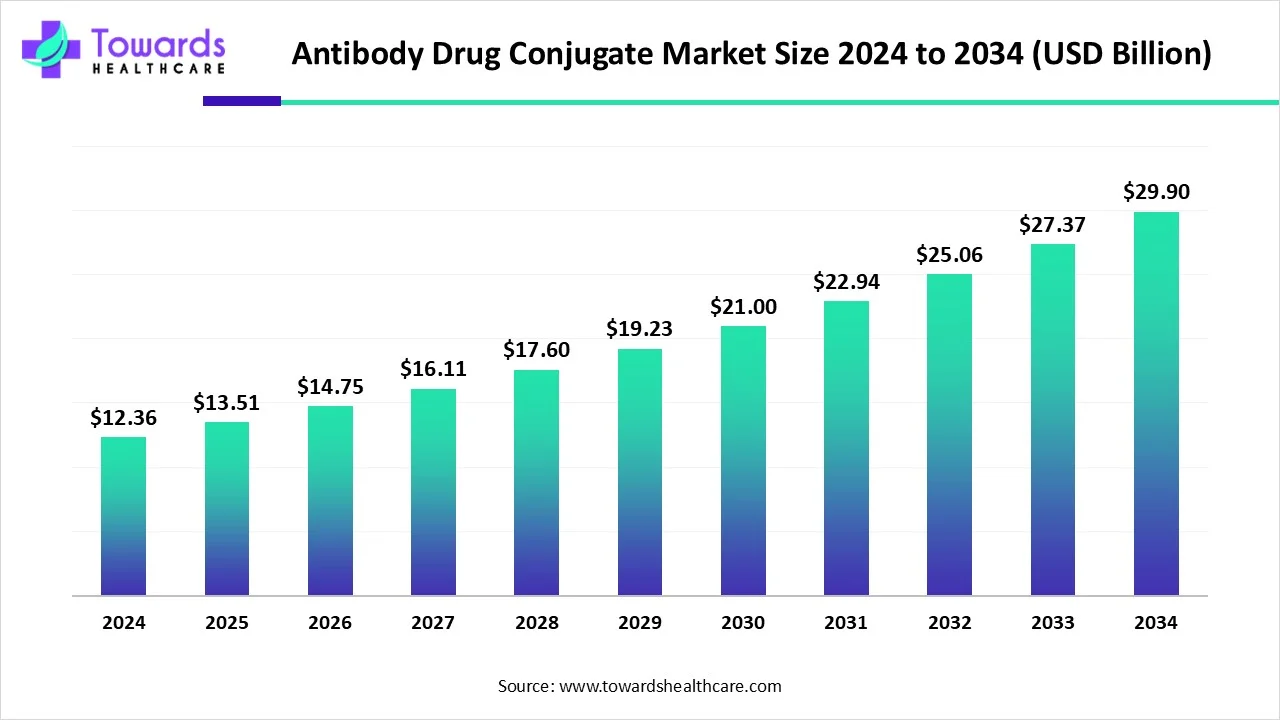
The global antibody drug conjugate (ADC) market size is projected to grow from USD 13.51 billion in 2025 to USD 32.66 billion by 2035, at a compound annual growth rate (CAGR) of 9.23% from 2026 to 2035.
Access Our Research Insights: https://www.towardshealthcare.com/download-sample/5178
China ADC Market at a Glance
| Indicator | China ADC opportunity |
|---|---|
| China ADC market, 2025 | US$0.81 billion |
| Estimated market, 2026 | US$0.90 billion |
| Forecast market, 2035 | US$2.34 billion |
| CAGR, 2025–2035 | 11.20% |
| Alternative 2025 industry estimate | US$1.0 billion |
| Alternative 2035 estimate | US$22.1 billion |
| Key application | Breast cancer |
| Major target | HER2 |
| Major emerging target | TROP2 |
| Key products | Enhertu, Kadcyla, Disitamab vedotin and others |
Market estimates vary according to methodology and market definition.
Why China Is Becoming an ADC Powerhouse
China has an unusually large oncology patient population that provides the underlying demand for targeted cancer therapies.
According to GLOBOCAN 2022, China recorded approximately 4.82 million new cancer cases and 2.57 million cancer deaths in 2022. Lung cancer accounted for approximately 1.06 million cases, followed by colorectal cancer with about 517,000 cases, thyroid cancer with 466,000, liver cancer with 368,000, and stomach cancer with 359,000.
For ADC developers, this creates several important therapeutic opportunities.
China has substantial patient populations across cancers where ADC development is particularly active, including:
- Breast cancer
- Lung cancer
- Gastric cancer
- Colorectal cancer
- Urothelial cancer
- Liver cancer
- Hematological malignancies
- Ovarian cancer
The commercial opportunity therefore extends beyond one molecule or one biomarker.
China ADC TAM, SAM and SOM
A conventional market-size figure does not fully capture the opportunity in China because ADCs operate across multiple cancer types, biomarkers and treatment lines.
A more useful commercial model is to divide the opportunity into TAM, SAM and SOM.
Total Addressable Market – TAM
The TAM represents the broader population that could potentially benefit from ADC-based treatment based on cancer type, biomarker expression, disease stage and clinical eligibility.
China’s 2022 cancer burden alone provides a substantial underlying population, with nearly 4.82 million new cancer cases annually.
However, not every cancer patient is eligible for an ADC.
The addressable population becomes narrower after applying:
- Cancer type
- Disease stage
- Biomarker expression
- Prior treatment
- ADC indication
- Clinical eligibility
Therefore, a more realistic TAM model is:China’s total cancer population → biomarker-positive population → ADC-eligible population → treatable population.
This is particularly important for HER2, TROP2, CD30, CD22, EGFR and other emerging targets.
Serviceable Available Market – SAM
SAM represents patients who can realistically access an approved or commercially available ADC.
This includes:
- Patients with an approved indication
- Appropriate biomarker expression
- Access to oncology specialists
- Access to tertiary hospitals
- Ability to receive intravenous therapy
- Availability through hospital procurement channels
- Sufficient reimbursement or ability to pay
China’s SAM is therefore strongly connected to its hospital oncology infrastructure and reimbursement system.
Major metropolitan healthcare centers are likely to remain important early adoption points, including:
- Beijing
- Shanghai
- Guangzhou
- Shenzhen
- Chengdu
- Hangzhou
- Wuhan
- Nanjing
However, expansion into lower-tier cities could significantly increase the addressable patient population as oncology infrastructure and reimbursement access improve.
Serviceable Obtainable Market – SOM
SOM represents the portion of the ADC opportunity that an individual company can realistically capture.
For an ADC company, SOM depends on:
- Target differentiation
- Clinical efficacy
- Safety
- Indication
- Price
- Reimbursement
- Hospital access
- Physician adoption
- Manufacturing capacity
- Distribution
- Biomarker testing
- Competitive pipeline
For example, using the US$0.81 billion 2025 China ADC market as a commercial benchmark:
| Hypothetical market share | Implied revenue |
|---|---|
| 1% | US$8.1 million |
| 3% | US$24.3 million |
| 5% | US$40.5 million |
| 10% | US$81 million |
| 15% | US$121.5 million |
These are scenario calculations and not company revenue forecasts.
For a new ADC entrant, SOM should ideally be modeled by target × indication × biomarker × treatment line × hospital segment rather than by applying a single national market-share assumption.
Breast Cancer Is a Core ADC Opportunity in China
Breast cancer remains one of the most commercially important ADC applications.
Grand View Research’s China analysis reported that breast cancer represented approximately 47.85% of China’s ADC market revenue in 2025.
This aligns with the growing importance of HER2-targeted ADCs.
China recorded approximately 357,000 new breast cancer cases among women in 2022, making it one of the country’s largest female cancer burdens.
The commercial opportunity is expanding further because ADC development is increasingly moving beyond HER2-positive disease into:
- HER2-low
- HER2-ultralow
- TROP2-positive disease
- Other biomarker-defined populations
This expands the potential patient pool for targeted therapies.
Enhertu Is Reshaping China’s HER2 ADC Landscape
A major development in China’s ADC market is the expansion of Enhertu (trastuzumab deruxtecan).
In August 2026, AstraZeneca and Daiichi Sankyo announced that China’s NMPA approved Enhertu in combination with pertuzumab as a first-line treatment for HER2-positive unresectable or metastatic breast cancer.
The DESTINY-Breast09 trial reported a 44% reduction in the risk of disease progression or death versus the THP regimen, with median progression-free survival of 40.7 months versus 26.9 months.
This type of indication expansion has major commercial implications.
The competitive advantage of an ADC is no longer determined only by:
“Is the drug approved?”
It increasingly depends on:
“How many treatment lines and cancer indications can the molecule capture?”
Enhertu Is Also Expanding Into Gastric Cancer
In January 2026, China’s NMPA approved Enhertu for adults with HER2-positive locally advanced or metastatic gastric or gastroesophageal junction adenocarcinoma after prior trastuzumab-containing therapy.
This is strategically important because gastric cancer represents a major cancer burden in China.
GLOBOCAN estimated approximately 359,000 new stomach cancer cases in China in 2022.
Consequently, expansion into gastric cancer gives HER2 ADCs another substantial commercial opportunity.
Disitamab Vedotin Demonstrates China’s Domestic ADC Capability
China is not simply importing ADC innovation.
Domestic developers are producing their own ADC platforms.
Disitamab vedotin (RC48) from RemeGen is one of the most prominent examples.
A March 2026 company filing stated that disitamab vedotin had received approvals in China across multiple indications, including:
- HER2-overexpressing gastric cancer
- HER2-overexpressing urothelial carcinoma
- HER2-positive advanced breast cancer with liver metastases
- HER2-low breast cancer with liver metastases.
This demonstrates the increasing ability of Chinese companies to develop, register and commercialize ADCs domestically.
China’s TROP2 ADC Competition Is Accelerating
The next major ADC battleground is increasingly moving toward TROP2.
In April 2026, AstraZeneca announced the commercial availability in China of Datroway (datopotamab deruxtecan) for previously treated HR-positive/HER2-negative advanced breast cancer.
The approval was based on TROPION-Breast01, in which Datroway reduced the risk of disease progression or death by 37% versus chemotherapy.
This is important because it illustrates the transition from a predominantly HER2-centered ADC market toward a multi-target ADC ecosystem.
Chinese ADC Pipeline Creates a Competitive Advantage
China has developed one of the world’s most active ADC development environments.
A peer-reviewed review of ADC development found that more than 80% of new ADC programs in China and globally were still in early development, while 33 ADCs had reached mid-to-late-stage clinical development at the time of the analysis. HER2, TROP2 and EGFR were identified as the three most common ADC target categories.
This pipeline provides China with several competitive advantages:
- Clinical trial scale
- Faster patient recruitment
- Domestic regulatory experience
- Platform technology development
- Licensing opportunities
- Global commercialization potential
China ADC Buyer Intelligence
ADC purchasing decisions are more complex than those for conventional oral medicines.
The principal stakeholders include:
| Buyer / Decision-maker | Key purchasing criteria | Commercial implication |
|---|---|---|
| Oncologist | Efficacy and safety | Clinical evidence |
| Hospital | Cost and outcomes | Hospital access |
| Pharmacy department | Supply and procurement | Reliable manufacturing |
| Patient | Outcomes and affordability | Access strategy |
| Payer | Cost-effectiveness | HEOR evidence |
| Pathologist | Biomarker testing | Companion diagnostics |
| Hospital administrator | Budget impact | Value proposition |
| Distributor | Volume and margin | Distribution strategy |
| CRO/CDMO | Development complexity | Outsourcing opportunity |
The oncologist is the central clinical decision-maker, but hospital procurement and reimbursement increasingly determine whether a high-cost ADC can achieve meaningful penetration.
Physician Buyer Intelligence
For ADC companies, oncologists are the most important customer group.
Their decision-making typically revolves around:
1. Overall survival
Does the ADC meaningfully extend survival?
2. Progression-free survival
Does it delay disease progression?
3. Response rate
How many patients achieve meaningful tumor response?
4. Safety
How manageable are adverse events?
5. Biomarker selection
Can the patient be accurately identified?
6. Treatment sequencing
Where does the ADC fit within the treatment pathway?
7. Real-world evidence
Does clinical-trial performance translate into routine practice?
Therefore, commercial teams need a strong medical-affairs strategy, not merely traditional sales promotion.
Patient and Consumer Behavior in China’s ADC Market
ADC consumer behavior is fundamentally different from consumer behavior in lifestyle-oriented pharmaceutical categories.
Cancer patients and their families are primarily concerned with:
- Survival
- Treatment efficacy
- Side-effect profile
- Physician recommendation
- Treatment availability
- Cost
- Reimbursement
- Hospital reputation
- Treatment convenience
The decision journey is typically:
Diagnosis
Biomarker testing
Oncologist consultation
Treatment options
ADC recommendation
Reimbursement/affordability assessment
Hospital treatment
Monitoring
This means ADC companies need to influence the entire treatment pathway, not just the patient.
Biomarker Testing Is a Critical Commercial Driver
ADC growth depends heavily on companion diagnostics and biomarker testing.
A drug targeting HER2, TROP2, EGFR or another antigen cannot reach its full commercial potential without identifying the right patients.
This creates an adjacent market opportunity for:
- IHC testing
- ISH testing
- Molecular diagnostics
- Companion diagnostics
- Digital pathology
- Biomarker interpretation
- Pathology laboratories
The commercial value chain therefore becomes:
ADC manufacturer → diagnostic company → pathology laboratory → oncologist → hospital → patient.
China’s Reimbursement Environment Is a Key Buyer Factor
Price is one of the most important determinants of ADC adoption.
Unlike conventional low-cost generics, ADCs are complex biologic therapies involving:
- Antibody engineering
- Linker technology
- Potent payloads
- Specialized manufacturing
- Conjugation
- Quality control
Consequently, companies must demonstrate value through:
Clinical efficacy + survival benefit + safety + cost-effectiveness.
In China, successful reimbursement and hospital access can significantly expand the commercially serviceable population.
For pharmaceutical companies, the commercial strategy should therefore integrate:
NMPA approval → reimbursement strategy → hospital listing → KOL adoption → patient access.
Domestic Innovation Is Increasing Competitive Pressure
Chinese biotechnology companies are changing the global ADC competitive landscape.
Important domestic players include:
- RemeGen
- Bio-Thera Solutions
- 3SBio
- CSPC Pharmaceutical
- Kelun-Biotech
- Sichuan Biokin
- ADC Therapeutics-related partners and licensees
- Multiple emerging biotechnology companies
Industry research has specifically highlighted investments by RemeGen, Bio-Thera Solutions and 3SBio in China’s ADC development ecosystem.
The competitive model is shifting from:
Western innovation → Chinese commercialization
toward:
Chinese innovation → China approval → global licensing → international commercialization.
China’s ADC Licensing Opportunity Is Becoming Global
A particularly important trend is the growing interest of multinational pharmaceutical companies in Chinese oncology assets.
For example, in September 2026, Cipla entered into an exclusive licensing and supply agreement with Chia Tai Tianqing Pharmaceutical Group for TQB2102, a HER2 bispecific ADC being developed for multiple HER2-expressing cancers. The agreement covers development and commercialization in India, South Africa and other emerging markets.
This demonstrates an increasingly important business model:
China biotech innovation
Clinical development
NMPA validation
Global licensing
International commercialization
This can create substantial value for Chinese ADC developers even before full global commercialization.
ADC Manufacturing Creates a Second Growth Market
The China ADC opportunity is not limited to drug sales.
ADC development requires specialized capabilities across:
- Antibody production
- Payload synthesis
- Linker synthesis
- Antibody-linker conjugation
- Drug-to-antibody ratio control
- Fill-finish
- Sterile manufacturing
- Analytical testing
- Quality control
- Stability testing
This creates significant opportunities for ADC CDMOs and CRDMOs.
The complexity of ADC manufacturing also creates high barriers to entry, because companies need multidisciplinary capabilities spanning antibody engineering, medicinal chemistry, payload chemistry, linker design and bioconjugation.
China ADC Value Chain
The emerging ecosystem can be represented as:
Target discovery
Antibody development
Payload development
Linker development
Conjugation
Preclinical development
Clinical trials
NMPA approval
Hospital procurement
Reimbursement
Oncology treatment
Real-world evidence
Every stage represents a potential commercial opportunity.
China ADC GTM Strategy
A successful China ADC go-to-market strategy should be built around six stages.
Stage 1: Target selection
Prioritize targets with:
- Large patient populations
- Strong biomarker expression
- Unmet clinical need
- Limited treatment options
- Competitive differentiation
Stage 2: KOL strategy
Develop relationships with:
- Oncology specialists
- Breast cancer specialists
- Lung cancer specialists
- Gastrointestinal oncologists
- Urologic oncologists
- Pathologists
Stage 3: Clinical evidence
Demonstrate:
- Overall survival
- Progression-free survival
- Objective response
- Safety
- Quality of life
Stage 4: Diagnostic integration
Ensure biomarker testing is available alongside drug commercialization.
Stage 5: Reimbursement strategy
Develop health-economic evidence and demonstrate value to payers and hospitals.
Stage 6: Geographic expansion
Begin with major oncology centers and expand through provincial and regional hospital networks.
Patent Competition Will Shape China’s ADC Landscape
ADC competition is becoming increasingly sophisticated.
Companies are competing across:
- Antibody targets
- Linker technology
- Payloads
- Drug-to-antibody ratio
- Site-specific conjugation
- Bispecific ADCs
- Dual-payload ADCs
- Novel payloads
- Next-generation ADC architectures
The traditional:
one antibody + one payload
model is evolving toward:
multi-target + multi-payload + improved linker + controlled conjugation.
This creates opportunities for Chinese companies to differentiate even when competing against established global products.
Next-Generation ADCs Could Redefine the Market
The future China ADC pipeline is likely to include:
Bispecific ADCs
Designed to recognize two targets or two epitopes.
Dual-payload ADCs
Designed to deliver different cytotoxic mechanisms.
Site-specific ADCs
Designed to improve conjugation consistency.
Novel payload ADCs
Using new mechanisms beyond traditional microtubule inhibitors.
TROP2 ADCs
Expanding targeted therapy beyond HER2.
EGFR ADCs
Potentially addressing large lung and head-and-neck cancer populations.
HER2-low ADCs
Expanding the eligible breast cancer population.
The commercial opportunity therefore expands as biomarker definitions become more sophisticated.
China ADC Market: TAM-SAM-SOM Strategic Framework
The commercial funnel can be summarized as:
TAM
China’s total cancer population potentially addressable by targeted ADC therapy
Approximately 4.82 million new cancer cases were estimated in 2022, creating a very large underlying oncology population.
SAM
Biomarker-positive, indication-eligible patients with access to ADC treatment
SOM
Patients a particular ADC can capture based on clinical differentiation, reimbursement, hospital access, physician adoption, price and supply.
Using the Towards Healthcare 2025 market benchmark of US$810 million, even a hypothetical 5% share would represent approximately US$40.5 million in annual revenue.
However, for individual products, a target-specific SOM is more meaningful than a national percentage.
Key Strategic Opportunities in China’s ADC Ecosystem
| Opportunity | Strategic driver |
|---|---|
| HER2 ADCs | Breast and gastric cancer |
| TROP2 ADCs | Breast and other solid tumors |
| EGFR ADCs | Lung and head/neck cancers |
| Bispecific ADCs | Improved targeting |
| ADC CDMO | Complex manufacturing |
| Payload manufacturing | Growing ADC pipeline |
| Linker technology | Next-generation conjugation |
| Companion diagnostics | Biomarker identification |
| Hospital oncology | Treatment delivery |
| Real-world evidence | Reimbursement and differentiation |
| Global licensing | International expansion |
| Domestic ADC innovation | China’s biotech ecosystem |
What Companies Should Watch Through 2035
The most important indicators for China’s ADC market will be:
1. NMPA approvals
More approvals will expand the commercially addressable patient pool.
2. Reimbursement inclusion
Reimbursement can substantially change patient accessibility.
3. HER2-low and ultralow expansion
This could expand the addressable breast cancer population.
4. TROP2 adoption
TROP2 could become one of the largest ADC target categories.
5. Domestic ADC launches
Chinese developers could increasingly compete with multinational innovators.
6. Licensing transactions
International partnerships will provide validation for Chinese ADC assets.
7. ADC CDMO investment
Manufacturing complexity will support outsourcing demand.
8. Companion diagnostics
Better biomarker identification will increase treatment precision.
China ADC Market Outlook to 2035
The China ADC market is positioned for substantial long-term expansion.
Towards Healthcare estimates growth from US$0.81 billion in 2025 to US$2.34 billion by 2035, representing an 11.20% CAGR.
A separate industry forecast is substantially more aggressive, estimating growth from US$1.0 billion in 2025 to US$22.1 billion in 2035, reflecting a 36.2% CAGR.
The difference should not be interpreted simply as one forecast being right and the other wrong. It highlights the importance of market-definition discipline when assessing China’s ADC opportunity.
The strongest underlying growth signals are nevertheless consistent:
Large oncology population- Increasing biomarker testing- Expansion of HER2 indications- Rapid TROP2 development- Domestic ADC innovation- International licensing- Growing manufacturing capabilities = Strong long-term ADC opportunity in China
