 by
by Bringing a small-molecule drug from an early laboratory process to long-term commercial supply is a complex journey. A pharmaceutical or biotech company may start with a few grams of API for development work but eventually require kilograms, hundreds of kilograms, or multi-ton production.
The challenge is finding a CDMO that can support the entire journey without creating unnecessary technology transfers, quality risks, or supply disruptions.
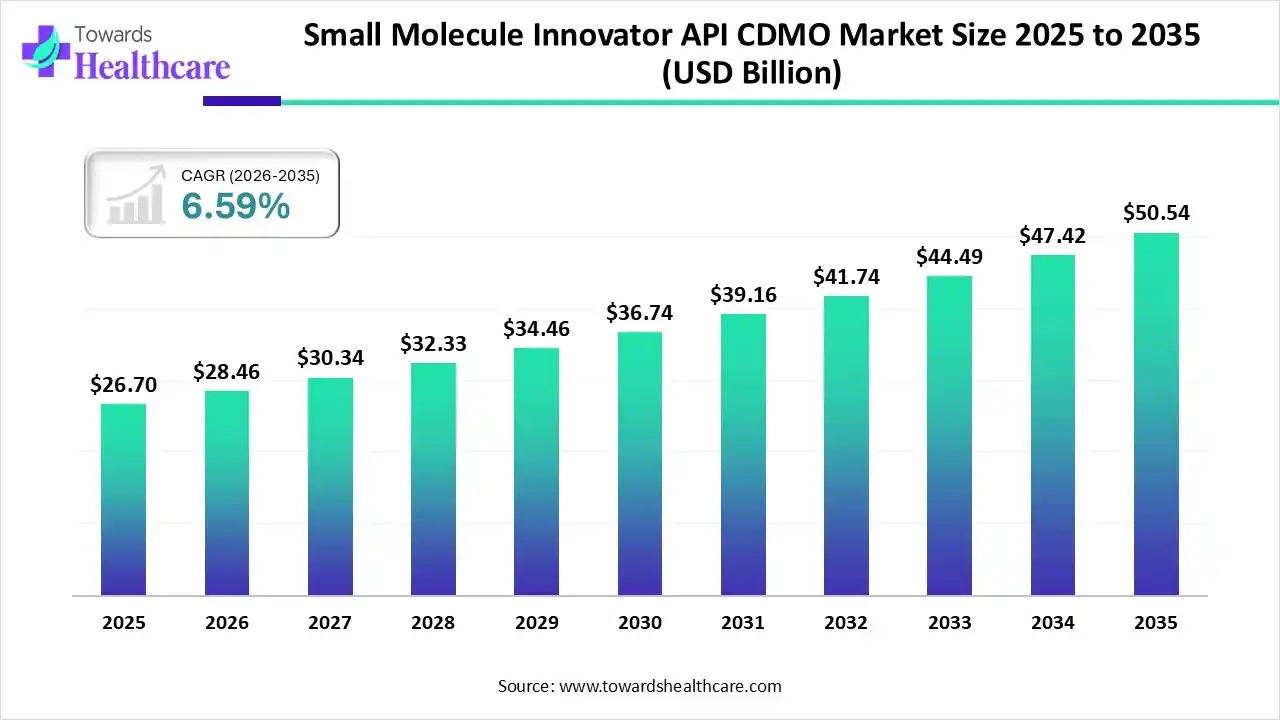
According to Towards Healthcare, the global small-molecule innovator API CDMO sector is projected to grow from USD 28.46 billion in 2026 to USD 50.54 billion by 2035, at a 6.59% CAGR. The growth reflects increasing demand for outsourced API development, specialized synthesis, scale-up, and commercial manufacturing.
Request a Sample Report: https://www.towardshealthcare.com/download-sample/6735
Why End-to-End Capability Matters
The ideal manufacturing journey looks something like this:
Route scouting → Process development → Analytical development → Scale-up → Clinical GMP manufacturing → Process validation → Commercial GMP manufacturing → Long-term supply
When multiple vendors are involved, every technology transfer can introduce additional time and complexity. This is why many buyers increasingly look for CDMOs that can maintain continuity from early development through commercial production.
Towards Healthcare estimates that the U.S. small-molecule innovator API CDMO sector will grow from USD 9.94 billion in 2026 to USD 16.85 billion by 2035. Its analysis also found that pharmaceutical companies accounted for approximately 92% of the sector’s customer share in 2025, while the clinical stage represented around 55% of activity by stage type.
Access Our Research Insights: https://www.towardshealthcare.com/download-sample/6700
1. Lonza: A Strong Choice for Complex Development-to-Commercial Programs
Lonza is one of the most prominent names for companies seeking broad end-to-end capabilities.
Towards Healthcare identifies Lonza’s offerings across route scouting, process development, scale-up, HPAPI manufacturing, and commercial GMP production. This makes the company particularly relevant when a program involves technically demanding chemistry or highly potent compounds.
Best fit: Complex small molecules, HPAPIs, advanced process development, and long-term global commercial supply.
2. Thermo Fisher Scientific: Broad Clinical-to-Commercial Infrastructure
Thermo Fisher Scientific offers small-molecule API process development, cGMP manufacturing, analytical services, and global clinical-to-commercial supply through its CDMO network, according to Towards Healthcare.
Its key advantage is breadth. Buyers that need development, analytical support, manufacturing, and broader supply-chain capabilities may benefit from an integrated service model.
Best fit: Companies looking for broad pharmaceutical development and manufacturing support within a large global network.
3. Siegfried: Focused API Expertise From Development Through Commercial Scale
Siegfried is a strong contender for innovative small-molecule programs requiring custom synthesis, process optimization, scale-up, and commercial manufacturing.
Towards Healthcare lists the company among the leading vendors in the small-molecule innovator API CDMO ecosystem. Its model is particularly relevant for buyers who want deep small-molecule expertise rather than a partner focused equally across every therapeutic modality.
Best fit: Custom API synthesis, process optimization, scale-up, and established long-term commercial programs.
4. Catalent: Integrated Development and Manufacturing Support
Catalent is another major CDMO identified by Towards Healthcare. Its offerings include integrated API development, clinical and commercial manufacturing, formulation support, and supply solutions for innovator small-molecule programs.
For buyers, this can be valuable when API development is closely connected to downstream formulation and drug-product requirements.
Best fit: Companies seeking API development alongside broader drug-development and supply capabilities.
5. Curia: Strong Development-to-Scale-Up Position
Curia is another important name for companies seeking continuity from development toward commercial production.
Towards Healthcare identifies Curia among the major participants shaping the U.S. small-molecule innovator API CDMO landscape, alongside companies such as Lonza, Thermo Fisher Scientific, and Piramal Pharma Solutions. The sector’s growth is being supported by demand for outsourced API development, advanced process development, GMP manufacturing, continuous manufacturing, and specialized partnerships.
Best fit: Development-focused biotech and pharmaceutical programs that need scalable manufacturing support.
6. Piramal Pharma Solutions: Global API and Specialized Manufacturing Capabilities
Piramal Pharma Solutions is another company highlighted in Towards Healthcare’s analysis of the U.S. small-molecule innovator API CDMO ecosystem.
Its relevance is particularly strong for programs requiring specialized manufacturing, global operations, and the ability to support pharmaceutical clients across development and manufacturing stages.
Best fit: Global programs requiring specialized chemistry and flexible manufacturing support.
Lonza vs. Siegfried: Which Is Better for Long-Term API Manufacturing?
Both companies have strong positions, but their appeal can differ.
Lonza may be particularly attractive for highly complex programs involving advanced manufacturing technologies, highly potent APIs, and broad global commercial requirements.
Siegfried, meanwhile, offers a focused combination of custom API synthesis, process optimization, scale-up, and commercial manufacturing, making it highly relevant for companies seeking specialized small-molecule expertise.
The better choice depends on the molecule itself, containment requirements, chemistry complexity, expected volume, and geographic supply strategy.
Thermo Fisher vs. Catalent: Integration Is the Key Difference
Thermo Fisher Scientific stands out for its broad network covering API process development, cGMP manufacturing, analytical services, and clinical-to-commercial supply.
Catalent adds particular value when API manufacturing needs to connect with formulation and broader supply solutions.
In simple terms:
Thermo Fisher → Broad development, analytics, manufacturing, and supply infrastructure
Catalent → Integrated API development plus formulation and manufacturing support
FDA Data Shows Why Manufacturing Quality Must Come First
Capacity alone does not make a CDMO best-in-class.
According to the U.S. FDA’s FY2025 State of Pharmaceutical Quality Report, CDER’s Site Catalog included 5,953 manufacturing sites globally, with 57% located in the United States. During FY2025, the FDA conducted 1,248 drug quality assurance inspections, including 702 inspections in the U.S. and 546 in foreign countries.
These figures demonstrate the scale and regulatory complexity of pharmaceutical manufacturing.
The FDA also emphasizes that an effective Pharmaceutical Quality System supports sustainable compliance and supply-chain robustness. The agency says quality metrics can help assess manufacturing performance, inform supplier selection, oversee contract activities, and identify risks that could contribute to supply disruptions.
For buyers, this means a CDMO evaluation should go beyond asking, “How much capacity do you have?”
The more important questions include:
- Can the process scale consistently?
- How strong is the site’s quality system?
- What is the facility’s regulatory inspection history?
- Can the company manage deviations and CAPAs effectively?
- Is analytical development integrated with process development?
- Can commercial capacity support future demand?
- How resilient is the raw-material and manufacturing supply chain?
What Buyers Want From a Long-Term CDMO Partner
The best CDMOs are increasingly expected to deliver more than manufacturing capacity.
Seamless Scale-Up
Buyers want to avoid moving their process repeatedly between vendors. A CDMO that can support development through commercial manufacturing may reduce technology-transfer complexity.
Strong Process Development
A process that works at laboratory scale may behave differently at commercial volumes. Heat transfer, mixing, impurity profiles, crystallization, and solvent recovery can all change during scale-up.
Reliable Quality Systems
The FDA notes that quality metrics can provide a more objective view of manufacturing quality and reliability and can help identify products at risk for quality problems, shortages, or recalls.
Commercial Flexibility
Demand can change after product approval. A long-term partner needs sufficient flexibility to support volume increases and ongoing supply.
Specialized Capabilities
Increasingly complex APIs may require expertise in areas such as:
HPAPI containment, continuous manufacturing, advanced process chemistry, flow chemistry, green chemistry, and digital manufacturing.
Healthcare Insights by Payal Rabde – uncovering emerging trends, innovations, and growth opportunities.
Towards Healthcare’s View
According to Towards Healthcare, the competitive landscape includes major companies such as Lonza, Catalent, Thermo Fisher Scientific, WuXi AppTec, Siegfried, and Bachem, with end-to-end development, specialized manufacturing, and commercial-scale capabilities becoming increasingly important differentiators.
Towards Healthcare also projects the overall global small-molecule API sector to grow from USD 219.52 billion in 2026 to approximately USD 374.03 billion by 2035, at a 6.1% CAGR. In 2025, North America accounted for approximately 45% of revenue, highlighting the continued importance of the region for API development and manufacturing.
Explore the latest healthcare insights, all in one dashboard: https://www.towardshealthcare.com/access-dashboard
About Us
Pharma Geek is a part of Towards Healthcare Research & Consulting which is a global healthcare market research and consulting firm dedicated to helping businesses make informed decisions through reliable market intelligence and strategic insights. We serve pharmaceutical, biotechnology, medical device, AI in healthcare, cell and gene therapy, digital health, and life sciences organizations with in-depth market research, custom consulting, competitive analysis, and growth forecasts. Our team combines industry expertise with rigorous research to deliver clear, actionable insights that support market expansion, product strategy, investment decisions, and long-term business growth. From emerging innovations to established healthcare markets, we help organizations understand where the industry is today and where it’s headed tomorrow.
You can place an order or ask any questions, please feel free to contact us at [email protected]
Europe Region – +44 778 256 0738
North America Region – +1 8044 4193 44
APAC Region: +91 9356 9282 04
Visit Our Website: Towards Healthcare Research & Consulting – Expert Consulting Solutions & Research Reports
Find us on social platforms: LinkedIn | Twitter | Instagram | Medium
