 by
by Point-of-care medical imaging is moving closer to the patient.
Across Asia-Pacific, healthcare providers are increasingly looking beyond traditional imaging departments toward handheld ultrasound, portable imaging, wireless connectivity, AI-enabled workflows, and imaging systems designed for emergency, clinic, and prehospital settings.
According to Towards Healthcare, the APAC point-of-care medical imaging sector was valued at USD 373.98 million in 2025 and is projected to grow from USD 395.67 million in 2026 to USD 657.21 million by 2035, expanding at a CAGR of 5.8% from 2026 to 2035.
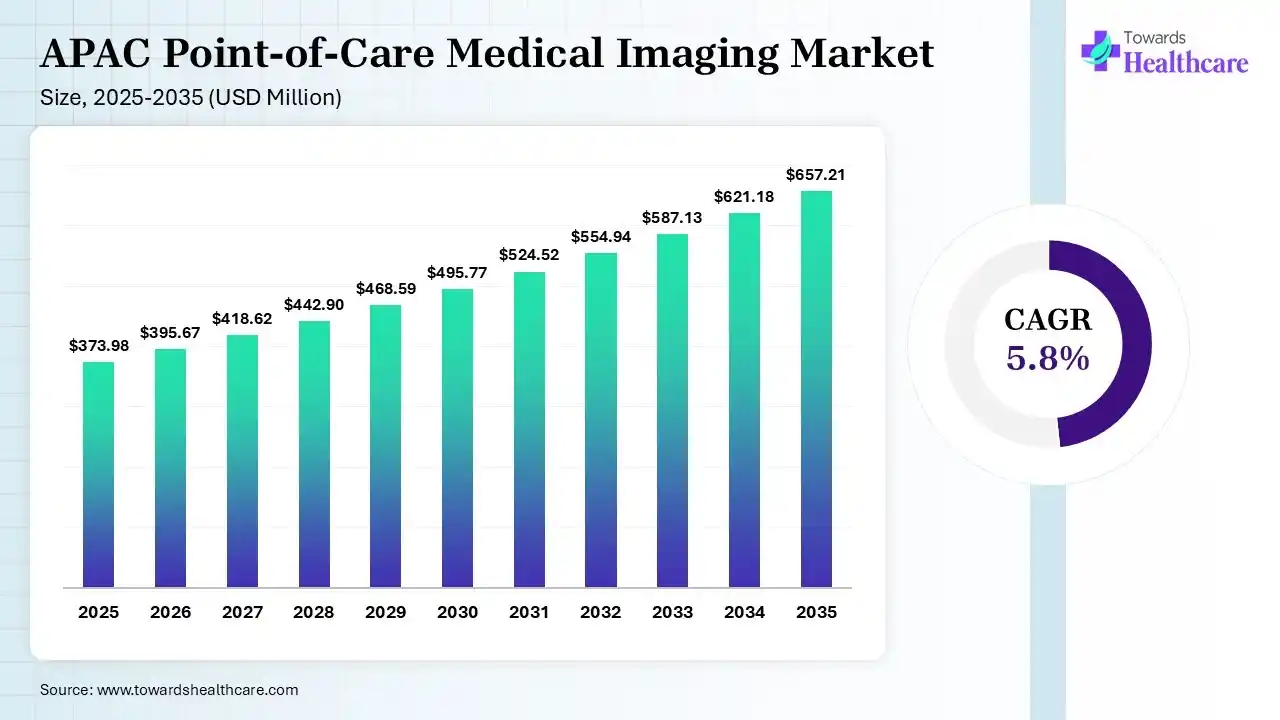
Request a Sample Report: https://www.towardshealthcare.com/download-sample/7056
The growth story, however, is not simply about selling more imaging devices.
The next competitive cycle will be shaped by:
AI integration + handheld devices + clinical workflow + local manufacturing + hospital partnerships + regulatory strategy + patent/IP positioning + geographic GTM execution.
APAC Point-of-Care Medical Imaging at a Glance
According to Towards Healthcare:
- The sector is projected to reach USD 395.67 million in 2026.
- Long-term revenue could reach approximately USD 657.21 million by 2035.
- Growth is forecast at a 5.8% CAGR between 2026 and 2035.
- China accounted for a 10.50% revenue share in 2025.
- India accounted for 4.30% in 2025 and is forecast to record the fastest country-level CAGR of 7.2%.
- Ultrasound represented 55% of revenue by product type in 2025.
- Handheld ultrasound accounted for 24.75% and is projected to expand at the fastest CAGR of 12.8%.
- The handheld portability segment held 42% of revenue and is projected to grow at 12.6% CAGR.
- General imaging represented 42% of applications.
- Cardiovascular imaging accounted for 25% and is forecast to grow at 7.5% CAGR.
- Hospitals represented the largest end-user group with a 56% share in 2025.
- Clinics accounted for 27% and are forecast to grow at 7.2% CAGR.
- Emergency and trauma care represented 32% of care-setting demand.
- Ambulance and prehospital applications accounted for 6% but are projected to grow at the fastest CAGR of 10.2%.
These numbers highlight one of the industry’s most important transitions:
Imaging is becoming more portable, more connected, and increasingly available outside the conventional radiology department.
Why the Need for Point-of-Care Imaging Is Growing
The expansion of portable imaging is closely connected with APAC’s growing burden of chronic disease.
The World Health Organization reports that 9.5 million people die from noncommunicable diseases every year in the WHO South-East Asia Region, with NCDs accounting for approximately 52% of all deaths. WHO also reports that around 53% of NCD deaths occur before the age of 70.
Cardiovascular disease is particularly relevant to the point-of-care imaging opportunity.
WHO estimates that more than 4.25 million deaths in the South-East Asia Region were caused by cardiovascular diseases in 2021, with 49.2% occurring prematurely among people aged 30–69 years.
This creates a strong strategic case for faster diagnostic access.
Portable and point-of-care imaging can support clinicians in settings where rapid assessment is important, including:
- Emergency departments
- Critical care
- Cardiology
- Primary and community care
- Rural healthcare facilities
- Ambulances
- Trauma settings
- Specialty clinics
The World Bank has also highlighted that East Asia and Pacific countries face growing NCD needs alongside population ageing and urbanization, while significant gaps remain in primary healthcare access, quality, and service coverage. In some countries, the probability of premature death from NCDs among people aged 30–70 exceeds 30%.
For imaging companies, this means the opportunity is increasingly linked to decentralizing diagnostics.
Handheld Ultrasound Is Becoming a Major Growth Engine
The most important product trend in the 2026 outlook is the rise of handheld imaging.
Towards Healthcare estimates that handheld ultrasound represented 24.75% of APAC point-of-care medical imaging revenue in 2025 and could expand at a CAGR of 12.8% through 2035.
The broader handheld device segment accounted for 42% of revenue and is projected to grow at 12.6% CAGR.
This is strategically important because handheld systems address several healthcare challenges simultaneously:
Portability + faster access + bedside imaging + mobility + workflow flexibility.
However, portability alone will not create a sustainable competitive advantage.
The next generation of winning products will need to combine:
High-quality imaging + AI assistance + easy workflows + cloud connectivity + cybersecurity + training + affordable ownership models.
AI Is Changing the Competitive Definition of Medical Imaging
Historically, imaging competition focused heavily on hardware specifications.
In 2026, the competition is expanding.
Buyers increasingly evaluate:
- AI-enabled image guidance
- Automated measurements
- Workflow automation
- Clinical decision support
- Cloud connectivity
- Data management
- Image sharing
- Remote collaboration
- Interoperability
- Cybersecurity
This is particularly important for handheld and point-of-care devices because users may include clinicians with different levels of imaging expertise.
AI can potentially support image acquisition, interpretation workflows, measurements, and documentation.
India is also strengthening its broader healthcare AI ecosystem. WHO reported that it supported India’s Ministry of Health and Family Welfare and ICMR in developing the Strategy for Artificial Intelligence in Healthcare for India (SAHI), describing it as a nationally led AI-for-health strategy focused on safety, ethics, governance, and health-system readiness.
For device manufacturers, this signals that AI adoption will increasingly require more than algorithm development.
Successful APAC strategies will need to address:
Clinical validation + regulation + data governance + local workflows + user training + reimbursement and procurement realities.
Who Is Leading the Competitive Landscape?
Several global imaging companies are shaping the competitive environment.
GE HealthCare
GE HealthCare continues to build its imaging strategy around portable technologies, ultrasound, AI-enabled workflows, and broader enterprise imaging capabilities.
Its competitive strength comes from:
Global scale + installed base + hospital relationships + imaging portfolio + AI ecosystem.
The strategic challenge is translating this scale into products that remain competitive in increasingly price-sensitive and decentralized APAC care settings.
Philips
Philips competes through ultrasound, patient monitoring, connected care, and enterprise-level healthcare technologies.
Its GTM opportunity is particularly strong where providers want to connect point-of-care imaging with broader patient-monitoring and digital-health ecosystems.
Siemens Healthineers
Siemens Healthineers brings significant strength in imaging technology, AI, software, digital infrastructure, and hospital relationships.
For point-of-care imaging, its competitive advantage depends on how effectively advanced imaging intelligence can move into decentralized clinical environments.
Canon Medical Systems
Canon Medical Systems remains an important imaging competitor with capabilities across ultrasound and broader diagnostic imaging.
Its opportunity in APAC includes combining established imaging expertise with region-specific manufacturing, partnerships, and clinical deployment strategies.
Fujifilm SonoSite
Fujifilm SonoSite is strongly associated with point-of-care ultrasound and portable imaging.
Its competitive position benefits from a focused point-of-care identity, particularly as emergency, critical-care, and bedside imaging applications expand.
The Competitive Battle Is Expanding
The future competitive map is not limited to five multinational companies.
New competition can emerge from:
- Handheld ultrasound specialists
- AI imaging software companies
- Regional manufacturers
- Chinese device companies
- Digital-health platforms
- Cloud imaging providers
- Hospital IT vendors
This means incumbent companies face competition at multiple levels:
Hardware competition + software competition + AI competition + workflow competition + price competition.
China and India: Two Different Strategic Opportunities
Towards Healthcare estimates that China held the largest country share identified in the APAC analysis at 10.50% in 2025.
China remains strategically important because of its manufacturing ecosystem, large healthcare system, technology capabilities, and growing domestic competition.
For global manufacturers, the question is increasingly:
How do you compete against local manufacturing speed and cost advantages?
India, meanwhile, held 4.30% in 2025 but is projected to expand at the fastest CAGR of 7.2%.
This creates a different GTM opportunity.
India’s growth potential is linked to:
- Expanding healthcare infrastructure
- Growing diagnostic demand
- Digital-health development
- Rising chronic disease burden
- Greater adoption of AI
- Demand for affordable technologies
- Need for portable systems across diverse care settings
A successful India strategy may therefore require:
Affordable pricing + local partnerships + clinician education + service infrastructure + strong regulatory execution.
GTM Strategy: How Can Companies Win in APAC?
A single APAC strategy will not work.
The region includes highly developed healthcare systems as well as markets where affordability, distribution, infrastructure, and workforce availability are major considerations.
A stronger GTM model should follow five stages.
1. Segment the Customer, Not Just the Country
Companies should identify different buyer groups:
Tier-1 hospitals → Multi-specialty hospitals → Specialty clinics → Emergency departments → Ambulance services → Rural facilities → Academic institutions.
Each group has different purchasing criteria.
Hospitals may prioritize:
Integration + reliability + image quality + enterprise contracts.
Clinics may prioritize:
Affordability + portability + ease of use + fast ROI.
Prehospital providers may prioritize:
Speed + ruggedness + battery performance + wireless connectivity.
2. Build an Application-Specific Value Proposition
A generic “portable imaging” message is becoming weaker.
Companies should build separate positioning for:
- Cardiovascular care
- General imaging
- Musculoskeletal care
- Emergency medicine
- Trauma
- Critical care
- Prehospital care
This is especially relevant because Towards Healthcare projects cardiovascular applications to grow at 7.5% CAGR, while ambulance and prehospital settings could grow at 10.2% CAGR.
3. Create a Clinical Education Engine
Point-of-care imaging adoption depends on user confidence.
The GTM strategy should include:
KOL partnerships + physician training + certification programs + clinical demonstrations + hospital workshops + real-world case studies.
A device without a strong training ecosystem can face slower adoption even when its technical specifications are superior.
4. Develop Flexible Pricing
Manufacturers should evaluate:
- Direct purchase
- Leasing
- Subscription models
- Pay-per-use models
- Enterprise contracts
- Managed-service agreements
This can be particularly valuable for smaller clinics and emerging healthcare facilities.
5. Build Local Service Capability
After-sales service can be as important as the initial sale.
Companies need strong:
Distributor networks + service engineers + spare-parts availability + application specialists + remote support.
Launch Strategy for New Point-of-Care Imaging Products
A successful launch should begin long before the product enters the market.
Pre-Launch
Companies should conduct:
Competitor mapping + KOL interviews + patent landscaping + pricing research + regulatory intelligence + unmet-need analysis.
The goal is to identify the strongest initial clinical use case.
Launch
The first launch should focus on a limited number of high-value applications rather than targeting every possible buyer.
For example:
Handheld ultrasound → Emergency care → Cardiovascular screening → Prehospital use.
Companies can then build evidence, case studies, and customer references before wider expansion.
Post-Launch
Track:
- Device utilization
- Clinical adoption
- Training completion
- Customer retention
- Service requests
- Revenue per account
- Geographic expansion
- Competitor response
This turns product launch into a continuous intelligence cycle.
Product Pipeline: What Technologies Should Companies Watch?
The future product pipeline is likely to focus on five major areas.
1. AI-Assisted Imaging
Systems that support image acquisition, measurement, and workflow efficiency.
2. Smaller Form Factors
Further movement from cart-based systems toward compact and handheld devices.
3. Wireless Connectivity
Real-time sharing of imaging information across clinical teams.
4. Cloud-Based Imaging Ecosystems
Integration with enterprise platforms, EHRs, and remote-care systems.
5. Specialized Clinical Applications
Products designed specifically for cardiovascular, musculoskeletal, emergency, trauma, and critical-care use.
The companies that combine these capabilities into a clinically validated workflow could build stronger competitive positions than companies competing only on device specifications.
Patent Competition: The Next Strategic Battleground
Patent competition in medical imaging is becoming increasingly important as AI and software become embedded in devices.
The IP landscape is expanding beyond:
Transducers + probes + imaging hardware.
Companies now need to monitor patent activity related to:
- AI image acquisition
- Automated image analysis
- Clinical decision support
- Ultrasound beamforming
- Signal processing
- Wireless transmission
- Cloud imaging
- Image reconstruction
- Data processing
- AI-enabled workflow software
A strong patent strategy should answer three questions:
Where is the innovation concentrated?
Identify technology clusters and rapidly growing patent areas.
Who owns critical IP?
Map competitors, startups, universities, and technology partners.
Where are the white spaces?
Identify opportunities for product development and future IP creation.
Patent intelligence can also help companies identify:
Licensing opportunities + acquisition targets + partnership opportunities + potential freedom-to-operate risks.
How Towards Healthcare Can Help Companies Build a Stronger APAC Strategy
The APAC point-of-care medical imaging opportunity is becoming more competitive and fragmented.
Companies need more than revenue forecasts.
They need actionable intelligence.
Market Intelligence
Towards Healthcare provides analysis of:
- Revenue opportunities
- Country growth
- Product segments
- End users
- Applications
- Care settings
- Emerging technology trends
According to our analysis, the APAC point-of-care medical imaging sector could expand from USD 395.67 million in 2026 to USD 657.21 million by 2035.
Competitive Intelligence
We can benchmark competitors across:
Products + pricing + technology + AI capabilities + partnerships + regional presence + launches + clinical strategy.
GTM Strategy
Our research can help identify:
High-growth countries + priority customers + clinical applications + distribution opportunities + pricing strategies + partnership models.
Patent and IP Intelligence
We can map:
Patent owners + technology clusters + filing trends + competitor portfolios + white-space opportunities.
Product Pipeline Intelligence
Track competitor:
Product launches + AI features + regulatory milestones + partnerships + acquisitions + clinical evidence.
Launch Strategy
Towards Healthcare can support a structured path from:
Opportunity assessment → Market segmentation → Competitor analysis → Positioning → Pricing → Partner strategy → Launch planning → Post-launch monitoring.
