by
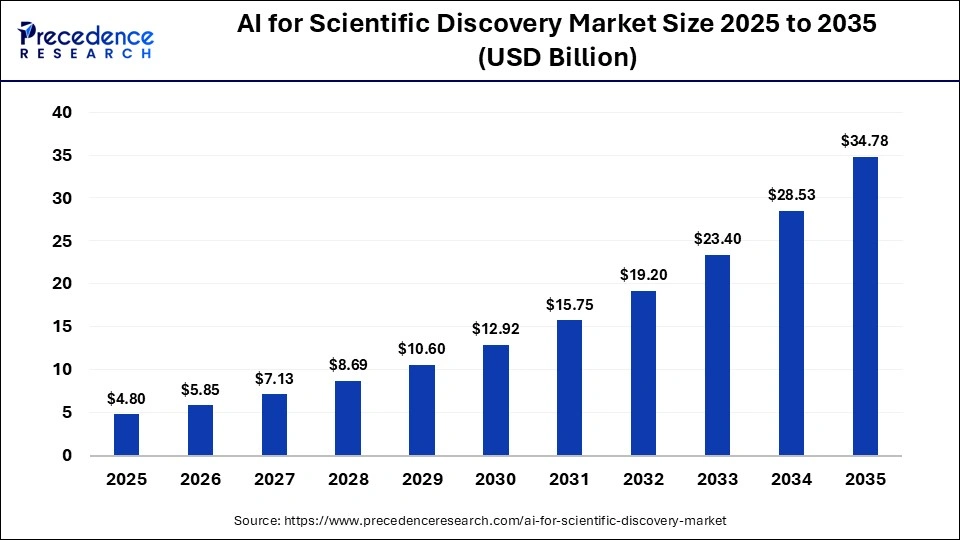
by The global AI for scientific discovery market size was valued at USD 4.80 billion in 2025 and is projected to grow from USD 5.85 billion in 2026 to approximately USD 34.78 billion by 2035, expanding at a remarkable CAGR of 21.90% from 2026 to 2035. The market is witnessing exponential growth driven by massive data generation, advancements in high-performance computing (HPC), and the increasing adoption of generative AI in drug discovery, materials science, and climate research.
Read Also: Vaccine Technologies Market
Market Overview
The AI for scientific discovery market includes artificial intelligence platforms, algorithms, and services that accelerate research across:
-
Life sciences
-
Chemistry
-
Physics
-
Materials science
-
Climate modeling
These solutions leverage machine learning (ML), deep learning, generative AI, and HPC systems to:
-
Analyze complex scientific datasets
-
Predict molecular structures
-
Simulate experiments
-
Generate new research hypotheses
AI-driven platforms are increasingly deployed by pharmaceutical companies, academic research labs, biotechnology firms, and industrial R&D centers to reduce research timelines and minimize experimental costs.
Key Takeaways
-
North America held nearly 40% market share in 2025.
-
Asia Pacific is projected to grow at the fastest CAGR during the forecast period.
-
AI software platforms led the offering segment with ~44% share in 2025.
-
Data infrastructure & HPC platforms are expected to grow at the fastest rate.
-
Machine learning algorithms dominated the technology segment with ~36% share.
-
Generative AI models are projected to witness the highest CAGR.
-
Drug discovery & biomedical research led applications with ~34% share.
-
Pharmaceutical & biotech companies held ~36% share by end user.
AI for Scientific Discovery Market Trends
1. Generative AI for Drug Discovery
Generative AI platforms are revolutionizing molecular design. For example, initiatives such as ADDISON by Merck & Co., Inc. are enabling virtual molecular modeling to accelerate new drug candidate identification.
Generative AI models can:
-
Design entirely new molecular structures
-
Predict drug-to-drug interactions
-
Support drug repurposing strategies
-
Reduce costly trial-and-error experimentation
2. Multimodal AI Adoption
Modern AI models integrate diverse datasets, including:
-
Textual research data
-
Microscopy images
-
Genomic sequences
-
Chemical compound libraries
This multimodal capability enhances predictive accuracy and improves scientific hypothesis validation.
3. Cloud & High-Performance Computing Integration
Advanced cloud-based HPC systems provide:
-
Low-latency networking
-
GPU-optimized processing
-
High-performance storage
These capabilities prevent GPU idling and enable training of massive AI models efficiently, accelerating scientific outcomes.
4. Data Privacy Innovations
Emerging techniques such as:
-
Synthetic data generation
-
Homomorphic encryption
Allow secure sharing of confidential research datasets without compromising intellectual property or regulatory compliance.
Segment Insights
By Offering
Why AI Software Platforms Dominated in 2025
The AI software platforms segment accounted for nearly 44% of market share in 2025.
These platforms:
-
Manage complex datasets like genomic sequences and chemical libraries
-
Predict compound efficacy before lab testing
-
Reduce early-stage drug trial failures
-
Accelerate materials research
Their ability to shorten development cycles gives them a competitive advantage across industries.
Fastest Growing: Data Infrastructure & HPC Platforms
The data infrastructure and HPC segment is expected to grow at the fastest CAGR due to:
-
Massive model training requirements
-
Large-scale dataset handling
-
Cloud-enabled scalability
-
GPU-intensive AI workloads
By Technology
Machine Learning Algorithms Led the Market
Machine learning algorithms held approximately 36% share in 2025.
ML enables:
-
Large-scale pattern recognition
-
Automation of repetitive research tasks
-
Molecular simulation
-
Faster drug-target interaction predictions
ML models can analyze millions of molecular structures daily — far beyond traditional lab capacity.
Generative AI Models: The Fastest Growing Segment
Generative AI models are projected to grow at the highest CAGR due to their ability to:
-
Simulate experiments virtually
-
Design new materials and compounds
-
Reduce R&D expenditure
-
Accelerate commercialization
By Application
Drug Discovery & Biomedical Research Led the Market
This segment accounted for nearly 34% market share in 2025.
High drug development costs and frequent clinical trial failures have pushed pharmaceutical companies to adopt AI for:
-
Drug interaction prediction
-
Molecular-level simulation
-
Target identification
-
Clinical trial optimization
Fastest Growing: Materials Science & Chemistry Discovery
AI tools such as graph neural networks and physics-informed neural networks allow:
-
Atomic-level material simulation
-
Prediction of chemical properties
-
Reduced physical synthesis costs
-
Sustainable material development
By End User
Pharmaceutical & Biotech Companies Dominated
Pharmaceutical and biotech companies held nearly 36% share in 2025.
Major players such as:
-
Novartis AG
-
Recursion Pharmaceuticals Inc.
-
Insilico Medicine
Are heavily investing in AI to reduce R&D failure rates and optimize clinical trials.
According to industry insights, over 50% of pharma leaders prioritize AI-driven analytics for operational efficiency.
Fastest Growing: Chemicals & Materials Companies
Chemical and materials firms are increasingly deploying AI to:
-
Identify new molecules
-
Predict chemical behavior
-
Reduce industrial waste
-
Develop environmentally sustainable alternatives
For inquiries regarding discounts, bulk purchases, or customization requests, please contact us at sales@precedenceresearch.com