
 by
by Table of Contents
ToggleMarket Overview
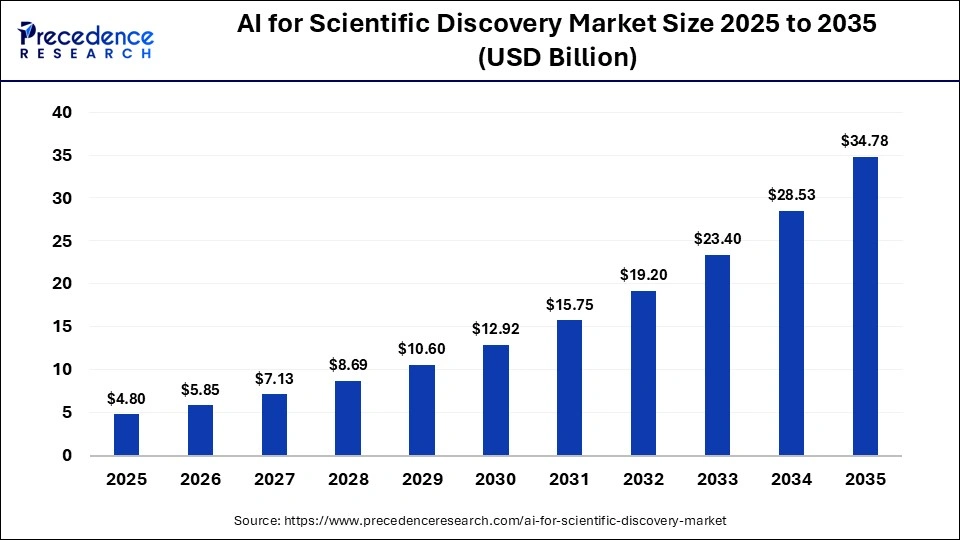
The global AI for scientific discovery market is witnessing rapid expansion as artificial intelligence continues to transform research methodologies across industries. The market size was valued at USD 4.80 billion in 2025 and is projected to grow from USD 5.85 billion in 2026 to approximately USD 34.78 billion by 2035, registering an impressive CAGR of 21.90% during the forecast period.
This remarkable growth is fueled by the exponential rise in data generation, advancements in high-performance computing (HPC), and increasing adoption of generative AI technologies in drug discovery, materials science, and complex simulations. AI is now playing a pivotal role in accelerating hypothesis generation, reducing experimental timelines, and minimizing research costs.
Read Also: Dental Acrylic Materials Market
Key Market Highlights
- Market Size 2026: USD 5.85 Billion
- Projected Size 2035: USD 34.78 Billion
- CAGR (2026–2035): 21.90%
- Leading Region: North America (~40% share in 2025)
- Fastest Growing Region: Asia Pacific
- Top Segment (Offering): AI Software Platforms (44% share)
- Top Application: Drug Discovery & Biomedical Research (34% share)
Market Dynamics
Why is the AI for Scientific Discovery Market Growing?
The integration of AI into scientific research is fundamentally transforming how discoveries are made. Traditional research processes are often time-consuming and resource-intensive. AI significantly reduces these barriers by enabling:
- Rapid data analysis across massive datasets
- Accurate prediction of molecular interactions
- Simulation of experiments without physical trials
- Faster identification of drug candidates
Industries such as pharmaceuticals, biotechnology, and materials science are heavily investing in AI-driven platforms to enhance innovation and improve efficiency.
Role of AI in Scientific Discovery
Artificial intelligence technologies—including machine learning, deep learning, and generative AI—are enabling researchers to:
- Predict protein structures and molecular behavior
- Automate repetitive experimental tasks
- Generate new hypotheses using pattern recognition
- Design novel compounds for drugs and materials
Generative AI, in particular, is revolutionizing drug discovery by designing entirely new molecular structures, significantly reducing dependency on trial-and-error methods.
Latest Market Trends
1. Generative AI Transforming Drug Discovery
AI platforms are now capable of designing drug molecules virtually, drastically shortening the drug development lifecycle and reducing R&D costs.
2. Rise of Multimodal AI
Modern AI systems can process multiple data formats—including text, images, and numerical datasets—enhancing research accuracy and insights.
3. Cloud and HPC Integration
Cloud computing and high-performance computing infrastructure are enabling scalable AI model training, ensuring faster processing of large scientific datasets.
4. Data Privacy Innovations
Advanced technologies such as synthetic data generation and homomorphic encryption are ensuring secure data sharing while maintaining confidentiality.
Segment Analysis
By Offering
AI Software Platforms dominated the market in 2025 with a 44% share. These platforms enable efficient handling of complex datasets and accelerate research workflows, particularly in genomics and chemical analysis.
Meanwhile, Data Infrastructure and HPC Platforms are expected to grow at the fastest pace due to their ability to support large-scale AI model training and real-time data processing.
By Technology
Machine Learning Algorithms held the largest share (~36%) due to their ability to automate data analysis and predict outcomes with high accuracy.
Generative AI Models are projected to witness the fastest growth, as they can simulate experiments and design new molecules, significantly reducing development timelines.
By Application
Drug Discovery and Biomedical Research emerged as the leading segment, accounting for nearly 34% of the market. AI is widely used to identify drug candidates, predict interactions, and optimize clinical trials.
The Materials Science and Chemistry Discovery segment is expected to grow rapidly, driven by AI’s ability to simulate atomic-level interactions and predict material properties before synthesis.
By End User
Pharmaceutical and biotechnology companies dominated the market with a 36% share in 2025 due to heavy investments in AI-driven R&D.
The chemicals and materials companies segment is expected to grow at the fastest CAGR, leveraging AI for sustainable material development and process optimization.
Regional Insights
North America
North America leads the global market due to:
- Strong R&D ecosystem
- Presence of major tech players
- Early adoption of AI technologies
- Significant investments in drug discovery
The U.S. remains the largest contributor, supported by government initiatives and advanced research infrastructure.
Asia Pacific
Asia Pacific is the fastest-growing region, driven by:
- Increasing government investments in AI research
- Expanding biotech and pharmaceutical industries
- Growing adoption of AI in drug discovery and diagnostics
Countries like China and India are rapidly advancing their AI capabilities, supported by strong talent pools and innovation ecosystems.
Europe
Europe is emerging as a strong market due to:
- Government-backed research programs
- Advanced academic institutions
- Growing collaborations between tech firms and research organizations
Initiatives like Horizon Europe are accelerating AI adoption across scientific disciplines.
Competitive Landscape
The market is highly competitive, with leading companies focusing on innovation, partnerships, and AI-driven research platforms.
Key Players Include:
- AbCellera Biologics Inc.
- Amazon Web Services Inc.
- Atomwise Inc.
- BenevolentAI
- IBM Corporation
- Microsoft Corporation
- NVIDIA Corporation
- Google LLC
- Recursion Pharmaceuticals Inc.
- Schrödinger Inc.
Recent Developments
- February 2026: Tamarind Bio raised USD 13.6 million to expand AI model libraries for life sciences research.
- February 2026: Google DeepMind launched AI collaboration initiatives in India to enhance access to advanced research tools.
These developments highlight the growing investment and innovation in AI-powered scientific discovery.
Future Outlook
The future of the AI for scientific discovery market looks highly promising. With continuous advancements in AI algorithms, quantum computing, and data infrastructure, the scope of AI in research will expand significantly.
Key opportunities include:
- Accelerated drug discovery pipelines
- Breakthroughs in climate modeling and sustainability
- Advanced materials innovation
- Personalized medicine and genomics
As organizations increasingly adopt AI to gain a competitive edge, the market is expected to witness exponential growth over the next decade.
Conclusion
The AI for scientific discovery market is entering a transformative phase, driven by technological innovation and increasing demand for faster, more efficient research solutions. With a projected market size of USD 34.78 billion by 2035, AI is set to become an indispensable tool across scientific disciplines.
Organizations that invest in AI-driven platforms today will be at the forefront of tomorrow’s scientific breakthroughs.
Get Sample Copy: https://www.precedenceresearch.com/sample/7938
For inquiries regarding discounts, bulk purchases, or customization requests, please contact us at sales@precedenceresearch.com

- Endotoxin Testing Market Size to Hit USD 3.78 Billion by 2035 - March 27, 2026
- AI for Scientific Discovery Market Size to Hit USD 34.78 Billion by 2035 - March 27, 2026
- Dental Acrylic Materials Market Size to Hit USD 3.29 Billion by 2035 - March 27, 2026
