 by
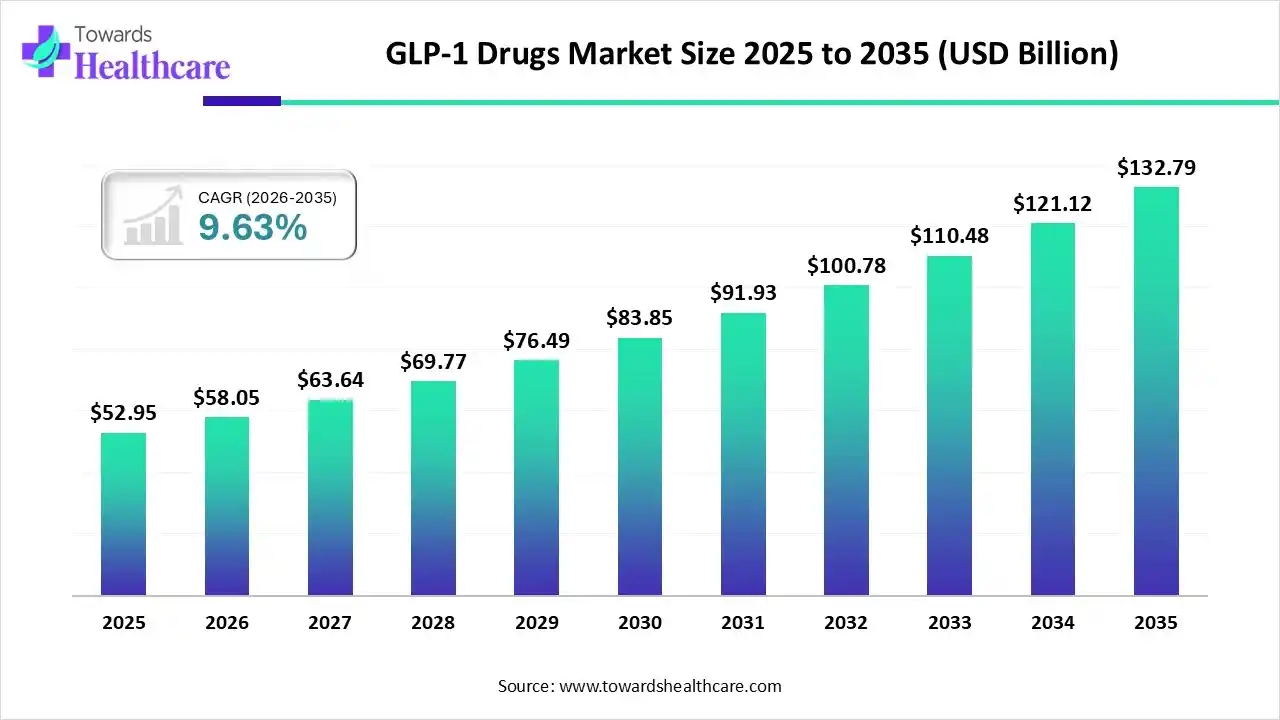
by The global GLP-1 drugs market is rapidly transforming the pharmaceutical industry as demand increases for diabetes management, obesity treatment, and broader cardiometabolic care. According to Towards Healthcare, the global GLP-1 drugs market was valued at US$52.95 billion in 2025 and is expected to reach US$58.05 billion in 2026. The market is projected to surpass US$132.79 billion by 2035, expanding at a 9.63% CAGR from 2026 to 2035.
Request a Customized Report Sample: https://www.towardshealthcare.com/download-sample/5878
The growth of GLP-1 therapies is being supported by rising obesity rates, increasing diabetes prevalence, growing physician adoption, improved clinical outcomes, and expanding investment in next-generation therapies.
Source: Towards Healthcare – GLP-1 Drugs Market Sizing
GLP-1 Drugs Market Size and Growth
The market is moving beyond its traditional diabetes-focused application. GLP-1 therapies are increasingly being used for chronic weight management, while cardiovascular and other metabolic indications are creating additional opportunities.
| Year | Global GLP-1 Drugs Market |
|---|---|
| 2025 | US$52.95 billion |
| 2026 | US$58.05 billion |
| 2035 | US$132.79 billion |
| CAGR, 2026–2035 | 9.63% |
Towards Healthcare estimates that North America accounted for approximately 64% of the global GLP-1 drugs market, while semaglutide represented around 49% of the market in 2025.
This concentration makes North America particularly important for pharmaceutical companies, manufacturers, healthcare providers, investors, and companies entering the GLP-1 value chain.
Why Is Demand for GLP-1 Drugs Increasing?
Several factors are contributing to the rapid adoption of GLP-1 medicines.
Rising obesity and overweight population
The potential patient pool is enormous. The World Health Organization estimates that 2.5 billion adults were overweight in 2022, including 890 million people living with obesity. Around 16% of adults worldwide were living with obesity.
The growing burden of obesity is creating demand for effective long-term treatment options and expanding the commercial opportunity for GLP-1-based therapies.
Diabetes remains a major demand driver
GLP-1 drugs have become an important treatment option for people with type 2 diabetes. Their ability to support glucose control and, for several therapies, weight reduction has increased physician and patient interest.
Weight-management demand is accelerating
The obesity-treatment segment has become one of the most important growth engines for GLP-1 drugs. Consumers are increasingly looking for therapies that can provide meaningful weight loss alongside broader metabolic benefits.
Greater awareness among consumers
Clinical studies, physician recommendations, social media discussions, telehealth services, and direct-to-consumer healthcare platforms have increased awareness of GLP-1 therapies.
GLP-1 Drugs Market TAM, SAM and SOM
The total addressable market provides a useful way to understand the commercial opportunity.
Total Addressable Market (TAM)
The global GLP-1 drugs market can be treated as a TAM of approximately US$58.05 billion in 2026, based on the Towards Healthcare estimate.
This represents the broad global revenue opportunity across major GLP-1 applications and geographies.
Serviceable Available Market (SAM)
Towards Healthcare estimates that North America represents approximately 64% of the global market.
Applying this share to the 2026 global market produces an indicative North American opportunity of approximately:
US$58.05 billion × 64% = US$37.15 billion
Therefore, an indicative North American SAM is approximately US$37.15 billion in 2026.
This is a derived estimate rather than a separately published market figure.
Serviceable Obtainable Market (SOM)
SOM depends on the individual company’s:
- Target geography
- Product portfolio
- Approved indications
- Pricing
- Manufacturing capacity
- Distribution network
- Reimbursement access
- Physician adoption
- Brand strength
- Competitive differentiation
Companies should therefore calculate SOM using patient numbers, treatment penetration, annual treatment value, and achievable market share instead of applying a generic percentage to the global market.
GLP-1 Consumer Behavior: What Are Patients Looking For?
Consumer behavior is becoming an increasingly important factor in the GLP-1 drugs industry.
U.S. data from KFF indicate that 18% of adults have ever used a GLP-1 drug and 12% currently use one.
Adoption is particularly high among people with metabolic conditions. KFF reported that approximately 45% of adults diagnosed with diabetes currently use a GLP-1, compared with 29% among those diagnosed with heart disease and 23% among those diagnosed as overweight or obese.
Cost remains one of the biggest barriers.
KFF found that 56% of GLP-1 users consider the drugs difficult to afford, while some patients report paying the full medication cost themselves.
This creates a clear commercial challenge: clinical demand is increasing faster than affordable access for many consumers.
What influences GLP-1 purchasing decisions?
Consumers are increasingly considering:
- Treatment effectiveness
- Weight-loss results
- Blood glucose control
- Side effects
- Treatment price
- Insurance coverage
- Dosing frequency
- Injection versus oral administration
- Physician recommendation
- Availability
- Convenience
- Long-term treatment expectations
The transition toward oral GLP-1 therapies could further influence consumer behavior by addressing the inconvenience associated with injectable treatments.
GLP-1 Buyer Intelligence
The GLP-1 ecosystem includes several important buyer groups.
| Buyer Group | Primary Buying Considerations |
|---|---|
| Patients | Price, effectiveness, convenience and safety |
| Physicians | Clinical evidence, outcomes and tolerability |
| Hospitals and clinics | Patient outcomes, supply and economics |
| Insurers and PBMs | Cost effectiveness and healthcare outcomes |
| Employers | Employee healthcare costs and productivity |
| Pharmacies | Product availability and demand |
| Telehealth companies | Prescription workflow and supply |
| Wholesalers | Volume, pricing and supply continuity |
| API manufacturers | Long-term contracts and quality |
| CDMOs | Manufacturing capacity and regulatory compliance |
This means companies competing in the GLP-1 ecosystem need more than an effective molecule. Pricing, access, manufacturing capacity, distribution and patient experience are becoming equally important commercial factors.
GLP-1 Prescription and Volume Trends
Prescription volume provides another way to understand the rapid adoption of GLP-1 medicines.
IQVIA reported that GLP-1 drugs accounted for approximately 52% of diabetes prescription volume by May 2025, compared with 18% in 2020.
Commercial GLP-1 prescriptions increased from approximately 680,000 in January 2020 to 4.7 million in May 2025.
This represents roughly a six-to-seven-fold increase in commercial prescription volume over the period.
The increase demonstrates that GLP-1 therapies are becoming increasingly embedded in the diabetes treatment landscape.
Novo Nordisk also reported strong growth in its obesity-care portfolio, with approximately 3.6 million people receiving its obesity products globally in 2025.
Novo Nordisk vs. Eli Lilly: Competitive Landscape
The GLP-1 market is currently dominated by major pharmaceutical companies, particularly Novo Nordisk and Eli Lilly.
Novo Nordisk
Novo Nordisk has established a strong position through its semaglutide portfolio, including therapies such as Ozempic, Wegovy and Rybelsus.
The company’s obesity-care sales reached approximately DKK82.35 billion in 2025, according to its annual report.
Novo Nordisk is also investing in higher-dose and oral GLP-1 formulations to maintain its competitive position.
Eli Lilly
Eli Lilly has strengthened its position through tirzepatide-based products.
In 2025, Lilly reported:
- Mounjaro revenue: US$22.97 billion
- Zepbound revenue: US$13.54 billion
Together, these products generated approximately US$36.5 billion in revenue during 2025.
The competitive battle is increasingly shifting toward:
- Greater weight loss
- Improved metabolic outcomes
- Oral delivery
- Higher-dose formulations
- Longer treatment duration
- Lower treatment costs
- Improved patient convenience
- Combination mechanisms
Oral GLP-1 Drugs Could Change the Market
The next major competitive shift is the move from injectable therapies toward oral formulations.
Oral GLP-1 drugs could attract patients who are uncomfortable with injections and may improve convenience and treatment acceptance.
The emergence of oral products also creates new competition around:
Convenience + adherence + pricing + efficacy + patient experience.
This could eventually influence how physicians prescribe GLP-1 medicines and how patients select treatments.
GLP-1 Drug Pipeline and Recent Developments
The competitive pipeline is becoming increasingly advanced.
One of the most closely watched programs is retatrutide, Eli Lilly’s investigational triple agonist targeting GIP, GLP-1 and glucagon receptors.
In a Phase 3 study, the 12 mg dose produced approximately 20.8% average weight loss at 80 weeks in the reported trial population.
Lilly has indicated plans to submit retatrutide for regulatory review, potentially creating another major competitive challenge for existing GLP-1 and incretin therapies.
Higher-dose semaglutide is another important development. The FDA approved Wegovy HD (semaglutide 7.2 mg) in March 2026 for certain adults with obesity or overweight plus a weight-related condition.
These developments demonstrate how competition is moving beyond the first generation of GLP-1 products toward higher efficacy, alternative delivery methods and multi-receptor mechanisms.
GLP-1 Import and Export Opportunities
International trade data require careful interpretation because there is no single global customs classification specifically dedicated to GLP-1 medicines such as semaglutide, tirzepatide, Wegovy, Ozempic or Mounjaro.
Finished medicines and pharmaceutical ingredients can fall under broader customs classifications.
For accurate GLP-1 trade intelligence, companies should combine:
- HS codes for pharmaceutical preparations
- Peptide/API trade classifications
- Country-level customs data
- Shipment-level trade databases
- Import and export volumes
- Supplier information
- Manufacturing locations
- Regulatory approvals
The supply chain is becoming particularly important as manufacturers attempt to secure sufficient peptide/API capacity.
Regulatory scrutiny of imported GLP-1 ingredients also highlights the growing importance of supplier qualification, manufacturing quality and regulatory compliance.
GLP-1 Manufacturing and Supply Chain Opportunity
The growth of GLP-1 therapies is creating opportunities beyond drug developers.
Companies operating in the following areas could benefit from increasing demand:
API and peptide manufacturing
Demand for high-quality GLP-1 APIs is increasing as drug volumes expand.
CDMO services
Pharmaceutical companies may increasingly rely on external manufacturing partners to expand capacity.
Fill-finish manufacturing
Injectable GLP-1 products require specialized filling, packaging and quality-control capabilities.
Cold-chain logistics
Temperature-sensitive pharmaceutical products require reliable distribution infrastructure.
Pharmaceutical packaging
Pens, cartridges, injectors and oral-dose packaging create additional opportunities.
Specialty pharmacies
Increasing demand creates opportunities for specialized dispensing and patient-support services.
Telehealth
Online healthcare platforms can support patient consultation, prescribing and ongoing treatment management where permitted.
Key Opportunities for GLP-1 Drug Companies
The market’s future growth will depend on more than increasing patient numbers.
Companies are increasingly competing around five major areas:
1. Clinical differentiation
Demonstrating stronger weight loss, metabolic outcomes and safety.
2. Patient affordability
Reducing out-of-pocket costs and improving reimbursement access.
3. Convenience
Developing oral, less frequent or easier-to-use formulations.
4. Manufacturing scale
Securing reliable API, drug-substance and finished-product capacity.
5. Market access
Building relationships with physicians, payers, pharmacies, employers and digital healthcare platforms.
GLP-1 Drugs Market: Strategic Outlook
The global GLP-1 drugs market is entering a more competitive phase. The market is projected by Towards Healthcare to grow from US$52.95 billion in 2025 to more than US$132.79 billion by 2035, creating significant opportunities across pharmaceuticals, biotechnology, healthcare services and manufacturing.
However, the next phase of growth will not be determined by demand alone.
Affordability, reimbursement, treatment adherence, oral formulations, manufacturing capacity, pipeline innovation and competitive efficacy will increasingly determine which companies capture the opportunity.
For pharmaceutical and healthcare companies, the biggest opportunity may therefore be at the intersection of patient demand and access.
Companies that can combine strong clinical outcomes with scalable manufacturing, competitive pricing, effective distribution and patient-friendly treatment options are likely to be better positioned as GLP-1 therapies move from a fast-growing drug category toward a broader cardiometabolic treatment ecosystem.
