 by
by Biotech companies sourcing high-purity bulk biological reagents need more than a supplier with a large catalog. For applications ranging from drug discovery and cell culture to diagnostics and biopharmaceutical manufacturing, buyers should assess purity, lot-to-lot consistency, traceability, analytical documentation, scalability, storage conditions, and regulatory support.
The importance of reagent quality is clear from U.S. government guidance. The FDA defines purity for biological products as relative freedom from extraneous matter, while its guidance emphasizes that biological-product manufacturing and licensing must maintain standards for safety, purity, and potency.
Why High-Purity Reagents Matter
Biological reagents can include proteins, antibodies, enzymes, cytokines, growth factors, cell-culture materials, nucleic acids, and other biological substances used in research and manufacturing.
According to the NIH, even slight variations in reagent quality, composition, preparation, reliability, and accessibility can produce major differences in research data and conclusions. That makes reagent sourcing a scientific reproducibility issue as well as a procurement decision.
For manufacturing applications, the FDA also notes that quality systems should ensure products meet their represented quality and purity characteristics. Its guidance specifically addresses controls across biotechnology processes, including cell banks, cell culture or fermentation, purification, bioburden, endotoxin, and process-related impurities.
Leading Sources for High-Purity Bulk Biological Reagents
Thermo Fisher Scientific
Thermo Fisher Scientific is a major option for companies requiring a broad life-science supply chain. Its portfolio spans research reagents, cell-culture products, biological materials, analytical tools, and bioproduction solutions.
It can be particularly relevant for biotech companies that want to source across the development lifecycle rather than manage numerous smaller vendors.
Best suited for: Large-scale biotech research, cell and gene therapy development, biologics development, and organizations seeking broad global supply capabilities.
Merck Life Science / Sigma-Aldrich / Millipore / SAFC
Merck offers multiple sourcing options through its life-science portfolio. Its official materials identify Sigma-Aldrich for laboratory and production materials, Millipore for biopharma-related solutions, and SAFC for pharmaceutical and biopharmaceutical raw-material solutions. The company also reports that more than 10,000 products can be shipped the same day through its India-facing life-science platform.
This makes Merck particularly relevant when buyers need to move from research-scale reagents toward more controlled production-grade materials.
Best suited for: Research-to-manufacturing workflows, bulk raw materials, filtration, culture media, analytical products, and biopharma sourcing.
Cytiva
Cytiva is particularly relevant for biotech and biopharmaceutical companies working with biological manufacturing processes, especially where cell culture, purification, chromatography, and bioprocess materials are central to operations.
For buyers, the value of a specialist supplier is often its ability to support process consistency as companies scale from development toward larger production volumes.
Best suited for: Biologics development, monoclonal antibodies, recombinant proteins, vaccines, and process-development applications.
Lonza
Lonza is a strong sourcing and development partner for companies that require more specialized biological and biopharmaceutical manufacturing capabilities. It is also identified by Towards Healthcare among major companies in the biotechnology reagents and kits ecosystem.
Its relevance is strongest when a biotech company requires quality-controlled biological materials combined with technical and manufacturing expertise.
Best suited for: Advanced biologics, biopharmaceutical manufacturing, cell and gene therapy, and companies scaling complex biological processes.
Bio-Techne
Bio-Techne is a specialized life-science supplier with relevance in proteins, antibodies, assays, and related biological research materials.
For companies where analytical performance and reagent specificity are more important than purchasing from a single broad supplier, specialist reagent companies can provide an important sourcing alternative.
Best suited for: Protein research, cell biology, immunology, biomarker development, and specialized research workflows.
Promega
Promega is another important supplier for biotech organizations requiring molecular-biology and biological research reagents, particularly for applications involving genomics, cell analysis, and analytical workflows.
Best suited for: Molecular biology, genomics, cell analysis, assay development, and drug-discovery research.
Towards Healthcare Data Shows Why Reagent Demand Is Rising
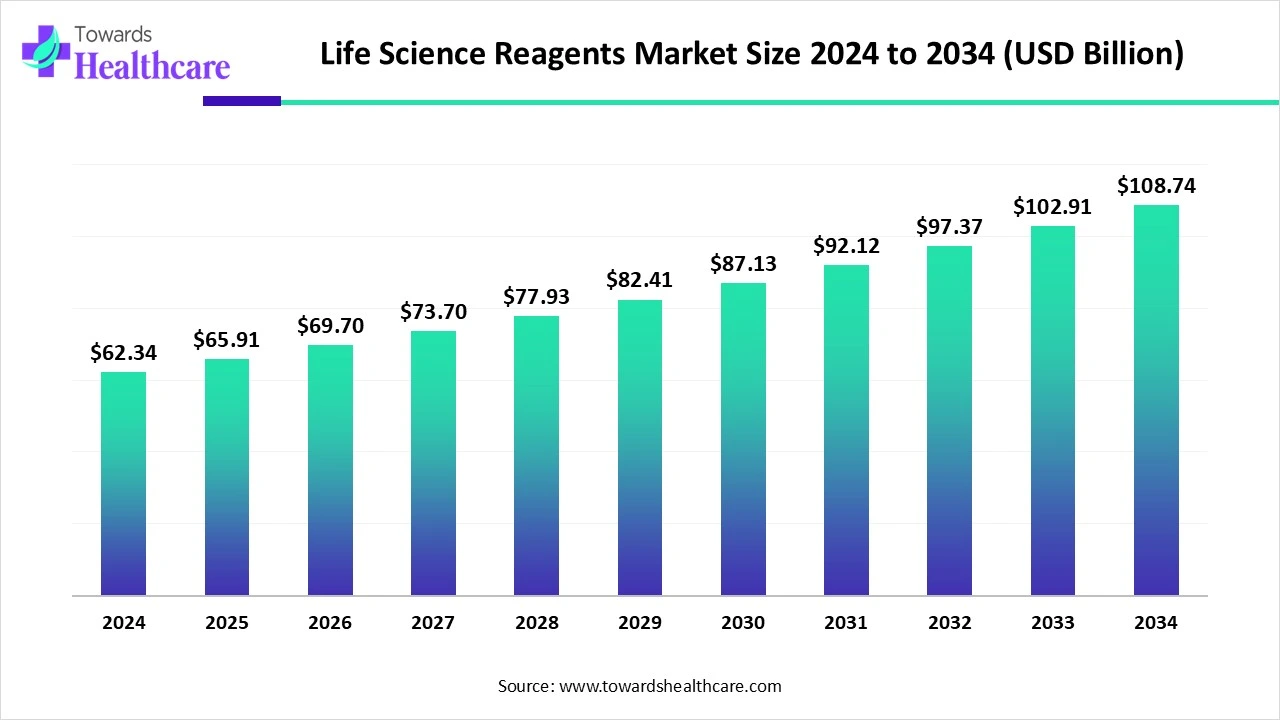
According to Towards Healthcare’s life science reagents analysis, the global life science reagents sector is projected to grow from USD 69.74 billion in 2026 to USD 115.24 billion by 2035, at a 5.74% CAGR. North America led the sector in 2025, while the biological reagents segment is expected to record the fastest growth. Pharmaceutical companies are also expected to be among the fastest-growing end users.
Access Our Research Insights : https://www.towardshealthcare.com/download-sample/5857
Towards Healthcare also estimates that the broader biotechnology reagents and kits sector could increase from USD 902.36 billion in 2026 to USD 2,297.07 billion by 2035, representing a 10.94% CAGR. The analysis identifies major participants including Thermo Fisher Scientific, Merck KGaA, Lonza, Bio-Rad, Bio-Techne, Promega, Qiagen, Sartorius, Roche, and Agilent Technologies.
Key Numbers to Watch
USD 69.74 billion — Global life science reagents sector in 2026.
USD 115.24 billion — Projected value by 2035.
5.74% CAGR — Expected growth from 2026 to 2035.
40% — Diagnostic reagents’ share by product type in 2025, according to Towards Healthcare.
50% — Clinical laboratories’ share by end user in 2025.
45% — Clinical diagnostics’ share by application in 2025.
USD 902.36 billion — Biotechnology reagents and kits sector size in 2026, according to Towards Healthcare.
USD 2,297.07 billion — Projected value by 2035.
10.94% CAGR — Projected growth rate for biotechnology reagents and kits.
What Government Data Says About Purity and Quality
The FDA’s quality requirements reinforce why buyers should not evaluate bulk biological reagents solely on price.
The agency states that biological-product licensing requires the product, manufacturing process, and facilities to meet applicable requirements designed to ensure continued safety, purity, and potency.
FDA guidance also notes that the absolute purity of biotechnology and biological products can be difficult to determine and is often assessed through a combination of analytical methods. Potential impurities may include cell-culture media components, host-cell proteins, DNA, purification materials, solvents, and buffer components.
The FDA further requires reporting of certain manufacturing deviations when the safety, purity, or potency of a distributed biological product may be affected.
These requirements make supplier qualification increasingly important for biotech companies moving toward clinical or commercial production.
What Should Biotech Buyers Check Before Ordering?
Before sourcing high-purity bulk biological reagents, companies should request and evaluate:
Certificate of Analysis (CoA) – Does the supplier provide lot-specific analytical data?
Purity specifications – How is purity measured, and which analytical methods are used?
Lot-to-lot consistency – Can the supplier demonstrate reproducible manufacturing quality?
Traceability – Are raw materials and manufacturing lots traceable?
Endotoxin and bioburden testing – Particularly important for relevant biological and manufacturing applications.
Host-cell protein and residual DNA data – Important for many biologics workflows.
Storage and cold-chain requirements – Can product integrity be maintained during transport?
Scalability – Can the supplier provide the same or equivalent material as demand grows?
Quality systems – Are appropriate GMP or other quality standards available for the intended application?
Regulatory documentation – Can the supplier support customer audits and regulatory submissions where needed?
FDA guidance emphasizes appropriate testing, impurity profiling, process controls, and quality-management systems to ensure materials meet relevant quality and purity specifications.
Expert View by Payal Rabde – highlighting the trends shaping the future of healthcare.
The Best Sourcing Strategy Is Usually Multi-Tiered
For many biotech companies, relying on one supplier for every reagent may create unnecessary supply-chain risk.
A stronger strategy can be:
Primary supplier → Established global vendor for critical and high-volume materials
Qualified secondary supplier → Backup source for business continuity
Specialist supplier → High-specificity proteins, antibodies, enzymes, or customized reagents
Manufacturing-grade partner → GMP or production-scale materials for clinical and commercial programs
This approach helps balance quality, availability, technical specialization, and supply security.
Explore the latest healthcare insights, all in one dashboard :
About Us
Pharma Geek is a part of Towards Healthcare Research & Consulting which is a global healthcare market research and consulting firm dedicated to helping businesses make informed decisions through reliable market intelligence and strategic insights. We serve pharmaceutical, biotechnology, medical device, AI in healthcare, cell and gene therapy, digital health, and life sciences organizations with in-depth market research, custom consulting, competitive analysis, and growth forecasts. Our team combines industry expertise with rigorous research to deliver clear, actionable insights that support market expansion, product strategy, investment decisions, and long-term business growth. From emerging innovations to established healthcare markets, we help organizations understand where the industry is today and where it’s headed tomorrow.
You can place an order or ask any questions, please feel free to contact us at [email protected]
Europe Region – +44 778 256 0738
North America Region – +1 8044 4193 44
APAC Region: +91 9356 9282 04
Visit Our Website: Towards Healthcare Research & Consulting – Expert Consulting Solutions & Research Reports
Find us on social platforms: LinkedIn | Twitter | Instagram | Medium
