 by
by For pharmaceutical and biotech companies, choosing a contract development and manufacturing organization (CDMO) is not simply about production capacity or cost. Quality systems, regulatory history, inspection readiness, data integrity, deviation management, and supply reliability can determine whether a drug reaches patients on schedule.
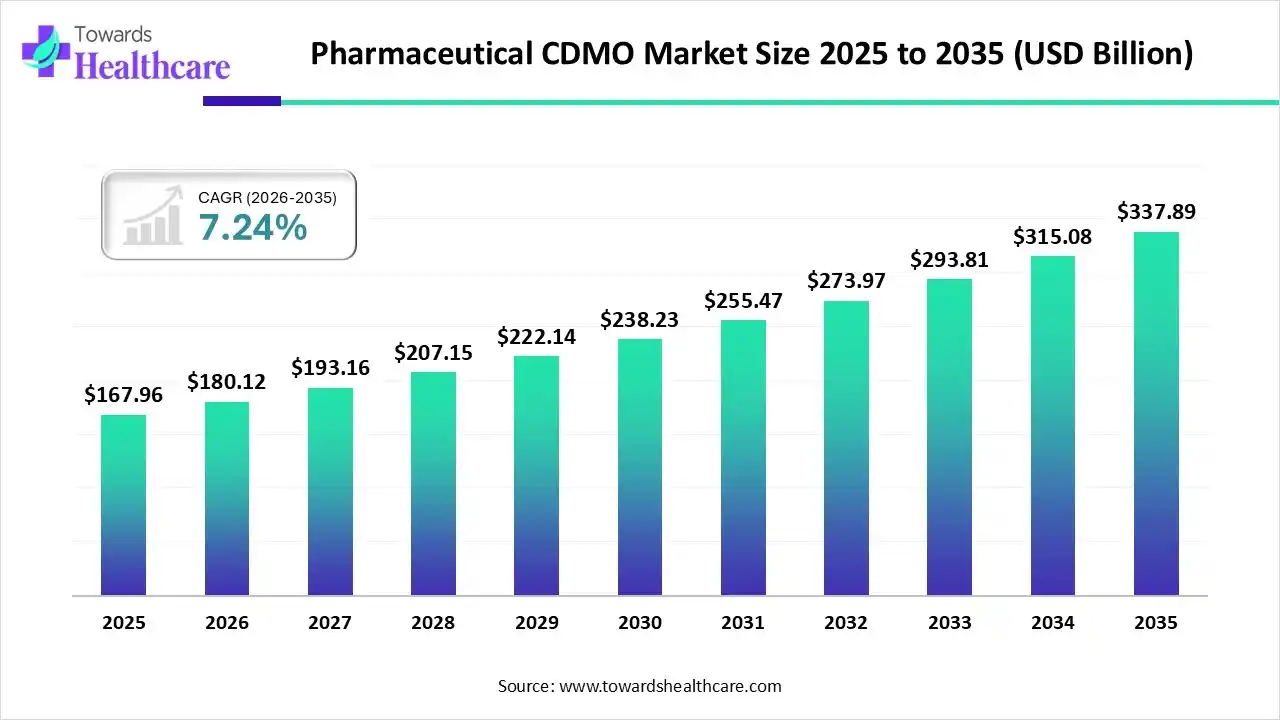
This is especially important as pharmaceutical outsourcing continues to expand. Towards Healthcare estimates that the global pharmaceutical CDMO market will reach USD 337.89 billion by 2035, up from USD 180.12 billion in 2026, representing a 7.24% CAGR.
Access Our Research Insights: https://www.towardshealthcare.com/download-sample/5327
Among the large global CDMOs, Lonza, Thermo Fisher Scientific (Patheon), Catalent, Samsung Biologics, WuXi Biologics, Siegfried, and Fujifilm Diosynth Biotechnologies stand out as companies buyers frequently evaluate for large-scale, regulated manufacturing programs.
However, there is an important distinction: there is no single FDA ranking that declares one CDMO to have the “best” compliance record. Buyers should evaluate facility-specific inspection histories rather than relying only on corporate reputation.
What Does a Strong Compliance Record Actually Mean?
The U.S. FDA says current good manufacturing practice (CGMP) compliance is the minimum standard for ensuring medicines are safe, effective, and of sufficient quality. The agency also emphasizes that CGMP compliance alone does not necessarily demonstrate sustainable quality performance.
For CDMO buyers, a stronger assessment should therefore consider:
- FDA inspection classifications
- Warning letters and regulatory actions
- Quality-system maturity
- CAPA effectiveness
- Deviation and OOS management
- Data-integrity controls
- Batch-release performance
- Regulatory inspection history
- Supply-chain reliability
- Ability to maintain quality during scale-up
This is why a CDMO with a large facility is not automatically a better-quality CDMO.
FDA Data Shows Why Buyers Should Look at Inspection History
The FDA reports that more than 90% of pharmaceutical inspections find facilities to have acceptable CGMP compliance.
In fiscal year 2025, the FDA issued 970 drug-facility manufacturing inspection classification letters, achieving its 90-day classification goal 96% of the time. The agency also issued more than 125 warning letters to drug manufacturers and added 76 firms to CGMP-related import alerts during the year.
These numbers show why regulatory due diligence matters.
A buyer should not simply ask:
“Is this CDMO FDA compliant?”
Instead, the better question is:
“What does the inspection history of the specific facility that will manufacture my product look like?”
1. Lonza: Strong Choice for Complex and Highly Regulated Programs
Lonza is one of the most established global CDMOs and offers services spanning small molecules, biologics, cell and gene therapies, and highly potent APIs.
Towards Healthcare identifies Lonza among the leading global pharmaceutical and life-science CDMOs, with capabilities covering complex drug development and manufacturing.
For buyers, Lonza’s strength is particularly relevant when the program requires:
Complex chemistry + advanced manufacturing + global regulatory support + commercial-scale production.
Towards Healthcare also reports that Lonza generated CHF 6.5 billion in sales in 2025, illustrating the scale of its global operations.
Why buyers consider Lonza
Its broad technical portfolio means clients can potentially maintain continuity as a program moves from development into commercial manufacturing.
2. Thermo Fisher Scientific / Patheon: Broad Regulatory Infrastructure
Thermo Fisher Scientific’s Patheon business is another major CDMO frequently considered by pharmaceutical companies.
Towards Healthcare lists Thermo Fisher among the leading pharmaceutical CDMOs, with capabilities covering drug substances, sterile injectables, oral solids, biologics, and clinical-to-commercial manufacturing.
Its breadth can be particularly useful for pharmaceutical companies that need multiple manufacturing technologies under one global network.
Towards Healthcare also reports that Patheon serves approximately 700 customers.
Why buyers consider Patheon
For companies managing multiple products or modalities, the combination of manufacturing scale, analytical capabilities, and global supply infrastructure can reduce the need to coordinate several specialist vendors.
3. Samsung Biologics: Quality at Large Biologics Scale
For biologics, Samsung Biologics is one of the companies most frequently considered for large-scale commercial manufacturing.
Towards Healthcare describes Samsung Biologics as an end-to-end CDMO supporting services from cell-line development through final aseptic fill-finish and laboratory testing.
Towards Healthcare’s 2026 comparison reports that Samsung Biologics has expanded its active global capacity to approximately 845,000 liters.
Why buyers consider Samsung Biologics
Its major advantage is the combination of:
Large-scale capacity + integrated biologics manufacturing + standardized processes + global pharmaceutical partnerships.
For large commercial biologics programs, this combination can be highly valuable.
4. Catalent: Strong in Drug Product and Fill-Finish
Catalent has traditionally been particularly important in drug-product manufacturing, formulation, delivery technologies, and fill-finish.
Towards Healthcare describes Catalent as a global CDMO with broad drug-delivery and manufacturing capabilities.
Its capabilities are particularly relevant when buyers need:
- Sterile manufacturing
- Fill-finish
- Drug delivery
- Formulation
- Clinical supply
- Commercial manufacturing
Towards Healthcare reports that Catalent has approximately 1,300 customers, highlighting the breadth of its customer base.
Why buyers consider Catalent
The company can be attractive when quality requirements extend beyond API or drug-substance manufacturing into complex drug-product and delivery operations.
5. WuXi Biologics / WuXi AppTec: Integrated Development and Manufacturing
WuXi Biologics and WuXi AppTec have built large integrated development and manufacturing networks.
Towards Healthcare lists WuXi among the leading global CDMO companies and describes its open-access technology platforms covering discovery, development, and manufacturing.
For buyers, the attraction is the ability to connect development activities with manufacturing within a broad technology ecosystem.
What buyers should evaluate carefully
For any multinational CDMO, buyers should still conduct facility-specific regulatory due diligence, because compliance is determined at the manufacturing-site level rather than simply by corporate brand.
6. Siegfried: Quality-Focused Small-Molecule Manufacturing
Siegfried is particularly relevant to companies developing and manufacturing small-molecule APIs and drug products.
Towards Healthcare lists Siegfried among the major pharmaceutical CDMOs and highlights its integrated capabilities for drug substances and drug products.
Its manufacturing model is attractive for programs requiring:
Process development → scale-up → GMP manufacturing → commercial supply.
Towards Healthcare also reports that Siegfried opened additional large-scale reactor capacity at its Minden, Germany site in 2026, incorporating technologies such as high-containment functionality and RFID-enabled recipe control.
These types of investments matter because digital manufacturing controls and containment can strengthen consistency and operational control.
7. Fujifilm Diosynth Biotechnologies: Strong Biologics and Advanced Therapies Position
Fujifilm Diosynth Biotechnologies is another major CDMO in the biologics and advanced-therapy ecosystem.
Towards Healthcare identifies the company among the leading life-science CDMOs and highlights its work across biologics, vaccines, and advanced therapies.
For biotech companies, the ability to transition from development to GMP manufacturing while maintaining process consistency is an important consideration.
Compliance vs. Quality: Why the Difference Matters
A CDMO can technically be compliant while still having areas that buyers want to investigate more closely.
The FDA explains that CGMP compliance is a minimum requirement, while sustainable compliance requires continuous control and improvement of manufacturing performance and quality.
This distinction is important for procurement teams.
A strong CDMO evaluation should therefore examine:
Regulatory history
Has the facility experienced FDA inspection findings, warning letters, or import alerts?
Quality systems
How mature are deviation, CAPA, change-control, and batch-review systems?
Data integrity
Are electronic and laboratory records appropriately controlled?
Process validation
Can the manufacturer demonstrate consistent process performance?
Supplier management
How does the CDMO qualify and monitor raw-material suppliers?
Tech transfer
Can the company transfer a process without creating new quality risks?
Inspection readiness
Can the facility demonstrate consistent regulatory readiness across different authorities?
FDA Warning Letters Are Not the Same as FDA 483 Findings
This is an important point for anyone comparing CDMOs.
The FDA states that a Form FDA 483 documents observations made by investigators at the conclusion of an inspection; it is not itself a final agency determination that a violation occurred.
An OAI (Official Action Indicated) classification, on the other hand, indicates that the facility is considered to be in an unacceptable state of compliance.
Therefore, buyers should avoid judging a CDMO based on a single inspection observation without examining:
Inspection date → observations → company response → FDA classification → corrective actions → subsequent inspection history.
Why Quality Metrics Are Becoming More Important
The FDA has increasingly emphasized the value of manufacturing quality metrics.
The agency says quality metrics can help:
- Evaluate manufacturing performance
- Identify quality problems
- Improve inspection planning
- Support supplier selection
- Reduce supply-chain disruptions
- Identify potential risks for shortages and recalls
This is particularly relevant for CDMO procurement.
A pharmaceutical company is not simply buying manufacturing capacity. It is effectively outsourcing part of its quality system and supply chain.
What Pharmaceutical Buyers Really Want From a CDMO
When selecting a CDMO, buyers increasingly want evidence rather than marketing claims.
1. Clean regulatory history
A strong inspection history can reduce regulatory uncertainty.
2. Consistent batch performance
Low deviation and failure rates can help protect supply continuity.
3. Strong CAPA systems
Problems should be investigated at root cause rather than simply corrected temporarily.
4. Data integrity
Laboratory and manufacturing records must be reliable and traceable.
5. Technology-transfer expertise
A CDMO should be able to reproduce the client’s process consistently at manufacturing scale.
6. Global regulatory experience
Programs targeting the U.S., Europe, and other markets need CDMOs familiar with multiple regulatory expectations.
7. Supply resilience
Manufacturing quality means little if the company cannot reliably supply commercial product.
Lonza vs. Thermo Fisher: Which Has the Stronger Quality Position?
Lonza is particularly attractive for buyers handling complex molecules, biologics, HPAPIs, and advanced therapies, while Thermo Fisher/Patheon offers a very broad manufacturing ecosystem covering drug substances, biologics, sterile injectables, oral solids, and clinical-to-commercial supply.
So rather than declaring one company the universal winner, buyers should match the CDMO’s capabilities with their specific product.
Lonza → complex and advanced manufacturing programs
Thermo Fisher/Patheon → broad multi-modality pharmaceutical manufacturing
Samsung Biologics vs. Catalent
The comparison becomes different for biologics.
Samsung Biologics is particularly strong in large-scale biologics manufacturing, while Catalent has a broader position in drug product, fill-finish, and delivery technologies.
Therefore:
Samsung Biologics → large-scale biologics production
Catalent → drug product, fill-finish and delivery
Both can be strong choices, but the appropriate partner depends on the manufacturing stage and modality.
Expert Commentary by Payal Rabde – decoding key healthcare trends and industry shifts.
Towards Healthcare’s View
Towards Healthcare tracks Lonza, Thermo Fisher/Patheon, Catalent, Samsung Biologics, WuXi, Siegfried, Fujifilm Diosynth Biotechnologies, and other companies as major participants in the global CDMO ecosystem.
Its pharmaceutical CDMO analysis estimates that the industry will grow to USD 337.89 billion by 2035, while its GMP drug-substance analysis estimates the GMP drug-substance sector will reach USD 4.91 billion by 2035. Commercial-scale manufacturing accounted for approximately 58% of the GMP drug-substance segment in 2024, while large pharmaceutical companies represented about 48% of end-user revenue.
This growth makes quality differentiation increasingly important.
As more pharmaceutical companies outsource manufacturing, regulatory credibility, quality-system maturity, and supply reliability can become as important as manufacturing capacity.
Discover deeper healthcare insights with our Healthcare Ecosystem Dashboard : https://www.towardshealthcare.com/access-dashboard
About Us
Pharma Geek is a part of Towards Healthcare Research & Consulting which is a global healthcare market research and consulting firm dedicated to helping businesses make informed decisions through reliable market intelligence and strategic insights. We serve pharmaceutical, biotechnology, medical device, AI in healthcare, cell and gene therapy, digital health, and life sciences organizations with in-depth market research, custom consulting, competitive analysis, and growth forecasts. Our team combines industry expertise with rigorous research to deliver clear, actionable insights that support market expansion, product strategy, investment decisions, and long-term business growth. From emerging innovations to established healthcare markets, we help organizations understand where the industry is today and where it’s headed tomorrow.
You can place an order or ask any questions, please feel free to contact us at [email protected]
Europe Region – +44 778 256 0738
North America Region – +1 8044 4193 44
APAC Region: +91 9356 9282 04
Visit Our Website: Towards Healthcare Research & Consulting – Expert Consulting Solutions & Research Reports
Find us on social platforms: LinkedIn | Twitter | Instagram | Medium
