
 by
by The global 3D printing medical devices market size is calculated at USD 5.59 billion in 2025 and is predicted to increase from USD 6.60 billion in 2026 to approximately USD 28.07 billion by 2035, expanding at a CAGR of 17.51% from 2026 to 2035.
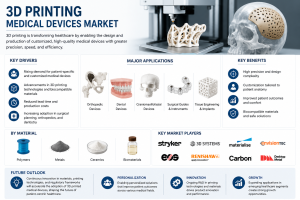
3D Printing Medical Devices Market Overview
The 3D printing medical devices market is transforming the healthcare industry by enabling the production of highly customized, precise, and patient-specific medical solutions. Unlike conventional manufacturing methods, 3D printing, also known as additive manufacturing, creates devices layer by layer from digital designs, allowing healthcare providers to produce complex structures with greater efficiency and minimal material waste. The technology has become increasingly important in orthopedics, dentistry, prosthetics, surgical planning, and medical research, where personalization and precision are critical to successful patient outcomes.
Healthcare organizations, medical device manufacturers, and research institutions are investing heavily in advanced 3D printing technologies to improve treatment quality while reducing production time and costs. The integration of digital imaging, artificial intelligence, and advanced biomaterials has expanded the capabilities of additive manufacturing, making it an essential component of modern healthcare. As demand for personalized medicine continues to rise, 3D printing is expected to play a central role in the development of next-generation medical devices and regenerative healthcare solutions.
Get Sample Link: https://www.precedenceresearch.com/sample/3098
3D Printing Medical Devices Market Growth
The global 3D printing medical devices market is experiencing rapid expansion as healthcare providers increasingly adopt personalized treatment approaches. The technology enables the production of patient-specific implants, prosthetics, surgical guides, and anatomical models that improve clinical accuracy and reduce surgical complications. Growing awareness of customized healthcare solutions, combined with advancements in digital imaging and computer-aided design (CAD), continues to support widespread adoption across hospitals and specialized medical centers.
Another major factor contributing to market growth is the increasing prevalence of orthopedic disorders, dental conditions, and age-related diseases that require customized medical devices. Rising investments in healthcare innovation, expanding research in tissue engineering and bioprinting, and the establishment of hospital-based 3D printing laboratories are further accelerating market development. As printing technologies become faster, more affordable, and capable of processing advanced biomaterials, adoption is expected to increase across both developed and emerging healthcare markets.
3D Printing Medical Devices Market Trends
- Growing Adoption of Personalized Medical Devices
Healthcare providers are increasingly utilizing 3D printing to manufacture implants, prosthetics, and surgical guides designed specifically for each patient’s anatomy. This improves treatment outcomes while enhancing patient comfort and recovery. - Expansion of Bioprinting Research
Research institutions are making significant progress in bioprinting tissues, cartilage, skin, and blood vessels. Although organ printing remains under development, advances in regenerative medicine continue to create new opportunities for medical innovation. - Integration of Artificial Intelligence and Digital Imaging
Artificial intelligence, combined with CT and MRI imaging, enables engineers to create highly accurate digital models for customized medical devices. This enhances design precision and streamlines manufacturing workflows. - Increasing Adoption of Point-of-Care Manufacturing
Hospitals are establishing in-house 3D printing laboratories to produce anatomical models, surgical instruments, and customized implants on demand. This reduces production time and supports faster clinical decision-making.
3D Printing Medical Devices Market Dynamics
Driver
One of the primary drivers of the 3D printing medical devices market is the growing demand for personalized healthcare solutions. Every patient has unique anatomical characteristics, making customized implants, prosthetics, and surgical tools more effective than standardized alternatives. The increasing number of orthopedic surgeries, dental procedures, trauma cases, and reconstructive surgeries has significantly boosted the demand for patient-specific medical devices. Continuous advancements in additive manufacturing technologies and biomaterials are further improving production quality and expanding clinical applications.
Opportunity
The market presents substantial opportunities through the advancement of bioprinting and regenerative medicine. Researchers are exploring the development of functional tissues, artificial skin, cartilage, and eventually transplantable organs using 3D printing technologies. Emerging economies also offer considerable growth potential due to improving healthcare infrastructure, increasing medical investments, and greater awareness of advanced treatment options. The integration of artificial intelligence, robotics, and cloud-based manufacturing platforms is expected to create additional opportunities for innovation and market expansion.
Challenges
Despite its promising future, the market faces several challenges. High equipment costs, expensive medical-grade materials, and strict regulatory requirements remain significant barriers for smaller healthcare facilities. Manufacturers must comply with rigorous quality and safety standards before commercializing customized medical devices. Additionally, the shortage of skilled professionals capable of operating advanced 3D printing systems and limitations in printable biomaterials continue to restrict broader adoption in certain healthcare applications.
