 by
by The global malaria diagnostic market is witnessing strong growth driven by rising malaria prevalence, advancements in rapid diagnostic tests, AI-powered diagnostics, and increasing government healthcare initiatives. Explore key trends, regional insights, market drivers, opportunities, and competitive analysis.
Malaria Diagnostic Market: Advancing Early Detection and Global Disease Control
The global malaria diagnostic market is experiencing substantial growth due to increasing malaria prevalence, rising awareness regarding early disease detection, and rapid advancements in diagnostic technologies. Malaria remains one of the most widespread and life-threatening infectious diseases, particularly in tropical and subtropical regions across Africa, Asia-Pacific, and Latin America.
Diagnostic technologies play a critical role in malaria prevention and treatment strategies by enabling rapid identification of infections and timely therapeutic intervention. Governments, healthcare organizations, and global health agencies are increasingly investing in advanced diagnostic infrastructure to strengthen disease surveillance and improve healthcare outcomes.
Rapid diagnostic tests (RDTs), molecular diagnostics, microscopy systems, and AI-powered diagnostic platforms are transforming the global malaria diagnostics landscape. The growing integration of artificial intelligence, machine learning, and molecular testing technologies is further improving diagnostic accuracy and accessibility.
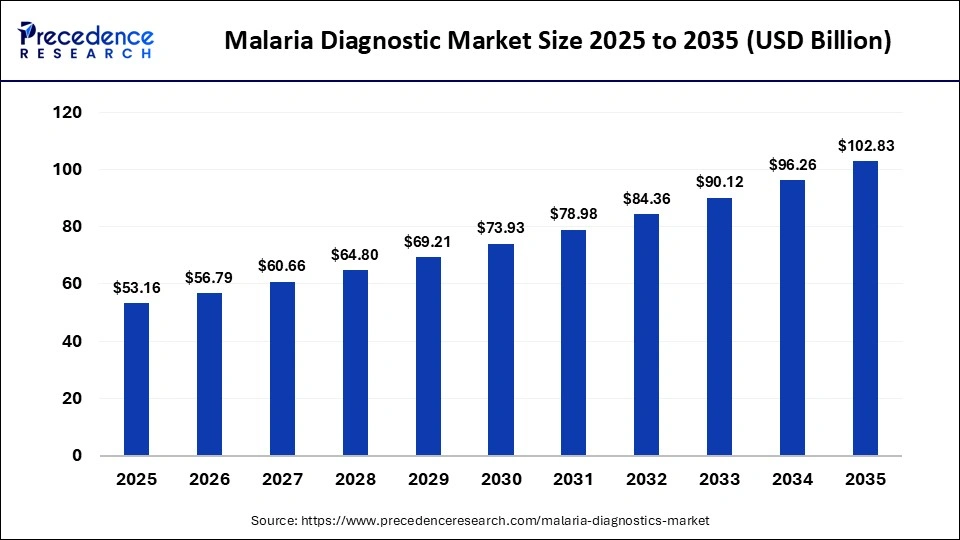
According to industry estimates, the global malaria diagnostic market size was accounted for USD 53.16 billion in 2025 and is predicted to hit around USD 102.83 billion by 2035, growing at a CAGR of 6.82%.
Read Also: Parkinson’s Disease Biomarkers Market
Market Overview
Malaria diagnostics involve laboratory and point-of-care techniques used to detect malaria parasites in blood samples. These tests help identify the presence of Plasmodium parasites responsible for malaria infection and support effective disease management.
The most commonly used malaria diagnostic technologies include:
- Rapid Diagnostic Tests (RDTs)
- Microscopy
- Molecular Diagnostic Tests
- Polymerase Chain Reaction (PCR)
- Loop-Mediated Isothermal Amplification (LAMP)
- AI-assisted diagnostic platforms
The increasing burden of malaria globally continues to drive demand for efficient and affordable diagnostic solutions. According to healthcare data, malaria remains highly prevalent in regions with limited healthcare infrastructure, poor sanitation, and tropical climatic conditions.
Key Market Drivers
Rising Global Burden of Malaria
The growing incidence of malaria infections is one of the primary factors fueling market growth. Climate change, inadequate healthcare infrastructure, population growth, and limited access to preventive treatments continue to increase disease prevalence in endemic regions.
Africa remains the largest regional market due to the high concentration of malaria cases and government-supported diagnostic initiatives. The region accounted for more than 89% of the global malaria diagnostics market share in 2023.
Increasing Adoption of Rapid Diagnostic Tests (RDTs)
Rapid diagnostic tests have emerged as the dominant diagnostic technology due to their affordability, simplicity, and fast turnaround time.
RDTs allow healthcare professionals to diagnose malaria within minutes without requiring advanced laboratory infrastructure. These tests are especially useful in rural and resource-limited settings.
From 2010 to 2022, manufacturers sold approximately 3.9 billion malaria RDTs globally, with the majority distributed across sub-Saharan Africa.
Growing Investments in Molecular Diagnostics
Molecular diagnostic technologies such as PCR and LAMP are gaining traction because of their high sensitivity and ability to detect low parasite concentrations.
Advanced molecular testing helps improve diagnostic precision, supports surveillance programs, and enhances disease elimination strategies.
Integration of Artificial Intelligence
Artificial intelligence and machine learning are increasingly being integrated into malaria diagnostics to improve detection accuracy and automate disease analysis.
AI-powered systems can analyze microscopy images, identify parasite patterns, and assist clinicians in diagnosing infections with greater efficiency.
Research organizations are actively developing AI-based diagnostic systems to improve healthcare accessibility in remote regions.
Emerging Market Trends
Growing Focus on Point-of-Care Testing
Point-of-care testing (POCT) is becoming a major trend in the malaria diagnostics market. Healthcare providers are increasingly adopting portable and rapid testing solutions that deliver accurate results in low-resource environments.
Innovative microfluidic immunoassays capable of generating results within 15 minutes are gaining significant attention.
Rising Demand for Non-Invasive Diagnostics
Researchers are increasingly exploring non-invasive diagnostic technologies that reduce patient discomfort and simplify disease screening processes.
Advanced blood-based and saliva-based diagnostic methods are expected to create substantial opportunities for future market growth.
Expansion of Telemedicine and Digital Healthcare
The expansion of telemedicine and remote healthcare services is accelerating the adoption of digital diagnostic technologies in underserved regions.
Digital healthcare platforms integrated with AI-powered diagnostics are improving disease management and healthcare accessibility worldwide.
Market Restraints
Limited Healthcare Infrastructure
In many malaria-endemic regions, limited healthcare infrastructure and lack of trained medical personnel remain significant challenges for diagnostic adoption.
Resource constraints often hinder access to advanced diagnostic technologies and laboratory services.
High Cost of Molecular Diagnostics
Although molecular testing offers superior accuracy, the high cost of PCR systems, reagents, and laboratory infrastructure may limit widespread adoption in low-income regions.
Regulatory and Quality Challenges
Ensuring diagnostic accuracy and compliance with international healthcare regulations can be complex for manufacturers operating in multiple markets.
Quality control and product validation remain essential challenges within the industry.
Technology Insights
Rapid Diagnostic Tests Dominated the Market
Rapid diagnostic tests accounted for the largest market share of approximately 67.8% in 2023 due to their affordability, portability, and rapid results.
Advantages of RDTs Include:
- Minimal training requirements
- Quick results
- Cost-effectiveness
- Easy deployment in rural areas
- Reduced dependency on laboratory infrastructure
Molecular Diagnostics to Witness Strong Growth
Molecular diagnostics are expected to experience steady growth during the forecast period due to increasing demand for highly sensitive and species-specific malaria detection technologies.
PCR and LAMP technologies are becoming increasingly important in disease surveillance and elimination programs.
End-Use Insights
Clinics Held the Largest Market Share
Clinics accounted for approximately 64.4% of the global malaria diagnostics market revenue share in 2023.
The widespread availability of rapid testing kits and growing patient visits for fever-related illnesses are supporting segment growth.
Hospitals and Diagnostic Centers
Hospitals and diagnostic centers are increasingly adopting molecular diagnostics and advanced imaging technologies for improved disease detection and treatment planning.
Regional Analysis
Africa Dominated the Global Market
Africa remains the largest regional market due to the extremely high prevalence of malaria infections and extensive deployment of rapid diagnostic tests.
Government initiatives, international healthcare funding, and disease elimination programs are significantly contributing to regional growth.
Asia-Pacific Emerging as a High-Growth Region
Asia-Pacific is witnessing increasing demand for malaria diagnostics due to growing healthcare investments, rising disease awareness, and expanding diagnostic infrastructure.
Countries such as India, China, Indonesia, and Bangladesh are actively strengthening malaria control programs.
India Market Trends
The India malaria diagnostics market was valued at approximately USD 52 million in 2023 and is expected to grow steadily due to increasing disease burden and growing adoption of advanced molecular diagnostics.
According to healthcare data, nearly 95% of India’s population resides in malaria-endemic regions.
North America and Europe
North America and Europe are witnessing moderate market growth due to increasing travel-related malaria cases, rising awareness, and expanding research activities focused on advanced diagnostics.
Competitive Landscape
The malaria diagnostics market is highly competitive, with major healthcare and biotechnology companies focusing on innovation, strategic partnerships, and product expansion.
Key Companies in the Market
- Abbott Laboratories
- Siemens Healthineers
- bioMérieux
- Bio-Rad Laboratories
- Beckman Coulter
- Sysmex Corporation
- Thermo Fisher Scientific
- PerkinElmer
These companies are investing heavily in AI-driven diagnostics, molecular testing technologies, and point-of-care solutions to strengthen their global market presence.
Recent Developments
- Researchers are increasingly integrating AI algorithms into malaria diagnosis systems to improve disease detection accuracy and automate clinical analysis.
- The growing adoption of microfluidic immunoassays and next-generation sequencing technologies is accelerating diagnostic innovation.
- Governments and global health organizations are significantly increasing investments in malaria surveillance and diagnostic infrastructure to support elimination initiatives.
Future Outlook
The future of the malaria diagnostics market appears promising as healthcare providers continue prioritizing rapid disease detection, precision diagnostics, and AI-driven healthcare solutions.
Advancements in molecular testing, portable diagnostics, AI-powered microscopy, and digital healthcare integration are expected to transform the global malaria diagnostics landscape over the next decade.
Emerging economies across Africa and Asia-Pacific are likely to create substantial growth opportunities due to expanding healthcare access and increasing investments in infectious disease management.
Conclusion
The global malaria diagnostic market is undergoing rapid transformation driven by technological innovation, increasing disease prevalence, and growing global healthcare investments.
Rapid diagnostic tests continue to dominate the market due to their accessibility and affordability, while molecular diagnostics and AI-powered technologies are emerging as high-growth segments.
As governments, healthcare organizations, and biotechnology companies continue investing in advanced diagnostic infrastructure, the market is expected to witness sustained growth and innovation in the coming years.
Get a Sample Copy: https://www.precedenceresearch.com/sample/8229
For inquiries regarding discounts, bulk purchases, or customization requests, please contact us at [email protected]
