by
by What is Ligase Enzymes Market Size in 2026?
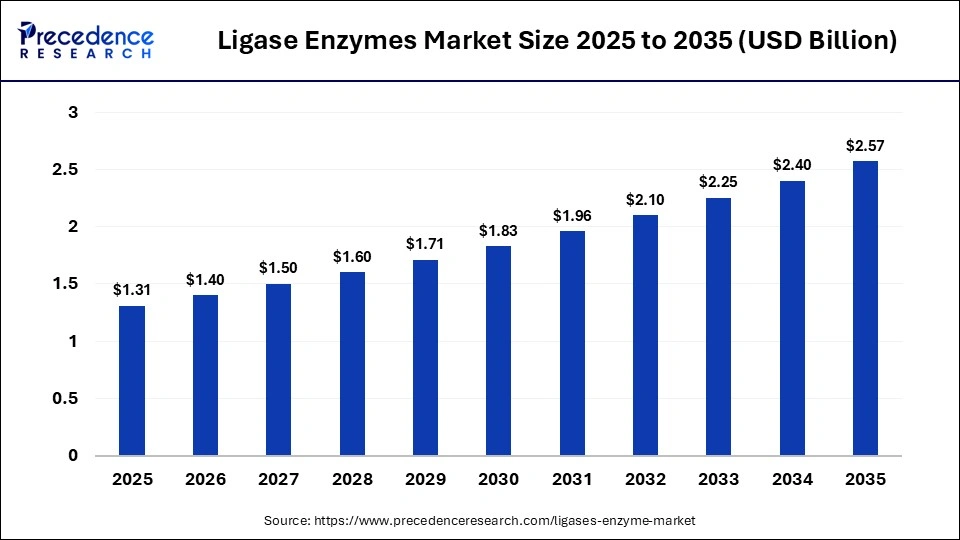
The global ligase enzymes market size was valued at USD 1.31 billion in 2025 and is projected to grow from USD 1.40 billion in 2026 to approximately USD 2.57 billion by 2035, expanding at a CAGR of 7.02% from 2026 to 2035.
The growth of the market is primarily driven by the increasing demand for genetic research, molecular diagnostics, and biotechnology applications. Ligase enzymes play a critical role in genetic engineering, DNA repair, recombinant DNA technology, and next-generation sequencing, making them essential tools in pharmaceutical research and advanced biotechnology development worldwide.
Read Also: Veterinary Monoclonal Antibodies Market
Key Takeaways
-
North America held the largest revenue share of the ligase enzymes market in 2025.
-
Asia-Pacific is expected to witness the fastest growth during the forecast period.
-
By product type, the T4 DNA ligase segment dominated the market in 2025.
-
The Taq DNA ligase segment is projected to grow at the highest CAGR between 2026 and 2035.
-
By source, the bacterial segment accounted for a significant share in 2025.
-
The synthetic segment is expected to grow at the fastest rate during the forecast period.
-
By application, molecular biology held the largest revenue share in 2025.
-
The agriculture segment is anticipated to grow rapidly in the coming years.
-
By end use, research laboratories dominated the market in 2025.
-
The pharmaceutical companies segment is projected to grow at the fastest CAGR during the forecast period.
Market Overview
The ligase enzymes market focuses on enzymes that facilitate the joining of two DNA strands by catalyzing the formation of phosphodiester bonds. These enzymes are essential in numerous biological processes, including DNA replication, DNA repair, recombination, and protein synthesis.
Ligases are widely used in modern biotechnology, including:
-
Genetic engineering
-
Gene cloning
-
DNA sequencing
-
CRISPR-based gene editing
-
Molecular diagnostics
Advancements in enzyme engineering, synthetic biology, and genomic research are significantly expanding the application scope of ligase enzymes. Additionally, the rising incidence of cancer and genetic disorders has increased the demand for advanced molecular diagnostics and gene therapy technologies, further driving market growth.
Government agencies and private organizations worldwide are also increasing investments in genomic research, biotechnology innovation, and drug discovery, which supports the long-term expansion of the ligase enzymes market.
Impact of Artificial Intelligence in the Ligase Enzymes Market
Artificial intelligence (AI) and machine learning technologies are increasingly being used to optimize enzyme design and improve ligase performance.
AI algorithms can analyze large genomic datasets and predict enzyme behavior, allowing researchers to design ligase variants that are:
-
More efficient
-
Highly specific
-
Cost-effective for industrial production
These technologies are helping scientists develop customized ligases for specific biological reactions, improving the accuracy and efficiency of molecular biology workflows.
Additionally, AI-driven platforms are supporting biomanufacturing optimization, enabling manufacturers to enhance enzyme production yields, reduce operational costs, and improve scalability.
The integration of AI in enzyme engineering is expected to accelerate advancements in gene therapy, molecular diagnostics, and industrial biotechnology applications.
Key Trends Influencing the Ligase Enzymes Market
Increasing Use in Next-Generation Sequencing (NGS)
Ligase enzymes play a critical role in next-generation sequencing (NGS) workflows. Ligation-based sequencing protocols rely on ligases for genomic library preparation, mutation detection, and genome analysis.
Biotechnology companies are developing improved ligase variants that:
-
Reduce sequencing errors
-
Increase reaction efficiency
-
Improve sequencing accuracy
These improvements are enhancing genomic research capabilities and accelerating scientific discoveries.
Rising Demand for Personalized Medicine
The growing adoption of personalized medicine is significantly influencing the ligase enzymes market.
Ligases are essential in technologies such as:
-
DNA sequencing
-
Mutation detection
-
Gene editing
-
Precision diagnostics
Healthcare providers are increasingly relying on genomic information to develop personalized treatment plans, making ligase enzymes a vital component of modern precision medicine workflows.
Advancements in Engineered Ligase Enzymes
Researchers are developing engineered ligase enzymes with improved properties such as:
-
Higher thermal stability
-
Faster reaction kinetics
-
Enhanced specificity
These advanced enzymes enable more efficient workflows in DNA cloning, sequencing, and molecular diagnostics, supporting the growth of biotechnology and life sciences research.
Market Scope
| Report Coverage | Details |
|---|---|
| Market Size in 2025 | USD 1.31 Billion |
| Market Size in 2026 | USD 1.40 Billion |
| Market Size by 2035 | USD 2.57 Billion |
| Growth Rate | CAGR of 7.02% (2026–2035) |
| Dominant Region | North America |
| Fastest Growing Region | Asia-Pacific |
| Base Year | 2025 |
| Forecast Period | 2026–2035 |
| Segments Covered | Product Type, Source, Application, End Use, Region |
| Regions Covered | North America, Europe, Asia-Pacific, Latin America, Middle East & Africa |
Segmental Outlook
Product Type Insights
T4 DNA Ligase Segment
The T4 DNA ligase segment dominated the ligase enzymes market in 2025 due to its extensive use in molecular cloning, DNA repair, and plasmid construction.
This enzyme is widely used in:
-
DNA fragment ligation
-
Recombinant DNA technology
-
Sequencing library preparation
Academic institutions and biotechnology companies prefer T4 DNA ligase because of its high reliability, efficiency, and cost-effectiveness, making it a standard enzyme in molecular biology laboratories.
Taq DNA Ligase Segment
The Taq DNA ligase segment is expected to grow at the fastest CAGR during the forecast period.
Taq DNA ligase is particularly useful in high-temperature ligation reactions and detecting single nucleotide polymorphisms (SNPs).
Its growing use in techniques such as:
-
Ligase chain reaction (LCR)
-
Polymerase chain reaction (PCR) based assays
-
Molecular diagnostics
is expected to drive strong market demand in the coming years.
Source Insights
Bacterial Segment
The bacterial segment accounted for the largest revenue share in 2025 due to the widespread use of enzymes derived from bacterial organisms such as E. coli.
Bacterial ligases offer several advantages, including:
-
High production yields
-
Reliable performance
-
Scalable manufacturing
These factors make them highly suitable for commercial enzyme production and laboratory applications.
Synthetic Segment
The synthetic segment is expected to witness the fastest growth during the forecast period.
Synthetic enzyme production enables researchers to engineer ligase enzymes with specific molecular characteristics, improving their performance in specialized applications.
This flexibility allows scientists to tailor enzymes to meet the requirements of advanced genomic and biotechnology research.
Application Insights
Molecular Biology Segment
The molecular biology segment dominated the ligase enzymes market in 2025.
Ligase enzymes are critical in molecular biology applications such as:
-
DNA cloning
-
Genome sequencing
-
Recombinant DNA technology
-
Genetic analysis
Increasing investments in genomic research and biotechnology development have significantly strengthened the demand for ligase enzymes in this segment.
Agriculture Segment
The agriculture segment is expected to grow at the fastest rate during the forecast period.
Ligase enzymes are increasingly used in genetic engineering of crops, enabling the development of:
-
Disease-resistant plants
-
Higher-yield crops
-
Climate-resilient agricultural varieties
The adoption of biotechnology in agriculture is expected to expand the use of ligase enzymes in plant genome editing and crop improvement programs.
End-Use Insights
Research Laboratories Segment
The research laboratories segment held the largest revenue share in 2025.
Academic institutions, government research centers, and independent laboratories are major consumers of ligase enzymes for:
-
DNA sequencing
-
Genetic mapping
-
CRISPR validation
-
Molecular cloning
Continued funding for life science research and genomic studies supports the strong demand for ligase enzymes in research laboratories.
Pharmaceutical Companies Segment
The pharmaceutical companies segment is expected to grow at the fastest CAGR during the forecast period.
Pharmaceutical firms are increasingly using ligase enzymes in:
-
Gene therapy research
-
Drug discovery
-
Development of genetic therapeutics
The growing focus on genomics-driven medicine and personalized therapies is accelerating the demand for high-performance ligase enzymes.
Regional Insights
North America
North America dominated the ligase enzymes market in 2025 due to its advanced biotechnology infrastructure and strong genomic research ecosystem.
The region benefits from:
-
High investments in life sciences research
-
Strong biotechnology industry presence
-
Early adoption of molecular diagnostic technologies
These factors contribute to high demand for ligase enzymes in academic, clinical, and commercial laboratories.
United States Market
The United States plays a key role in driving the North American ligase enzymes market.
Major biotechnology companies such as:
-
Thermo Fisher Scientific
-
Illumina
-
Agilent Technologies
are actively developing advanced molecular biology reagents and enzyme technologies.
The strong presence of research universities, biotechnology startups, and pharmaceutical companies further supports market growth.
Asia-Pacific
Asia-Pacific is expected to witness the fastest growth in the ligase enzymes market during the forecast period.
Rapid expansion of biotechnology infrastructure, pharmaceutical research, and genomic initiatives in countries such as China, India, Japan, and South Korea is driving regional growth.
Government programs supporting biotechnology innovation, genetic research, and agricultural biotechnology are also contributing to increased demand for ligase enzymes.
China Market Trends
China is emerging as a major contributor to the Asia-Pacific ligase enzymes market.
The country is investing heavily in:
-
Biotechnology development
-
Pharmaceutical R&D
-
Domestic enzyme manufacturing
Chinese biotechnology companies are expanding enzyme production capacity and developing cost-effective ligase enzyme variants for both domestic and international markets.
Market Segmentation
By Product Type
-
T4 DNA Ligase
-
Taq DNA Ligase
-
E. coli DNA Ligase
-
Others
By Source
-
Bacterial
-
Synthetic
-
Viral
-
Mammalian
By Application
-
Molecular Biology
-
Diagnostics
-
Agriculture
-
Forensic Science
-
Others
By End Use
-
Research Laboratories
-
Pharmaceutical Companies
-
Biotechnology Companies
-
Diagnostic Laboratories
By Region
-
North America
-
Europe
-
Asia-Pacific
-
Latin America
-
Middle East & Africa
For inquiries regarding discounts, bulk purchases, or customization requests, please contact us at sales@precedenceresearch.com