
 by
by What is the Fluid Management Visualization Systems Market Size in 2026?
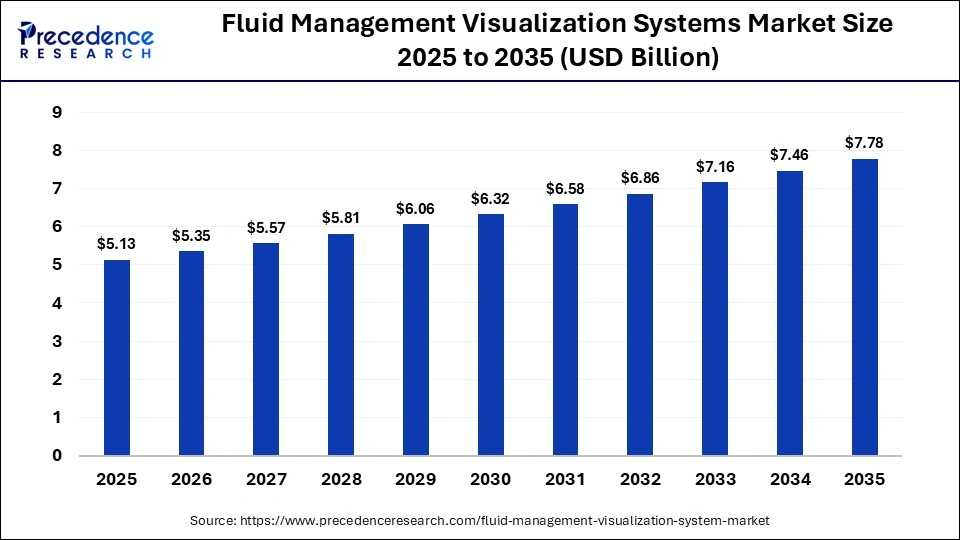
The global fluid management visualization systems market was valued at USD 5.13 billion in 2025 and is projected to grow from USD 5.35 billion in 2026 to approximately USD 7.78 billion by 2035, expanding at a CAGR of 4.25% from 2026 to 2035.
The market is witnessing steady growth due to the rising adoption of minimally invasive surgeries, increasing prevalence of chronic diseases, and rapid integration of AI, robotics, and smart sensors in surgical systems. These advanced technologies enable real-time monitoring of surgical fluids, improving efficiency, reducing human error, and enhancing patient safety.
Read Also: Varicose Veins Treatment Market
Key Takeaways
-
North America dominated the market in 2025.
-
Asia-Pacific is expected to grow at the fastest CAGR during the forecast period.
-
By product, the accessories segment held the largest market share in 2025.
-
By product, the instruments segment is projected to grow at the fastest rate.
-
By end-use, hospitals accounted for the largest market share in 2025.
-
Ambulatory surgical centers (ASCs) are expected to grow at the fastest CAGR between 2026 and 2035.
-
By application, urology dominated the market in 2025.
-
Orthopedics is expected to grow at the fastest rate in the coming years.
How AI is Influencing the Fluid Management Visualization Systems Market
Artificial intelligence is transforming fluid management systems by enabling real-time data analysis and predictive monitoring.
AI-powered systems can:
-
Analyze sensor data and patient records
-
Predict fluid loss during surgery
-
Enable proactive clinical decision-making
-
Improve patient safety through predictive modeling
These intelligent systems convert complex datasets into clear visual dashboards, helping surgeons quickly interpret information during procedures. AI-driven automation also simplifies surgical documentation and improves workflow efficiency through cloud-connected medical devices.
Fluid Management Visualization Systems Market Trends
AI-Powered Predictive Fluid Monitoring
Machine learning algorithms are shifting fluid monitoring from reactive observation to predictive risk management, detecting imbalances before they become critical.
Integrated Surgical Platforms
Modern systems are evolving from standalone devices to integrated surgical ecosystems combining irrigation, suction, and waste management within a single interface.
Growth of Single-Use Accessories
Healthcare providers are increasingly adopting sensor-integrated disposable accessories to reduce cross-contamination and hospital-acquired infections (HAIs).
Expansion of Minimally Invasive Surgery
Growing adoption of minimally invasive procedures in urology, gastroenterology, and gynecology is increasing demand for high-definition fluid visualization systems.
Rise of Home-Based Dialysis Solutions
Portable and wearable fluid management devices are enabling home dialysis therapy, especially for patients with chronic kidney diseases.
Market Scope
| Report Coverage | Details |
|---|---|
| Market Size in 2025 | USD 5.13 Billion |
| Market Size in 2026 | USD 5.35 Billion |
| Market Size by 2035 | USD 7.78 Billion |
| Growth Rate | CAGR of 4.25% (2026–2035) |
| Dominating Region | North America |
| Fastest Growing Region | Asia Pacific |
| Base Year | 2025 |
| Forecast Period | 2026–2035 |
| Segments Covered | Product, Application, End-use, Region |
Segmental Insights
Product Insights
Why Did the Accessories Segment Lead the Market?
The accessories segment dominated the market in 2025 due to the growing demand for single-use surgical consumables that minimize infection risks.
Key factors driving growth include:
-
Increasing surgical procedure volumes
-
Sensor-integrated consumables
-
Strict infection control standards
-
Growing adoption in orthopedic and urological procedures
Accessories have become a high-frequency revenue source for hospitals and surgical centers due to their disposable nature.
Instruments Segment – Fastest Growing
The instruments segment is expected to grow at the fastest CAGR due to:
-
Rising prevalence of chronic diseases, such as renal failure
-
Increasing minimally invasive surgeries
-
Integration of AI-enabled closed-loop fluid systems
-
IoT-connected surgical devices
Portable smart devices are also expanding their use in home healthcare settings.
End-Use Insights
Hospitals – Largest Market Share
The hospital segment dominated the market in 2025 due to the large volume of complex surgical procedures.
Hospitals benefit from these systems through:
-
Reduced biohazard exposure for healthcare staff
-
Improved surgical precision
-
Real-time fluid monitoring
-
Safer intravenous therapy management
The increasing burden of chronic and age-related diseases is further driving adoption.
Ambulatory Surgical Centers – Fastest Growth
Ambulatory surgical centers (ASCs) are expected to grow rapidly due to their cost-efficient surgical models.
ASCs prefer compact and integrated systems that help:
-
Reduce operating room turnaround time
-
Improve patient recovery speed
-
Lower operational costs
-
Enhance workflow efficiency
Application Insights
Urology – Dominant Segment
Urology accounted for the largest market share in 2025 because many urological procedures rely heavily on endoscopic visualization and fluid balance control.
Advanced fluid monitoring systems help prevent complications such as fluid overload, making them essential in modern urological surgery.
Orthopedics – Fastest Growing
The orthopedics segment is projected to grow rapidly due to the increasing shift toward arthroscopic procedures for joint injuries.
Growth drivers include:
-
Rising osteoarthritis cases
-
Increasing sports injuries
-
Growing elderly population
-
High demand for minimally invasive joint surgeries
Modern orthopedic procedures require large volumes of irrigation fluid, increasing demand for efficient fluid management systems.
Regional Insights
North America
North America dominated the market in 2025 due to its advanced healthcare infrastructure and strong adoption of digital surgical technologies.
Major medical technology companies such as Stryker Corporation and Baxter International play a major role in driving innovation.
Additional growth factors include:
-
High prevalence of chronic renal and urological diseases
-
Favorable reimbursement policies
-
Rapid adoption of AI-driven surgical systems
-
Strong healthcare investments
United States Market
The U.S. market continues to expand as healthcare providers increasingly adopt AI-enabled surgical platforms and automated fluid monitoring systems.
These technologies support enhanced recovery pathways (ERPs) by reducing hospital stays and improving patient outcomes.
Asia-Pacific – Fastest Growing Region
Asia-Pacific is projected to experience the fastest growth due to:
-
Expanding healthcare infrastructure
-
Growing chronic disease burden
-
Rising government investments in healthcare technology
-
Increasing demand for minimally invasive surgery
Countries such as China, India, and Japan are rapidly adopting AI-enabled surgical visualization systems.
China Market Trends
China is witnessing rapid growth due to the increasing adoption of:
-
Robotic-assisted surgery
-
AI-powered surgical systems
-
Advanced endoscopic technologies
The country is also expanding portable home dialysis technologies, improving accessibility to advanced treatments.
Europe
Europe is expected to grow steadily due to rising healthcare spending and widespread adoption of technologically advanced medical devices.
The region has strict infection prevention regulations, encouraging hospitals to adopt AI-driven fluid management and visualization systems.
Germany Market
Germany remains a major healthcare technology hub with increasing adoption of integrated surgical systems combining irrigation, suction, and 4K visualization.
Latin America
Latin America is witnessing the growing adoption of AI-driven diagnostic and surgical systems, improving patient safety and operational efficiency.
Governments in the region are investing in advanced healthcare infrastructure to expand access to modern surgical technologies.
Middle East & Africa
The market in the Middle East and Africa is growing steadily due to:
-
Improving economic conditions
-
Healthcare infrastructure modernization
-
Increasing adoption of smart surgical technologies
Countries such as Egypt and South Africa are investing heavily in digitized healthcare solutions.
Fluid Management Visualization Systems Market Key Companies
Major companies operating in the market include:
-
Medtronic
-
Stryker Corporation
-
CONMED Corporation
-
Smith & Nephew
-
Hologic
-
AngioDynamics
-
B. Braun
-
Olympus Corporation
-
Fresenius Medical Care
-
Ecolab
For inquiries regarding discounts, bulk purchases, or customization requests, please contact us at sales@precedenceresearch.com

